Topic

Vapor Barrier question

  • This topic is empty.
Viewing 18 posts - 76 through 93 (of 93 total)
PostedJan 27, 2009 at 9:35 am

I know it sounds like I was giving some advice here but I was just sharing a thought.

Daniel brings up an interesting point. I suppose most WPB do work in high humidity but not very well.

>As soon as you have a very high humidity inside the VB liner

I had like to know how long would that take. 8 hours of insensible perspiration?

PostedJan 27, 2009 at 10:22 am

Stephen,

Interesting- if a trip incorporated stops in huts or cabins, this certainly would test the limits of a system where VB and insulation could not be separated.

Jon,

Some ideas that have been put forward so far about incorporating clothing as insulation with a VB liner in an SB include include arranging items like jackets and vests outside the liner, putting the foot end of a VB inside a jacket or vest, and wearing the liner up to just below the armpits, therefore allowing for the option of wearing a jacket or vest while sleeping. It would seem this option would compromise, to some extent, the main goal of the liner, which is to prevent internal moisture from getting into the SB. While I've not experimented at all with heavier layers inside the liner, from what I've read it seems less effective- more layers to get wet, less chance of establishing that elusive VB microclimate around the skin, etc. VB clothing would seem to be more flexible in this regard, and yet others have said they still prefer a liner. No experience with VB clothing here.

I'll share the results of last night's backyard VB test session in low temps around 2F, cold enough to render an msr windpro chilled to air temps intert even with an inverted canister. Yes I know most stay inside in this weather, but I prefer to see my behavior as motivated by a passion for scientific knowledge (thanks to Roger C.) rather than an indication of deeper psychological unrest.

While I know many use VB liners effectively, and in much more extreme temps, my experience may be of interest to VB novices interested in extending the range of their sleep system and experimenting before making larger investments in VB gear. My MYOG VB liner consists of 3 hefty ultra flex large trash bags (30 gal, 113 l) taped end to end, with a doubled-over section near the head through which a line was run with a toggle for tightening- the toggle was operable from the inside, and this helped tremendously.

I slept in an mld soul bivy, on top of plenty of ground paddage, using an rei sub kilo 20F down bag, later complemented by an mh phantom down bag. Inside the liner I wore merino midweight layers, including gloves and liner socks. On my head a neckwarmer and warm fleece hat, underneath which I wore a buff (those tubular things).

First, the experience of a VB in temps from 20-25F versus 0-5F was a very different experience. While the higher temps made the VB, for me, clammy and unpleasant, I never experienced much moisture in the VB liner last night. The ability to effectively cinch the top of the VB (from the inside) helped keep it in place and seal warm air in. I stuffed the mh phantom SB into my bivy in the middle of the night to help with cold feet, but in retrospect stuffing the end of the liner in an insulated vest probably would have sufficed, and I did eventually overheat with the phantom in place.

While the full VB liner arranged up to the head regulates almost all interior moisture, the main disadvantage is that one's arms are inside the bag, making it impossible to adjust anything outside the liner while inside it. Taking steps to make sure your pillow or additional pieces of insulation don't move much in the night will make things more comfortable. With the liner up to the armpits, arms are free, and one can wear a jacket or vest on their body with the VB in place. In practice, with the liner in this position, a small amount of frost did form on the inside bivy surface above my upper body, most likely moisture from arms, chest, etc. Farther down towards the legs, everything stayed perfectly dry.

Roger wondered about the durability of the trashbag VB liner. I've seen no indications of wear, though the liner does include dust tape at certain stress points. I'm sure, though, that the primary merits of the trashbag liner are its easy repair, and its minimal expense.

As I get better at using the liner, I may find it easier to use it in full length form. Wearing it 3/4 length allows use of arms, yet also compromises moisture management to some degree. There is always the option of starting the evening at 3/4 length, and drawing it full length as things chill down.

Anyhow, I enjoyed the experiment, and would be eager to hear from others who have developed useful tricks with their VB liners. I am still trying to figure out how best to deal with frost from respiration forming around the head of the bag- breathing through material does seem to help. I am also investigating ways to fix in place the lip of my bivy so that it stays close to the breathing hole of the SB so that most condensation occurs on the bivy itself.

PostedJan 27, 2009 at 10:28 am

I would bet (if your moving fast, say as part of a rope team sking) – maybe an hour, hour and half, at most.

It would be less confusing if when your forming a thought, or had no personal experice, you indicated as such in your response.

Besides the point of the vbl vest was to keep my back insulation dry. Thats hard to do when the vbl is on the outside of everything.

Roger Caffin BPL Member
PostedJan 27, 2009 at 1:33 pm

Hi James

I will admit I had not expected such a fast response! But very interesting stuff, for which much thanks. I have summarised, with some Qs.

> My MYOG VB liner consists of 3 hefty ultra flex large trash bags (30 gal, 113 l) taped end to end, [with drawcord]
This is cheap enough for anyone to try it out.
* Could you give the ruler dimensions of the bags maybe?

> I slept in an mld soul bivy, on top of plenty of ground padding,
The insulation underneath is a critical factor, always.

> the experience of a VB in temps from 20-25F versus 0-5F was a very different experience.
Yes indeed. The comment from others has been that you need to be below 20 F to justify a VBL. Also you need to sleep a bit cool for best comfort.

> the main disadvantage is that one's arms are inside the bag, making it impossible to
> adjust anything outside the liner while inside it.
This is rather like being inside a cinched mummy bag of course.
* Did you have your pillow inside the VBL?

> the durability of the trashbag VB liner. I've seen no indications of wear, though the liner does include dust
> tape at certain stress points. I'm sure, though, that the primary merits of the trashbag liner are its easy repair,
> and its minimal expense.
* A photo would be great if possible? Where did you reinforce?

> I am still trying to figure out how best to deal with frost from respiration forming around the head of
> the bag- breathing through material does seem to help.
* So did you have the VBL over your head as well, or was your head sticking out? Not clear.

I have woken up vaguely wondering why snow was falling on my face. It was the water vapour from my breath condensing and freezing in the air above my head, and falling back down on me! I found that sleeping with my mouth shut was better…

Cheers

Jim Colten BPL Member
PostedJan 27, 2009 at 1:51 pm

James,

Thanks for the nice test report.

Yes I know most stay inside in this weather, but I prefer to see my behavior as motivated by a passion for scientific knowledge (thanks to Roger C.) rather than an indication of deeper psychological unrest.

ya know, I'll have to try that line on my wife and neighbors … ya think they'd grown accustomed to me doing that sort of thing after all these decades.

PostedJan 27, 2009 at 3:48 pm

I'm glad my experiment was somewhat useful. When my neighbors ask, I'll just blame the whole thing on BPL. Or perhaps take the Peter Venkman route from Ghostbusters: "Back off, man. I'm a scientist."

*Dimensions on the bags are listed as 2'6" x 2'9", 76 cm x 83 cm, 30 Gal., 113 L, 1.3 Mil.

*Padding was a regular length Thermarest Ridgerest Deluxe, a short inflatable from REI, and some 3/8 closed cell foam from the hardware store. Seemed adequate.

*I second the opinions on sleeping cool, and have found (as others have noted) that if there is any overheating, the VB lets you know pretty quickly.

*Pillow was not in the VB, but inside the SB. The VB drawcord was roughly around my neck, made more comfortable by the fleece neckwarmer. If I was to cinch the VB more around my face, and enclose my head, I would have to reposition the drawcord relative to its current position. I would have to give some thought to the advantages and disadvantage of this. My sense is that the head alone probably gives off relatively little moisture, and what moisture it does give off is mostly from breathing, which obviously can't be in the VB! Also, even with a nicely tightened SB hood around the face, there is probably still some opportunity for moisture to leak out that opening, unlike other areas of the SB. So at this point, even simply for psychological reasons, I would prefer to keep the liner around my neck, retain some connection to my surroundings through all that fabric, and leave the head outside the liner: then throw on a warm hat, balaclava, etc. In a tent, w/o a bivy, I can picture a simple, small piece of material with a face hole and perhaps some elastic to hold it in place, but imagine that it might not be worthwhile in many situations.

*Respiration moisture did condense around my face on the SB, though not enough to significantly influence loft or wet the down. I remember Andrew Skurka mentioning this issue, though I don't recall he discussed in detail how he resolved it other than by drying. With the bivy, the trick is figuring out a way to position the bivy (or any other piece of material) reliably in place close to the "airhole" before sealing oneself in, at which point you are encased in the whole rig. For many trips, with a decent DWR on the bag, this would probably not become a serious issue- and any drying opportunities could be focused on that one small area of the SB. Other BPL members have suggested that breathing through fabric like a neck warmer or balaclava captures at least some of the moisture, and makes for warmer, more humid air to breathe. I did breathe through fleece and didn't mind it, but this solution does not solve the problem entirely. As Roger mentioned, sometimes you are going to be snowing on yourself regardless!

*I reinforced with duct tape in a few spots- the end seam of the liner down by my feet, as well as the edges near where my elbows would usually fall- I sleep with wide elbows. Perhaps I will post a picture of the next version- this one was slapped together and its lack of aesthetic merit might lead others to doubt the scientific value of my claims :). The path for the drawcord was made simply by folding the bag back on itself by 2 inches or so to create a channel that was then taped shut. I found it very helpful to place the drawcord inside the liner. I did keep some excess material above the drawcord- once you were certain about the length you preferred, you could simply make the drawcord the top of the liner, therefore making the issue of inside or outside irrelevant.

*It would stand to reason that stresses on a VB liner would vary depending on sleep style, size of person, etc. Once the basic design was tested with garbage bags, I'm sure a lighter, much more durable version could be constructed by someone with much greater knowledge of materials and a hand for sewing.

*There are other options that probably start to sound impractical/ludicrous but might be fun to at least consider, such as elasticized arm holes in the side of the bivy allowing some use of hands while also sealing the upper torso to the neck. VB "overalls" with integrated feet, leg, torso, and arm coverage (this approaching closer to VB clothing, but a bit more integrated), like kids pajamas. Perhaps even some way to take advantage of body heat while making a VB stew? Bon appetit?

PostedJan 27, 2009 at 4:03 pm

Perhaps another direction would be to custom tailor the VB liner depending on sleep style- for example, could be quite narrow in the legs, then expand out to accomodate those my preference for wide elbows, then narrow again near the top. I imagine that less fabric results in less weight, and a more efficient VB experience…

PostedJan 27, 2009 at 7:57 pm

I have edited my post to make it clear.

I was thinking of using WPB breathable inside VB(liner/clothes) while sleeping. I wasnt actually responding to your post.

>Besides the point of the vbl vest was to keep my back insulation dry. Thats hard to do when the vbl is on the outside of everything.

I understand. That is why it is better to avoid VB for high activity use. See this:

Theoretical analysis of condensation in vapor barrier clothing systems

PostedJan 28, 2009 at 7:07 am

Hydrostatic head for cuben fiber would lie somewhere
between a couple of plastic grocery bags and glass.
It is not only waterproof but air tight too. They use
it for inflatable kites.

PostedJan 28, 2009 at 7:28 am

>
As mentioned before David, you were lucky, or living the ideal conditions, if you never had condensation problems with a GoreTex covered bag. Neither Roger or myself have a vested interest in making up condensation issues with this system. His wife and I both noticed problems, and in different conditions. At minus 40, my situation could have been deadly if habitation wasn't close by. Then again, I've also had condensation in a momentum covered bivy when the conditions are right (as you experienced, high humidity etc…), so sometimes it's inevitable without a VBL. The trick is to know when you are going to experience those conditions and be prepared. If you've only seen it once in a long life in the hills, then you must live in a very dry but not too cold environment."

In the coldest conditions I use a polarguard overbag,
which had a very loose fabric cover. Even this
had condensation form on the outside at times.
Sleeping multiple nights under the stars at sub zero,
The system I slept warmest with was-

poly long johns
vbl 3/4 bag
down coat and hood
fleece jacket and goretex parka over feet
goretex summer bag
polargard overbag
goretex bivy

this was a heavy system, but when you have to stay warm
no matter if your sick or soaked for days it was worth
carrying.

If you get stuck in cold conditions and your sleeping gear is behaving like Sir Scott's in the antarctic, (they
used cotton covered sleep gear and they still didn't
breath well) take a hot water bottle
to bed to help drive the moisture out, out, out.

I would be very careful with any waterproof material and
trying to give a complete seal while sleeping. You don't
want to run out of breath!

PostedJan 28, 2009 at 11:35 am

>I was thinking of using WPB breathable inside VB(liner/clothes) while sleeping

I don't understand the purpose of this?

>Besides the point of the vbl vest was to keep my back insulation dry.

I can't even get a WPB layer to prevent accumulation of perspiration while active, especially with a pack against my back. A VBL would be even worse IMHO.

PostedJan 28, 2009 at 2:53 pm

Alison-

The idea of a VBL vest is one used on Alaskan
Climbs where you need to wear insulation while climbing,
but don't want to sweat it out where the pack rides on your
back. Some used a vest with a wet suit type neoprene back
to provide cushioning and keep your outer layers dry. Inside
you just go ahead and sweat. Go Lite was trying a lighter
version.

By the way, what type of WPB did you have on that sleeping
bag in Yellowstone?

PostedJan 28, 2009 at 3:06 pm

David, the WPB was DryLoft. I have a hunch that this kind of condensation can happen in any WPB covered bag, but most may not notice it if they have opportunities to dry their bag during the day or warmer nights. For me though, it's not just the internal condensation that puts me off 'coated' bags, but that I have also had to pack away a bag that was wet from external moisture, only to have the moisture migrate through the shell and into the down. It's just a personal preference (based on some admittedly rare but very uncomfortable experiences) that makes me like to keep my bag's outer moisture barrier separate from the down. It's a lot easier to pull a bivy bag out in the middle of the day to dry than a whole sleeping bag, and the bivy dries quicker too. The weight penalty for modern UL DWR bivies is minimal, and they are very breathable though note deluge-proof. Just perfect for tarp or tarptent camping.

PostedJan 28, 2009 at 3:13 pm

Alison-

I would agree, I like layered sleep systems for cold weather.
It is faster to dry a thin layer than a thick one, on
occasion I have loaned part of my layers to companions whose
own gear was very inadequate or sodden.

Roger Caffin BPL Member
PostedJan 28, 2009 at 4:15 pm

Hi James

Much thanks for all the details.

> When my neighbors ask, I'll just blame the whole thing on BPL.
Better still, sell them a subscription! We need more subscribers!

Cheers

PostedApr 11, 2009 at 7:52 pm

Even though spring is well on its way, there are plenty of frigid nights left in the Colorado high country. With those in mind, I am experimenting with a new MYOG vapor barrier project. I've had good luck with the MYOG vb liner described above on this thread, but like others have been frustrated that vb liners do not allow for clothing layers (beyond the baselayer) as insulation. However, I have been hesitant to invest in vb clothing because I am rarely if ever in conditions where I would use them during the day while active, and they can be on the pricey side. What would you do if I said you could get all the benefits of a vb liner, at the price of a MYOG vb liner, without losing the layering benefits of vb clothing?!

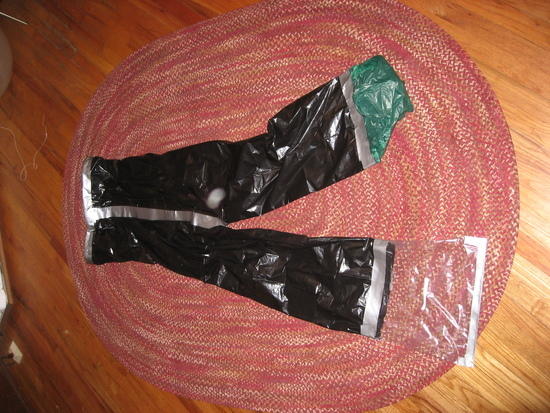
Without further ado, let me introduce the world's first (well, at least the world's cheapest) vapor barrier overalls!

VB Overalls

Yes, those are plastic bags of various shapes and sizes. Yes, that is duct tape. No, I have no sewing skills of any kind!

The foot areas are taped directly onto the pant legs, and there is an elastic cord at the top of the overalls to create a seal. Oftentimes I end up locating the vb liner just below my armpits, so at this stage that is where the overalls end. In the future I may try to patch together a top to go with it, but seems too darn complicated right now!

Socks, pants, and top layers can be added with ease to this system. At least that is the theory. Once I have the opportunity to test this out, I will report back.

Oh, total weight is 7.7 oz., with plenty of opportunities to drop weight in future versions…

James

Edit: not sure what that blurry thing in the picture is- oops. Oh, and the main body is made from Hefty ultra flex large trash bags, 1.3 mil. Full disclosure, I have no vested interest in the Hefty company. :-)

PostedDec 8, 2009 at 12:45 am

@Bill your blog is awesome.

http://ultraliteskunkworks.blogspot.com/

I'm curious as to how the Cuben sleeping bag worked out. Extremely impressive. Would love to read a follow up on it after a years useage.

I'm wondering, if you're going to make a sleeping bag completely waterproof then why not go the DAM route. Which is to say why not make it completely inflateable. Perhaps a seperate top and bottom chamber.

In the top chamber very low pressure would be all that is necissary.

This would ensure the Down is never compressed and because it wouldn't get squashed even when moving around hot air wouldn't get moved out and cold air wouldn't get sucked back in. Instead when you move around air would get pushed around inside the bag and sort of "recycled" between different regions or layers of the bag. A conservation of energy if you will.

For that matter maybe this is an advantage of a Vapor barrier. Air gets conserved and moved around so that hot areas get cooled and cool areas get warmed as you move around inside the vapor barrier.

I've heard no one talk of this, though I would think it'd be quite an important if not intriguing part of the vapor barrier equation.

Back to the integrated DAM bag issue: Obviously not a summer bag, but might be a great winter bag where the temps are nearly always below a max of say 55.

Though you could make the top interchangeable I guess with something more breatheable for summer. Making it essentially an interchangeable quilt/dam system.

Anyway… you would know more then anyone about what temps a non-breathing bag would be good for with your Cuben bag.

Viewing 18 posts - 76 through 93 (of 93 total)
Loading...