There was a small amount waffling last week over the decision to purchase a new Sublite. After all, I have the prototype test model. But after a year of testing Tyvek prototypes I ordered and paid for the production model to now have all of the features of the finished product. It is a good tent and perfect for the dry climate where I live and hike. This is the tent I will be using for now. There is no other tent out there that does what the Tyvek Sublite does for me. Take a look at it. Doesn’t it somewhat resemble a “half Scarp” all pitched out nice and tight? It exudes stability. It breathes, it sheds water; it refuses to condensate and it is lightweight. Furthermore, it is inexpensive. I wanted the finished product rather than an unfinished draft of the final version.
A pre-release discussion can be found at:
http://www.backpackinglight.com/cgi-bin/backpackinglight/forums/thread_display.html?forum_thread_id=13561
Discussed above are the topics of pitch, condensation, storm worthiness and a general comparison with other fabrics, particularly silnylon. Others have discussed their experiences and some folks have reported leakage in prolonged periods of rain which is a represented risk on the Tarptent website. For the Sierras and the Southwest where I hike, it has been all that I had hoped for. The following comments are made just to answer a some questions a few folks have PMed to me.
I am not, as is readily apparent, a professional gear tester with experience in orthodox gear reviews. However I am not apologizing for this. I have had the advantage of using the tent for a year and now that I have used it and judged it, I have purchased it and look forward to receiving the commercial model. I wouldn’t have ordered the Sublite today unless it was absolutely the tent that I wanted. There is other gear on my wish list and funds are not unlimited.
So what is so great about the Sublite to cause me plunk down a wad of cash when I already have the prototype? Here are some selling points for me.
The Sublite is lightweight, lighter than silnylon, breathable, roomy with both elbow and headroom and quick and easy to pitch, even on a solid rock bench. As hard and as often as I have tried, the tent refuses to generate condensation on the tent walls. Even when my head is directly adjacent to the wall breathing directly into the fabric the walls have remained dry. More importantly, it has sheltered me in some pretty strong and lengthy periods of rain.
Although condensation has never dripped nor even formed on the tent walls, I have experienced condensation on objects laying on the floor on two occasions. This problem was posted here in this forum and several experts explained the phenomena. It has happened twice in the last year. The colder air seeps in through the mesh condensates on the warmer objects on the floor. Amazingly it has not formed on the tent walls and this I really don’t understand even though folks have attempted to explain it to me. It would be interesting to test a model without the mesh having the Tyvek connect directly with the bathtub floor.
The prototype weighs 16 ozs.
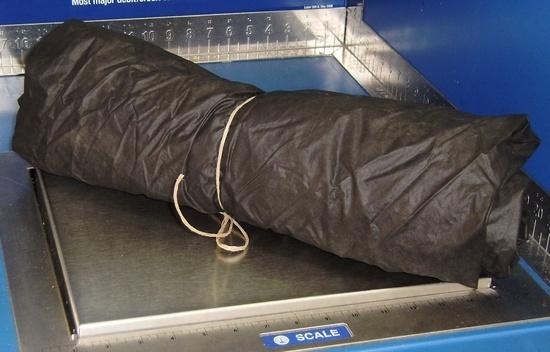
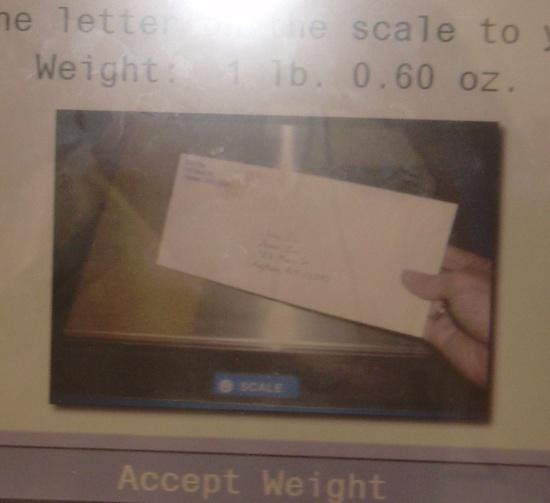
The production model is 18 oz, hardly a penalty for the improved features such as a larger vent at the top, added bottom vent, wrapped door flap zipper and some other amenities that provide value in the field.
The steep pitch of the front peak provides maximum usable length, especially when combined with the boxed foot so that even tall folks will find room to stretch out.
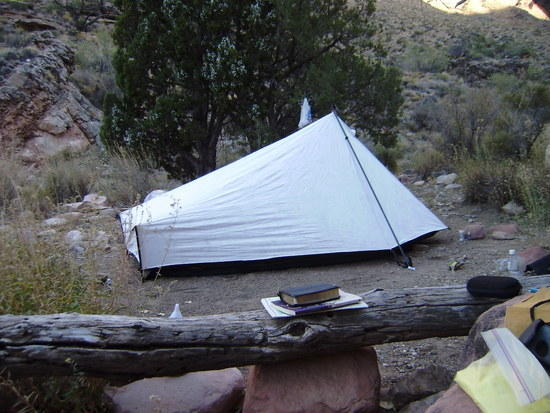
Notice also the taut pitch on the fabric with no need for resetting the stakes or re-tensioning of the guy lines after the sun dips and the air cools.
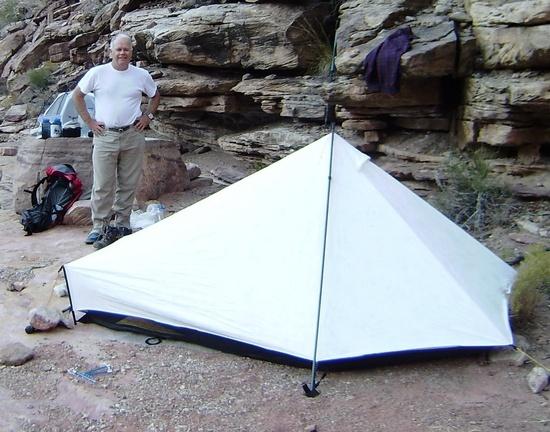
As roomy as the tent is, it has a small footprint and easily slides into the most untenable space such as this precious and only flat spot for miles around. Also notice how perfectly the tent is pitched in spite of not being able to drive stakes into the rock. A long stick or a hiking pole can be hooked into the rear guys and anchored with rocks for a nice tight and effortless pitch. I probably threw this up faster than Franco’s record breaking time with his Contrail.
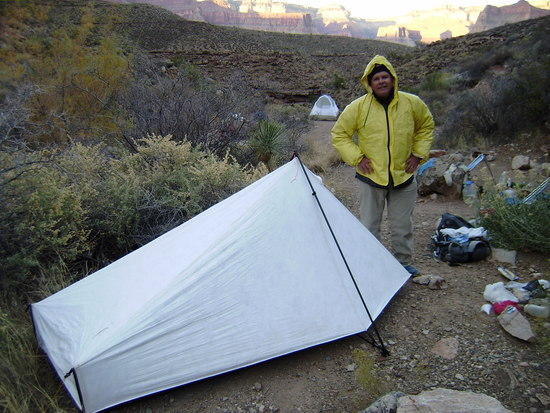
The space on the third evening in Lonetree Canyon was even more problematic but the Sublite easily takes advantage of small spaces. There is no compromise in the tight pitch due to suboptimal space.
Another important feature is the support for the bathtub floor. Instead of only the four supports at each corner, the sides of the floor are supported with adjustable straps attached at the pole holster. The strap is a thin ribbon style nylon that slides easily through the buckle for adjustment. There is plenty of room for gear at the head of the tent and on the sides especially near the middle where the floor widens.
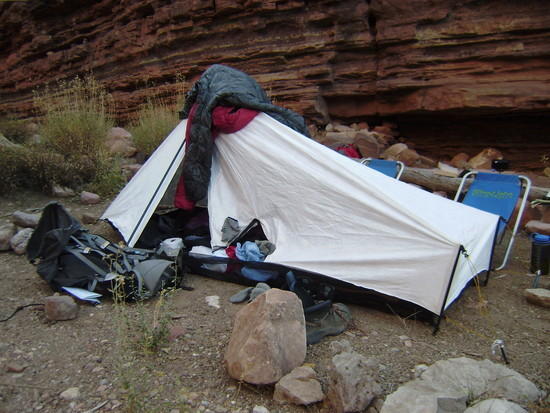
There is ample room to sit up. The boxed foot allows a gradual taper of the roofline allowing headroom to maneuver without interference from the roof. The mesh below the door is not zippered on my prototype so I have to be careful to tuck it in when it is raining or water drips down the mesh into the floor. I learned this lesson once. I am informed that this has been resolved on the production model with a full zipper.
Lastly, Tyvek has provided complete protection against rain. This last trip presented some anxiety accompanying the longest rain experienced so far. The previous last rain with the prototypes was a vicious two-hour storm last August. This past week at GCNP it rained for a combined 6 hours with no leaks.
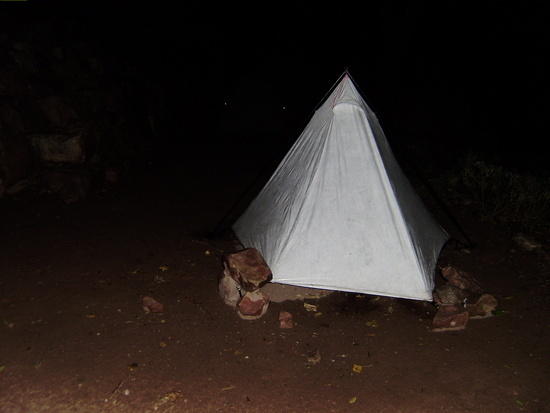
The storm was essentially two periods of rain separated by a dry period of several hours before it started raining again the last night at Indian Gardens. I have an expensive sleeping bag and was concerned about it sopping up a bunch of water dripping into to the tent. I woke up several times worrying about water pouring in. It didn’t happen even though it was pelted by hours of rain.
I have covered most of these features in other posts. Hopefully this helps with decision making. Here in the Sierras and the Southwest I enjoy the CLIMATE FOR WHICH THIS TENT WAS DESIGNED. Henry is a California boy himself in addition to being a PCT alum and has designed a tent for his own enjoyment as well as for folks who share a like climate. Hiking the Sierras where rain can be expected late in the summer in the afternoons and early evening, the Sublite will provide assurance of a dry bed, even if lasts most of the night. Not incidentally, the cost factor of Tyvek is a significant plus considering the weight. I have suggested that to Henry that he cut out the mesh and bring the Tyvek down to connect directly with the bathtub floor but he was worried about condensation.
Due to rapidly changing styles of gear and technology, this fabric makes very good sense. It won’t break the bank while making it easier to justify buying the newest style to hit the market when the urge hits. Of course only the very shallow minded materialist changes his gear frequently anyway and this is not really a concern for the stalwart, stable minded and discerning ultralighter.