Topic

Let’s talk about softshell clothing systems!

  • This topic is empty.
Viewing 25 posts - 1 through 25 (of 29 total)
PostedNov 21, 2008 at 8:02 am

Hey everyone,

Last winter I started a thread about clothing systems and it was very helpful, but this year there is new gear and new options and new people to get in on the discussion.

This year I'd like to think about a shoulder/winter season system that incorporates a softshell. I know some people say this isn't as versatile, and I certainly won't argue, but I bought a Rab Vapour Rise smock this summer and I plan on using it! :)

I hike in New England and I can only get out when there is no snow. I have a double wall tent (rei halfdome) and and WM ultralight sleeping bag. I'd love to venture into the whites especially since they won't be as busy this time of year! I would stick to low areas, trying to stay below treeline, but weather is still unpredictable so I should be prepared for rain and temps down to….zero Fahrenheit? Does that temp sound right?

So my current system is:

Torso:
1st layer: Patagonia cap1 long sleeve t (also have cap2 if it is really cold but I would hope to leave it at home.)
2nd layer: Rab Vapour rise smock (hooded)
If raining: Patagonia Rainshadow

Legs:
1st layer: Ibex merino wool tights
2nd layer: Patagonia R2 tights
Outerlayer: K2 snowboard pants

aaaand, that's all folks! So what needs to be added? Firstly, my torso needs insulation.

Vest or jacket?

I hopefully only need insulation while stopped with this setup. Would it be most versatile to have a good parka for the stops and forget the vest?

Secondly, do I need true wind protection? The Vapour rise does okay at stopping the wind, but it is pretty breathable so I pay the expected price; Good brisk wind can be felt. Should I add a true wind layer to be thrown over the shell just in case? Should the Houdini do the trick or can I get away with something cheaper?

I guess those are really my thoughts right now. Can someone shed some light on my questions or softshell clothing systems in general? Any suggestions on how to handle New England weather with a softshell system would be awesome. Am I missing something? I know the legs could use insulation, but I think I won't have enough money. Also, some down booties would be great and those I may splurge for. Likely not though unless I REALLY have to.

Thanks for the help!

Mark Verber BPL Member
PostedNov 21, 2008 at 8:38 am

If you are bring a hardshell for rain, then I won't bother to bring anything. The Vapour Rise will take you through most conditions, and if you really need to block more wind use your hard shell.

If you are going to face 0F, then you definitely want a loft loft jacket (not vest) to layer over the Vapour. I found a light + base vapour was good down to around 10F when moving, 45F when stopped. Stopped + vest I was good down to around 25F… at which point my trunk was find but I notice my arms chilling… and I run normal to a bit hot.

My experience is that you are doing more for your legs than I would.

–mark

PostedNov 21, 2008 at 10:24 am

Awesome!

Tt's great to hear I'm doing more for my legs than necessary. When snowboarding I go with the merino wool and snowboard pants and I'm good so I suppose that should work for these late year trips also.

I don't know if I will face 0F or not. I would hope to only encounter temps like that at night when I can have a parka draped over my sleeping bag and all my other clothes on. I figured a jacket would be ideal for my stops as opposed to a vest, especially if it was 0F out. I will have to look into a good insulation piece for these trips. How much insulation do I need in a jacket to be warm in 0F weather with my current system? For reference, I can wear a short sleeved cotton tee shirt under my softshell while walking to work and have slightly chilly arms in the low 20's.

Brett Peugh BPL Member
PostedNov 21, 2008 at 2:46 pm

First off, for me I really notice no difference between Cap 1 or 2 for breathability or insulation properties. Since you are wearing a thin softshell I would probably go with a Cap 3 that does have some insulative properties. These two for your top would probably keep you warm while moving but not sitting around a 0F. At those temps I would not getting yourself a nice piece of insulation. You could put on a shell and for that I would suggest just a DriDucks jacket because it will cut the wind and water while still being light and breathable. This should get you a few extra degrees.

For your legs, that seems like overkill. I am roasty toasty in my expedition weight bottoms for 0F let alone two layers insulation layers that together are much thicker. I would just go with your tights and pants while moving and get something like the Pat Micropuff Pants-Special that have side zips and are on sale off the Pat website to keep your legs warm when stopped if you need it.

Personally I do not like softshells and think that they should only be used for around town or possibly as pants to trudge through snow with. I would ditch the softshell jacket and get yourself a lofting insulation piece. While you are moving the Cap 3 and shell will keep you pretty good and then get some insulative piece that has a full zip so you can wear it fully open if you need a bit more or closed when stopped.

PostedNov 21, 2008 at 6:23 pm

"At those temps I would not getting yourself a nice piece of insulation. You could put on a shell and for that I would suggest just a DriDucks jacket because it will cut the wind and water while still being light and breathable. This should get you a few extra degrees."

Are you saying you wouldn't get a piece of insulation because of a softshell? What does ditching the softshell have to do with getting an insulation piece? The softshell replaces two pieces that are totally unrelated to insulation. I don't understand your logic, care to explain?

PostedNov 21, 2008 at 7:19 pm

It's all about compromises. Softshells are bulkier, heavier, and less warm than the pieces they replace. That's the compromise of combining a fleece jacket with a wind jacket. The most notable situations in which the above compromises are inconsequential would be in mountaineering and rock climbing, when the de-layering and re-layering of a wind jacket + a fleece layer would be too much of an inconvenience to be practical.

In backpacking, softshell jackets tend to work well as an active layer when temperatures are at about 0-10*F or lower, but considering that backpacking does not carry the same limitations on stopping to de-layer that rock climbing does, the compromises fail to outweigh the benefits, IMO. When it's hot out, you're going to have to stuff that bulky thing in your backpack anyway. If you just want extra insulation for while active, something like a Montbell thermawrap vest would do the trick. It provides nearly the same core warmth and windproofness, but is both lighter and less bulky than a softshell jacket.

Active layers aside, I've yet to meet a softshell jacket that, by itself, kept we warm while at rest at temperatures below about 40*F. Down is just way warmer for the weight and bulk. Talking about winter use, a softshell just doesn't cut it when the temps are 20*F. The softshell jacket I have weighs about a pound. By contrast, I also have a 14 ounce down jacket that I'd estimate to be at least 3 times warmer, and it compresses smaller.

An ultralight 3-4 ounce windshirt provides the same windproofness that a softshell layer offers, but is more versatile, as you can use it with any combination of your base layers. In winter, however, many people may not need the enhanced breathability that a windshirt offers. A Goretex rain jacket is also a wind layer (think multi-use, guys), and if it's very cold outside, there simply is not the same concern of internal condensation that you have in 50-80 degree weather (if it gets too hot, just unzip it or de-layer).

EndoftheTrail BPL Member
PostedNov 21, 2008 at 7:24 pm

Richard,

Is this a question of… having gotten a softshell already, you are trying to find a use for it while on the trail?

To me, a softshell that combines some insulation property with some weather resistance is good for wearing around town — and for three-season day trips where long rains aren't expected. These are the occasions where a versatile layer giving 80% protection is good enough.

But for multiple day trips or any trips where cold and rains can't be ruled out — I would want clothing that provide real protection and efficient warmth for the weight. My fully rainproof Driducks jacket and my MontBell Thermawrap together provide much more versatility, protection, and warmth than a softshell that can't protect against real rain and isn't all that warm for the weight.

CW BPL Member
PostedNov 21, 2008 at 7:38 pm

I can't speak for a softshell as a torso layer but in my experience, they excel on the legs. I've successfully used them down to the low teens including on the WT3 trip in feet of snow and 20-30 mph winds. My RAB VapouRise pants are 12.9 oz so they're not heavy for pants and were the only thing I wore on my legs the entire WT3 trip including while sleeping.

PostedNov 21, 2008 at 7:53 pm

To me, softshells represent the worst of both worlds. They don't really protect you from rain, they are not particularly warm, and they are heavy as lead, and they will take up half the volume in your backpack.

I'll stick with a baselayer, insulation layer, windshirt and, a ultralight hardshell (usually a poncho).

PostedNov 21, 2008 at 8:09 pm

Good point, Chris. Softshell pants tend to be pretty ideal hiking pants for winter. It's just the softshell jackets that don't compute as a backpacking layer. Like I mentioned in my previous post, if you can wear it while hiking, then the bulkiness factor of a softshell is out of the equation. Add to that the fact that a lot of softshell pants have some sort of side zips for ventilation, and they end up being quite versatile as well as warm. I've got an old pair of Mountain Hardwear Alchemy pants that are killer winter hiking pants. They are fleece-lined windproof and quite warm, but they also have 3/4 length side zips so I can get nearly the same ventilation as if I were wearing shorts, or at least enough so they don't get sweaty when the sun comes out.

PostedNov 21, 2008 at 8:19 pm

Awww…I was all excited about my softshell! :-( I guess I will have to consider layering options. I definitely knew of their merits and thought I would prefer them, but I just wanted to try this piece. It's great for walking to work in which is the prime reason I got it, but I was hoping to use it for hiking.

Back to the drawing board I suppose. I at least have a merino baselayer for my torso and legs and a rain jacket. Guess I will keep looking to complete my system for as cheap as possible!

PostedNov 21, 2008 at 9:09 pm

The utility of a soft shell pant is probably agreed upon here, so I won’t continue to belabor that one other than to say that I’m a huge fan of soft shell pants in the winter.

The upper layer is problematic, but I have to admit one important scenario in which I think it works very well for backpacking: conditions that are cold enough so that the shell stays on your body the whole time.

For me, I start thinking soft shell when temperatures dip below ten degrees and I’m expecting foul weather: wind and what will obviously be pretty frozen precipitation.

There are two approaches here. The first is the baselayer-wind shirt combo, which must be counted as a “soft shell system”.

For these temps, I’m using a full hooded jacket like a Patagonia Essenshell (13 oz) over a Patagonia R1 Hoody (13 oz) or over a wool combo like the BPL Merino UL L/S shirt + Beartooth Merino Hoody (combo = 13 oz). For lesser weather I’ll swap out the Essenshell for a Houdini wind shirt or similar and save 9 oz. But a full on hooded, thigh length jacket is awfully nice when the weather is pretty bad, and a light wind shirt just can’t quite cope with it well enough at those temps.

I’ve also used two other soft shell jackets with brushed linings at length on multi-day trips. The GoLite Kinetic (14 oz) and the Arc’Teryx Gamma MX Jacket (has a hood, 14 oz), always worn over a thin wool base layer like the BPL Merino S/S or L/S shirt.

These systems too are very comfortable and handle bad weather very well. That Powershield Micro fabric is the best “bad weather” softshell fabric I’ve ever used, far more protective (and breathable “enough”) than say, Schoeller Dynamic.

Note that both of these styles of systems are very wind-protective and less breathable than Schoeller Dynamic and other fabrics that you can blow air through, so they are out for warm conditions.

For warm conditions, above say 20 deg F, I’m back into wind shirt mode mostly, and since precip is going to be wet, I’m carrying a rain jacket too.

For this year’s Wilderness Trekking III course, which had its good share of foul weather including wind, snow, and temps in the 15-30 deg F range, I wore the Beartooth Merino Hoody, a Houdini Windshirt, and an ID eVENT Jacket. I had no regrets, and more flexibility and less weight than if I’d thrown in a typical soft shell jacket.

There are some interesting articles here at BPL that address soft shells specifically, and now that we have a new search engine I can actually find them amongst the 1,300+ articles in the archives here!

So, don’t give up on soft shells. Try them out. With experience, you’ll figure out what works and doesn’t work on multi-day trips.

My closing comment, however, is to be cautious about what soft shell makers promise you: comfort in “most” conditions and “ideally suited” for backpacking. Frankly, I can’t see the utility of a soft shell jacket as a part of a weight-conscious clothing system for temperatures above freezing on multi-day trips. The risk of water absorption and lack of being able to dry it out are too high for me, in addition to the amount of time where it will ride in your pack vs. on your body.

Mark Verber BPL Member
PostedNov 21, 2008 at 10:32 pm

I would second much of what Ryan said. Softshell pants rock. Soft shell jackets aren't as much a clear win, but I have been very hapy with them in conditions that they don't come off. Yes, I could wear a light fleece and a separate windshirt… but I have found that some of the soft shells on the market seem to work better than the combination of separate pieces.

While it's true that when backpacking it is easier to change layers than when climbing… I would rather not mess with taking layers on and off. With something like the Vapour Rise I found that between venting using the zipper and pushing the sleeves up to my elbows I could cover a wide range of conditions. Do I take one on three season trips which it could end up in the backpack? No. Do I take it on winter trips when I will need at least it all the time? Absolutely.

–Mark

PostedNov 21, 2008 at 11:06 pm

I got a 10 oz powershield shirt that is fantastic for colder temps where, as Dr. J mentioned, you leave it on all day.
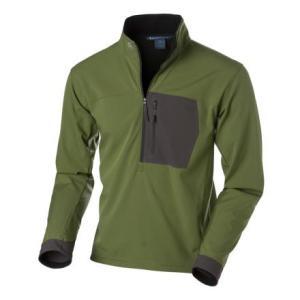
Backcountry.com Rime Pullover: hoodless, 1 chest pocket, 1/2 zip. LINK
I had to size up on this, but use of powershield as a snugger base layer seems like a good idea for cold conditions, like make the R1 hoody out of it.
fdtyk;l

Brett Peugh BPL Member
PostedNov 22, 2008 at 8:21 am

Sorry about that but I work on 5-6 different computers each day and they all have their own keyboard quirks. Replace 'not' with 'be'

Steven Nelson BPL Member
PostedNov 22, 2008 at 10:06 am

Another vote for what Ryan said.

I use softshell tops (and bottoms) in winter when the precipitation won't be wet, and find them to be warm and breathable yet protect well from wind and snow. I like the way they feel for heavy exertion while snowshoeing or skinning up a slope – better for me than a light insulating layer + shell.

PostedNov 22, 2008 at 11:47 am

Just to really drive the point home, I also only use a softshell jacket in the winter (pants pretty much year round)In the right conditions, it is awesome.

Snowshoeing and winter camping in the Pacific Northwest, I wear a softshell jacket, (north face apex) which is more breathable than weatherproof, over a capilene zip neck or a patagonia R1 hoody, depending on the temperature. If it going to be above about 30 degrees or so, I will swap out the softshell with a windshirt, and bring a rain jacket (marmot precip, which is heavy, but it's what I own)

In the PNW, it's not that cold (relatively speaking) and it is wet. Some would say that this is not a good climate to use a softshell top in, and in summer I am in agreement. However, the fact is, when it is warmer out here in the winter, you tend to get wet, no matter what you wear, and in my experience, you get less wet from persperation in a softshell, and the temperature gradient keeps the softshell from getting soaked by typical warmer PNW winter precipitation, which usually take the form of freezing rain or light rain mixed with snow.

I think to really make a softshell jacket work it needs to be part of an intergrated system, which for me involves the use of a synthetic parka (patigonia DAS) for insulation, with synthetic sleeping insulation. I layer over the top of my softshell, which helps keep it dry, and helps keep me warm at rest stops. The synthetic sleeping bag helps preserve the loft of insulation in a damp climate.

Of course this is a system tailored to specific climactic condition, YMMV.

PostedNov 22, 2008 at 1:43 pm

Wow, great to see that a discussion got started. I certainly learned a lot from everyone's posts so now I have a better idea of what conditions most people would consider a soft shell top useful. I'm not so upset about my purchase anymore as it seems like I can have some perfect days for using the softshell here in New England.

Before this thread I was ready to give up on my top and build a system that was more versatile. I was hoping to get some advice on how to use the top for this winter and I really think everyone has helped so much! Thank you!

I've been really thinking about getting the most versatile setup possible by choosing systems that are flexible instead of just owning a bunch of gear! I've been thinking about a tarp/bug system for next season to go along with this new mindset as well as finally purchasing a wind shirt and insulation piece. I guess I will keep my softshell and experiment with it more. So far it hasn't caused any problems and I haven't regretted taking it along. It is heavy though!

Thanks again for all the discussion and helpful thoughts!

Steven Evans BPL Member
PostedNov 22, 2008 at 4:24 pm

I use my softshell religiously all winter. My experience has been that you should only use it if the temps will be consistently below zero, any warmer and I believe there are better options. Using a softhshell in 40* weather and then saying that softshells are no good is like using a tool incorrectly and then complaining about it. IMO, if there is any chance of rain, it's too warm for a softshell. Of course, like anything else, your experiences may differ.

Rod Lawlor BPL Member
PostedNov 22, 2008 at 7:03 pm

"Do I take one on three season trips which it could end up in the backpack? No. Do I take it on winter trips when I will need at least it all the time? Absolutely.

–Mark"

Mark, once again you've summed this up in one (half) paragraph.

Softshells, unlike hardshells, are for wearing, not carrying. They're best used when you'll have them on for the whole trip, +/- other layers.

I would never PACK my softshell jacket (OR pants when I think about it) If I'm not wearing them as I walk away from the car/trailhead, I don't need them. Sure I may occasionally take them off if it really heats up or I'm working hard for a long time, but I'd be considering this to be a reason to reexamine my gearlist when I got home for this location/trips next time. ie, I made a mistake this time. That's okay, mistakes are a way to learn what works. Plus, it's pretty hard to make mistakes about what to wear for sitting at home in front of the TV (or computer) :^)

PostedNov 28, 2008 at 3:41 am

Broadly agree with best worn not carried, especially with the heavier ones.

One thing you can do with shelled micropile – like the Vapour rise, Montane Scarab, lighter weight Buffalos etc – is to wear it next to the skin.

It works very well – indeed probably best – like this and it also of course extends the comfortable temperature range a fair bit, especially on ones with side vents.

I'd probably be happy setting off in one if I knew the temperature wasn't going to go above 60 or so and was expected to be a little lower.

Very useful in the sort of rather changeable, on/off showery conditions often seen in the UK. Rather less so in more stable climates I'd imagine.

Dave . BPL Member
PostedDec 16, 2008 at 6:07 pm

A while back, Ryan posted about using the Patagonia Essenshell as a tougher windshirt/softshell for cold conditions. However, it looks like the Essenshell is no longer being made. What has taken its place? Are there similiar pieces being made by other manufacturers?

I notice the Patagonia Ready Mix and Cloudveil Inertia Hooded Jacket might be similar, but I'm not that up on softshell materials. What is inertia like relative to Scoeler or Powershield etc.?

PostedDec 16, 2008 at 7:03 pm

I believe the essenshell went through many versions and eventually become the Ready Mix. My essenshell, which is a simple pullover, is a non-stretch polyester that- I believe- has an Epic coating. It is nothing like the Epic Malibu I have used, but is windproof and sheds light rain, but does not breathe as well as the Ready Mix. Still, it's light, has a helmet compatible hood, and is tough. Damn ugly color though (greenish yellow).

In my opinion, Inertia is more like Schoeller Dryskin than the Ready Mix fabric in that it is stretchier, not %100 windproof, but very breathable. The Ready Mix is less stretchy, more windproof but slightly less breathable. The nice thing about Inertia is that it all Polyester with mechanical stretch- better drying than Schoeller. These excell for high exertion activities.

Powershield has a membrane- unlike the other fabrics mentioned here.

Dave . BPL Member
PostedDec 17, 2008 at 8:57 am

Thanks Michael. Very helpful.

I'm looking around for heavier wind shirt/sort shell like the Essenshell of Ready Mix. I want to use it for snowshoeing this winter as my Montane Litespeed just isn't up to snuff for the coldest parts of the winter.

Unfortunately it looks like the Ready Mix isn't available anymore either. (Anyone know what's up with that?)

Do you think that the Ready Mix would perform about the same as shells made from Schoeller Dryskin or Inertia for snowshoeing in cold that's too extreme for lighter wind shells?

Viewing 25 posts - 1 through 25 (of 29 total)
Loading...