Topic

How many stuff sacks?

  • This topic is empty.
Viewing 23 posts - 1 through 23 (of 23 total)
Ed Barkowski BPL Member
PostedOct 31, 2008 at 6:08 pm

I'm getting ready to buy ALL of the stuff sacks (waterproof and otherwise) for a 2009 thru-hike of the AT, and I'm at a loss.

Can I get some feedback on how many to take, what sizes to buy and which ones would HAVE to be some form of waterproof?

Please be specific (ie. favorite brand(s), sizes, type of waterproofing, etc) if possible.

THANKS FORUM

CW BPL Member
PostedOct 31, 2008 at 6:20 pm

If solo, I would have 3. One for food, one for bivy, one for tarp.

If with the GF, I usually only have the one for my food.

All of the ones I've bought by themselves are SeaToSummit UltraSil. The ones for the tarp and bivy are MountainLaurelDesigns and came with them.

Jay Wilkerson BPL Member
PostedOct 31, 2008 at 6:39 pm

I think you need a clothes sack,sleeping bag sack, food sack and maybe a tiny essentials bag. All H2O proof is a must to be safe. Size depends on your personal needs and how much gear you take. Check out my stuff/packing sacks on my gear list in=community gear list. Goodluck with your hike.

PostedOct 31, 2008 at 8:39 pm

I've done half the AT over the last couple of years, and I used 4 stuff sacks: sleeping bag, clothes, food, and "other." The last was a ditty bag that held my compass, spare matches, journal, reading book, wallet, headlamp, knife, tape, and anything else small that I didn't want to get lost in my pack. I think a ditty bag is a must, especially if you're using a UL pack that doesn't have a bunch of zippered pouches.

Three of my sacks were OR Hydrolite: 30 L for the sleeping bag, 10 (or maybe 15?) L for clothes, and 5 L for the ditty bag. I used a 20 L Sea-to-Summit Ultra-sil Dry Sack for food (I wanted something a bit more waterproof since the food bag would be hung outside in the rain some nights).

When are you starting your thru-hike? I'm planning to do Springer to Hot Springs starting around April 1st.

PostedOct 31, 2008 at 8:47 pm

I think you are going to get all kinds of recommendations if you ask how many and what size stuffsacks will you need for a thru hike because everybody has their own preferences for gear and for organization of that gear. You'd probably get more relevant responses if you posted a brief gear list, including details about your backpack

PostedOct 31, 2008 at 9:33 pm

I agree with Art.

I carry one for my kitchen: Pot, Cozy, Cup, Stove, Spoon, Knife, Camp Suds, Pot Scrubber, Water Bag, Water Filter.
One for my breakfasts and dinners (stuff that needs hot water). One for lunch and snacks. One for clothes. One for my sleeping bag. And one for "ditty":first aid, extra guy line, toothbrush, camp towel, flashlight. I also carry an OPSAK of the appropriate size for any electronics I may be carrying and my ID.

The kitchen bag is always the same, color coded, and varies only in weight depending on the Pot and Stove I'm using. The food bag is always the same, color coded also, and varies in weight depending on how many days I'll be out. I can get 8 days of food in it, if I have to. The usual three season clothes bag is quite small as I tend to only take clean underwear, one extra pair of socks, a warm beanie, gloves and tights. My three season sleeping bag is
a North Face Beeline (old version) and rides in an ultralight dry bag.

PostedOct 31, 2008 at 10:36 pm

I recently ordered a OR Hydrolite #4 stuff sack, to keep my sleeping bag/down jacket in.

Unfortunately the 20L sack weighs 2.5 oz.

Not sure if this is the norm for waterproof stuffsacks but I'm thinking a silnylon sack (even seam-sealed) would still be lighter.

Can you guys recommend a vendor that makes sil-nylon sacks? (Besides Sea to Summit, cheaper please)

Monty Montana BPL Member
PostedOct 31, 2008 at 10:38 pm

Guess I must like stuff sacks as I use eight:
* OR Hydrolite #1: sleeping bag.
* large silnylon: clothes (fleece, merino longjohns, gloves
balaclava, socks).
* medium silnylon: food.
* small silnylon: gatewood cape, ti stakes.
* small nylon mesh: bivy.
* produce mesh: pot, stove, fuel.
* small silnylon: personals (1st aid, toothbrush, headlamp,
monocular, ultrapod, book, etc).
* small silnylon: MB down inner jacket.
Windshirt, snacks and other items I need immediate access to go in the back pocket of my GG Whisper pack. Weight (including food, 1 L water) ranges between 11 – 13 lbs for three day weekend.

Joe Clement BPL Member
PostedOct 31, 2008 at 10:45 pm

I'm trying to get to where I just use a pack liner and not stuff sacks. I have a few mesh bags to gather up certain things.

PostedNov 1, 2008 at 2:53 am

I'm with Joe here, I use a big waterproof garbage bag for sleep/clothes, and a mesh bag for food and kitchen, and nothing else. Tarp gets shoved in the rucksack anyways to fill in gaps when dry, and lives outside in the mesh section when wet.
Makes life a bit easier.- I hate fiddling with too many stuff sacks!!
cheers,
fred

Roger Caffin BPL Member
PostedNov 1, 2008 at 3:23 am

> Can you guys recommend a vendor that makes sil-nylon sacks?

I love nylon and silnylon stuff sacks. Lined where possible with a light freezer bag as well. OK, paranoid, but all my gear and all my food stays dry, no matter what.

Source? I do have this sewing machine … and stuff sacks are so easy to make. Almost zero cost that way.

Cheers

Dale Wambaugh BPL Member
PostedNov 1, 2008 at 7:32 am

I try to get rid of as many cases and other covers as possible. I use three Sea to Summit roll-top waterproof sacks: one for clothes, another for my essentials/hygiene gear, and one for my sleeping bag. I have a small Granite Gear bag for my shelter accessories and a GoLite Landlubber large size for food and cooking kit– these are both simple drawstring bags. I have a zippered pouch on one shoulder strap for compass, sunglasses and digital camera.

I hate digging around in a pack to find things and I want my clothing and sleeping bag to stay dry.

PostedNov 1, 2008 at 9:49 am

The Hydrolite stuffsacks ARE heavy. However, apart from being seam sealed, they are not truly waterproof, since the mouth is just held closed by a drawcord. By contrast, take a look at the Granite Gear Airvent Dryblocs. http://www.granitegear.com/products/packingsystems/seamsealed/airventdryblocs.html
They are truly waterproof, they are made of silnylon, and the eVENT patch allows air purging. They range in weight from size XXS (7L) @ 1.2oz to size LG (25L) @ 2.0oz.

As for silnylon stuffsacks, take a look at some of the small manufacturers. I know Zpacks sells some. Conversely, you could buy a yard of silnylon yardage and, if you have access to a sewing machine or even if not, just make your own. They are incredibly easy to make them as well as the big manufacturers like S2S do, even if you're just hand-stitching. It may take an hour to hand sew a stuffsack, but the cost is incredibly low to make them like this.

Monty Montana BPL Member
PostedNov 1, 2008 at 11:35 pm

Ed, for a definitive discussion on stuff sacks, check out Jim Wood's article, "Keeping your Critical Gear Dry". It runs 17 pages but is well worth the time. I found it through a link on this site but have lost that info. However, I did print it out. Here's what he says about sylnylon: "…fill the sack with water…you'll find that even the minimal water pressure inside the sack will cause some leakage through the fabric. To roughly quantify the pressure, consider that water weighs 0.036127 lbs/ci and if the water is say 12" high in the sack the pressure in the bottom of the sack will be about 0.43 lbs/sq in (or ~305mm of hydrostatic head). But you'll probably find that leaks also occur even near the top of the sack, where the water pressure is far less." He does not recommend sylnylon for waterproofness.

He has this to say about purge valves: "…while this feature sounds good in theory, it doesn't work very well with the kinds of things that backpackers are most likely to store in these sacks. What happens with sleeping bags and puffy jackets is that thay create air pockets when stuffed into these bags as their own fabric presses against the sides of thje sacks. Likewise, these items also tend to form seals around purge valves, effectively blocking air access. As a result, purge valves usually just add weight, complexity and potential leakage points and are therefore not recommended for most backpacking applications."

To solve the waterproof dilemma, just use a large turkey roasting bag to line your pack and then any stuff sack you like (for sure waterproofness use a roll-top dry sack for the sleeping bag).

PostedNov 1, 2008 at 11:58 pm

Monty, I do believe that's an apples to oranges comparison. There's a huge difference between the conditions a stuffsack will experience inside a backpack and a stuffsack that is simply filled with water. For one, a backpack's own pack fabric will repel most of the rain, but the rain that does leak through generally won't fill (most) backpacks such that an inside-of-backpack stuffsack would have to have such a high hydrostatic head to maintain waterproofness.

I've heard people use the immersion test to supposedly debunk the concept of a silnylon dry bag before and frankly I think it makes about as much sense as if I were to say that some tent was inferior because its bathtub floor was only 3" tall, rather than the desired 10".

Dana S BPL Member
PostedNov 2, 2008 at 5:39 am

Art,
I believe one point in the article talks about the extreme scenario of your pack falling into a river/stream and filling internally. With only 9" of head ,i believe that was the number (honestly haven't read the article in a while), the pressure will cause failure in the silnylon sacks. your pack is longer than 9" and say it was half submerged, well there you go, fail. Grant it this article points out the Murphy's Law scenarios, but hey, it could happen right? :)

I use three stuff sacks similar to what's been mentioned on this thread already, but I also use a trash compactor bag to line my pack just as an extra precaution.

– Dana

PostedNov 2, 2008 at 6:03 am

My sleeping bag and any sleeping layers are the only thing that goes in my pack liner. I roll down the seal and I don't open it again until I'm in my shelter at night. My shelter goes in another dry bag. I can pull it out in the rain without getting anything wet. I can also put it away wet and not have to worry about it getting anything else wet. I have a couple of zipper dry bags for clothing and miscellaneous stuff. Finally, I have a regular stuff sack for my food. All of my bags are Sea to Summit and Outdoor Research.

PostedNov 2, 2008 at 7:27 am

On long distance hikes I carry:
a trash bag pack liner
a waterproof stuff sack for my sleeping bag
a waterproof stuff sack for my clothes
two food bags (I like two better than one)

PostedNov 2, 2008 at 8:21 am

Hmmm…. I would think the number of stuffsacks carried would be more personal than "scientific," based on individual organizational wants/needs. For me, I carry many stuffsacks since, like most everyone here, I wear a pack with limited storage pockets; and I prefer to keep everything organized.

I also only carry a handful of items demanding waterproofness: insulated clothing, sleeping bag, and my camera.

1) My sleeping bag, insulated clothing, spare boxers, and spare socks are carried in an oversized drybag that fits snugly and horizontally at the bottom of my pack. Outdoor Research drybag.

2) My cookware, stove, and utensils are kept in a Spinnaker stuffsack fit to size. Granite Gear Spinnaker stuffsack.

3) My miscellaneous small items, morning/camp gels, firestarting, maps, navigation, emergency kit, spare batteries, etc, are kept in a small Spinnaker stuffsack. Granite Gear Spinnaker stuffsack.

4) My raingear is initially kept in a Spinnaker stuffsack fit-to-size, but, if not being worn, it is most often carried loose in my outer mesh pocket for drying — that's the Smokies for you. I primarily carry this stuffsack to be used as a pillow if the contents are dry. Granite Gear Spinnaker stuffsack.

5) My shelter is kept in the manufacturer's stuffsack, but will often be carried strapped to the outside of my pack for drying — re-arranged often to allow different surfaces to dry.

6) Food is carried in one, possibly two, Ziploc freezer bag(s) for high visibility and waterproofness. It should be noted that I often carry two spare freezer bags, one solely for freezer bag cooking, and one as a backup.

7) Small sandwich-size Ziploc for my camera — either carried in a hipbelt pocket or a pant pocket for easy access. When not in use, it is always secured in the Ziploc regardless of how dry the weather is.

8) Small sandwich-size Ziploc for water purification, sunscreen, bug repellent, lip balm, and other items I may need to use frequently — again, either carried in a hipbelt pocket or pant pocket. This is carried strictly for organization, but when I get lazy I will frequently carry them loose in the aforementioned pockets.

9) My packout bag is also a Ziploc freezer bag carried in my outer mesh pocket, and hung from a tree or bear hanging system as such (in my pack's mesh pocket). The idea is that rodents will go for the packout bag as a treat of least resistance in the mesh pocket, and not my food contents secured inside my pack. So far this has worked in the Smokies, for my packout bag has often been compromised by rodents, but my food and pack have not been. For a long-distance hike, I would probably elect to carry my food in something more odor-resistant if planning to hang it on the AT — my longest AT hike has only been ~50 miles.

For your question, I suppose only 4 of those would qualify as stuffsacks. For me, the only item carried loose is my foam sleeping pad; but I also elect not to use a pack liner or cover. However, I could easily see someone getting away with just carrying one, or none, stuffsacks if they elect to carry a pack liner and pack contents in a way that would seem blasphemously disorganized to me. My opinion is that the weight of stuffsacks and Ziplocs is so negligible that you should just carry as many as you feel comfortable with from an organization standpoint. HYOH!

PostedNov 2, 2008 at 3:25 pm

I USE JUST TWO STUFF SACKS!
==========================

My packing system is shown below.

1.
ONE actual stuff sack for the cook kit.

2.
ONE actual stuff sack for the food.

Other storage noted below:
=====================

a.
ONE simple ziploc bag for my toiletries

b.
ONE simple ziploc bag for my maps

c.
I put my sleeping bag inside my non-waterproof bivy-sack as an extra bit of protection.

d.
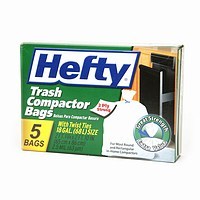
I line my backpack with ONE trash compactor bag. This is a waterproofing for absolutely everything.

These are heavy gage white plastic bags designed for kitchen trash compactors. I have never found anything better or lighter. They are white, so it's easy to find stuff in the bag, and they last for multiple trips.

available at your local grocery store

Hefty Trash Compactor Bags
18 Gal. (68 L) Size
2 Ft. 1 3/4 x 2 Ft. 10 in. / 2.5 Mil.

They weigh just 2.2 ounces, and they are plenty big to line my backpack. I have plenty extra to wrap over at the top for absolute waterproofing. I have no redundancy.

I do NOT use a pack cover.

If the tarp is wet in the morning, I stuff it in the bottom of my backpack FIRST and then put the compactor bag on top. So, everything stays dry INSIDE the compactor bag.

I put my rain gear on top, outside the bag, because if it rains, I'll end up wearing it. Simple!

e.
Any small items get put in a simple ziploc bag. I use them over and over, and I have a box of old ones.

PostedNov 2, 2008 at 3:52 pm

>Art,
>I believe one point in the article talks about the extreme
>scenario of your pack falling into a river/stream and
>filling internally. With only 9" of head ,i believe that was
>the number (honestly haven't read the article in a while),
>the pressure will cause failure in the silnylon sacks. your
>pack is longer than 9" and say it was half submerged, well
>there you go, fail. Grant it this article points out the
>Murphy's Law scenarios, but hey, it could happen right? :)

Very few of the backpacking trips I've been on in the past 10 years have involved crossing streams that are large enough to fall into, and only 1 of them has involved crossing said hazardous streams. I do believe you're right, though, that when things like large streams are entered into the equation, it adds a different set of risks, which requires a different set of gear to minimize those new risks.

Viewing 23 posts - 1 through 23 (of 23 total)
Loading...