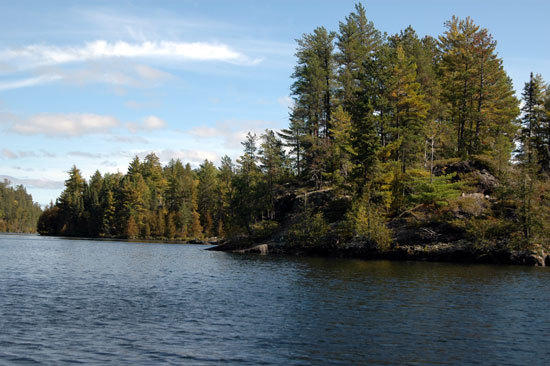
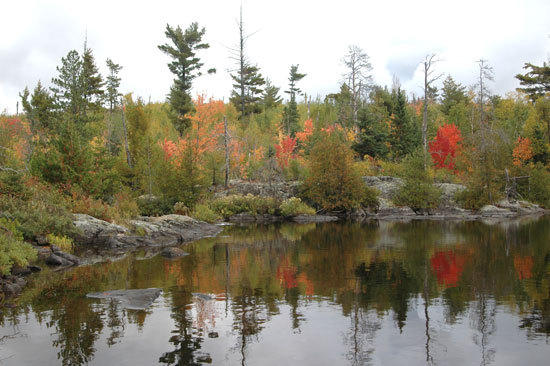
We managed to find room in our autumn schedule this year for a few days of canoeing, so we spent the week of 9/27 – 10/4 paddling the lakes of the BWCAW. Celebrating the fall season in this wilderness means a guest list sans mosquitoes, black flies, and to a large extent, people. The party goes on at the North- South border of the boreal forest of Canada, and the North Woods of the US, in a 1.3million acre parcel that is sometimes dotted with, and sometimes dominated by a varied assortment of some 1000 lakes.
After following the US-Canada border from Birch Lake northeast, we spent Sat. night at a campsite on Knife Lake, some 10.5 miles and five portages (190 rods) from our put in. Partly sunny skies and near sixty degree temps continued from Saturday through Sunday morning, and gradually gave way to a cloud cover during the afternoon. Portaging played a larger part during Sunday afternoon as we traveled south out of Knife Lake, through a series of small lakes that took us through Lunar Lake and to our second campsite on Cherry Lake. This route’s apparent light use was reflected in the narrow, overhung, overgrown, and relatively steep (for Minnesota) portage trails. With our relatively heavy food pack these portages gave us a nice warm-up for the coming days.
Our two packs weighed 36# 03 and 41# 10 when we began. The lighter pack (P-1) included food, food canisters, kitchen, fuel, filter, water containers, tp, and one person’s essentials. The Watershed Westwater dry pack, the balance. During the first couple of days my date portaged the food pack and I carried the Westwater and the canoe, separately. When the food pack reduced to 31#, we switched packs, and began the days single portaging. If I tired of the weight, or a steep trail, or a challenging trail, I’d simply park the canoe and return for it. If we fatigued as the afternoons wore on, I would double portage, especially on the short portages. The 42# weight of the Westwater was challenging for my date as well, so when the food pack, which lost about 3# per day, approached 25#, we began to shift weight away from her Westwater to the P-1.
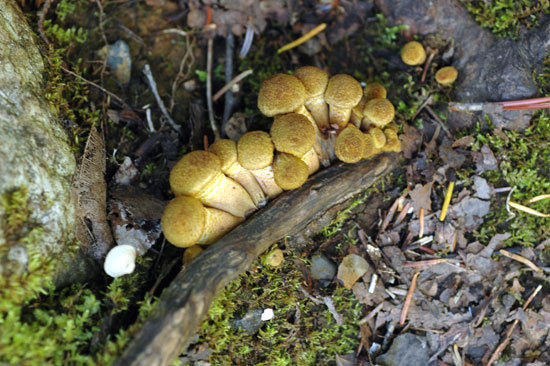
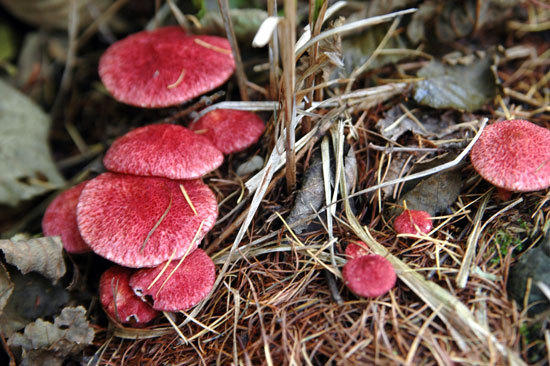
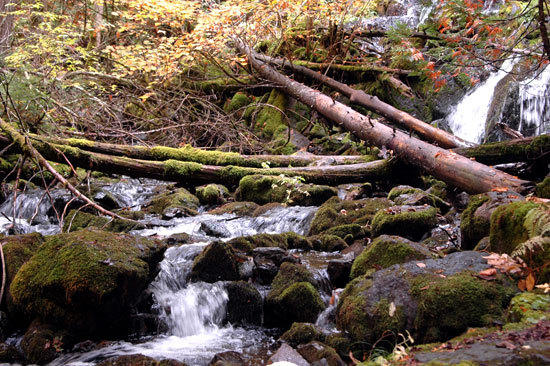
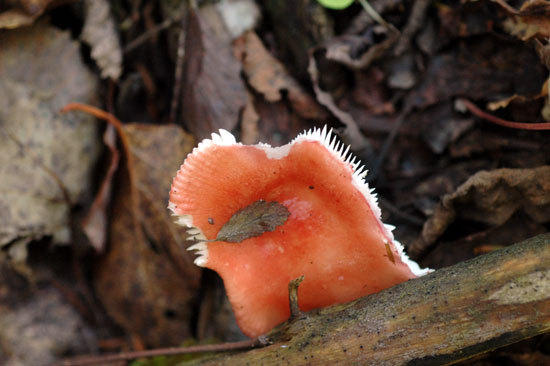
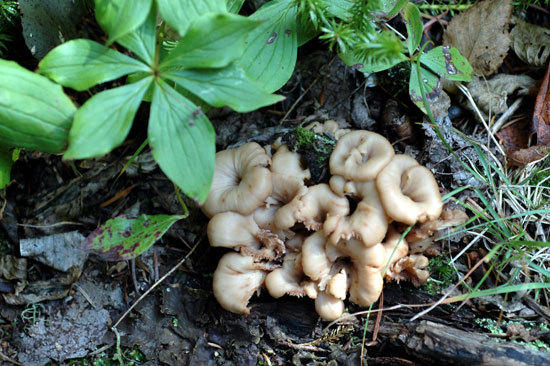
Into the tent at the end of Sunday, our second day, (6.9 mile floating and 220 rods in 6 portages), a light intermittent rain began to fall. That intermittent weather pattern stuck with us through the next several days, finally raining itself out Wednesday night and early Thursday morning. We traveled southeast and then southwest during those days, past gushing waterfalls and through marshes of still black waters. We stepped carefully around mushrooms as they exploded silently upward, from the soft organic mass that quieted our footfalls. We paddled carefully through the lily pads that punctuated the dark water, and then harder as the pads grew thicker and threatened our capture. We saw no one in two days during our stays on Ogishkemuncie and Elton Lakes, and a couple of hours after we left our campsite on the Kawishiwi River, we felt the warm October sun.
And its wind. The twenty-five mile per hour gusts pinned us to the bottom of Alice Lake for over four hours while we hoped for relative calm. Some combination of impending schedule, frustration, and less wind, launched us into the fray across Alice and Thomas Lakes. The water was finally calm as dusk settled Thursday evening and we located a campsite in the northwest end of Thomas. The relief was palatable and carried us through Friday’s travel to Ensign Lake. We began to see people again, but were pleasantly awakened on Saturday morning by the rather mournful sounds of a pair of wolves. That morning we paddled the last of fifty-eight miles and completed our fiftieth portage for a total of nearly seven miles. I hope you enjoy the following pictures.