


What is the empty weight of the SnowPeak Gigapower 7.76 oz (fuel weight) canisters? I have a couple of partial cans here that I need to check.
Topic
Become a member to post in the forums.
What is the empty weight of the SnowPeak Gigapower 7.76 oz (fuel weight) canisters? I have a couple of partial cans here that I need to check.
Their website lists the net weight of the larger canister as 250 g or 8.8 oz.
Not sure if that is accurate.
Yeah, but I need either gross weight or weight of the empty canister.
The smaller Snow Peak canisters are 3.5 oz when empty.
I have an MSR 8 oz. fuel canister which lists the gross weight as 12 oz.
The Snowpeak is likely to be very close to the same.
The middle-sized canisters (~220 g of gas) go from 130 g each (MSR, Kovea) to 160 g each (Coleman, other brands) when empty.
Cheers
My MSR can listed a gross weight as 12 oz, with 8 oz of fuel. The can did not weight 4 oz, it weighed 4.75.
Either way, I probably have two oz in one and four in my remaining cans.
I did some measurements with my Snow Peak stove and canisters a while back to provide information for planning fuel consumption and to determine the potential life of partially used canisters.
I collected and weighed a number of empty Snow Peak canisters using my laboratory beam balance (+/- 0.01g). The weights for the 110g (small) canisters were 3.05g, 3.15g and 3.19g. The weights of the 220g canisters were 5.15g and 5.22g. The small canisters were all purchased at the same time and are probably all from the same lot. The larger canisters were purchased about a year apart and could easily have been from different lots. I didn't check batch numbers on the canisters when I weighed them and discarded them soon after weighing so don't have any information on variation among lots.
I also measured fuel consumption of my Snow Peak Giga Power titanium stove in order to estimate how long a fuel canister would last under field conditions. The study was done in my shop at an air temperature of about 80 degrees F, an altitude of 3200 ft and with no wind.
I brought 16 oz. (2 cups) of 40 degree F (temperature was measured) water to a full rolling boil in a Snow Peak Mini-Solo pot with lid using a 110 g canister. I measured the canister weight before and after each trial. I ran five trials with 40 degree water and three with 80 degree water. There was no wind in the shop so I did not use a wind shield. All trials with 40 degree water used 8.3 grams of fuel as measured on a laboratory beam balance reading directly to the nearest 0.1 gram. For 40 degree water this rounds closely to 0.3 oz of fuel per heating. The trials using 80 degree F water required 6.7 grams of fuel; again, there was no significant variation at the 0.1g level.
1. Grams of fuel required to boil 40 degree F water: 8.3;
number of 16 oz “boils” with 40 degree water with 110 gm canister: 13.
2. Grams of fuel required to boil 80 degree F water: 6.7;
number of 16 oz “boils” with 80 degree water with 110 gm canister: 16.
These trials were done under windless conditions and used a single, new, canister. One can expect a significant increase in fuel use under windy conditions, especially without a wind screen. I use a wind screen and my casual field observations would put fuel consumption under windy conditions somewhere around half-again that without wind. Consumption trials were done at 80 degree F air temperature; lower temperatures should also increase fuel use. Also, bear in mind that all trials in this study were done using the same canister; there may be significant canister to canister variation in fuel consumption.
Thanks for the info – I have been reading the Stove Efficiency series articles extensively lately.
Charles,
Did you want to check your notes on the weight of your canisters. By my calculation you're stating that they're only around 0.1oz each.
(If you're quick you can correct it before Roger gets up!)
Rod
> (If you're quick you can correct it before Roger gets up!)
Too Late!! Too Late!!
Actually, the only problem is the 'g' symbol – the weights are ounces, not grams.
Fuel consumption figures – fairly standard and consistent results (in grams!).
Cheers
Beyond the amusement value of the geekery in play here, I'll add my admittedly geeky method for tracking those pesky partial cartridges: I tape and label my new cartridges as "New". On returning from each trip I used a cartridge stove, I weigh the partial cartridge and label it with the remaining amount. Knowing roughly how much fuel/person/day I typically use, I can use up these partials on subsequent trips my matching them to the length.
Nevertheless they still accumulate, and that's when I look for a stove test to participate in :-)
I also note in passing that canister fuel has nearly tripled in price the last three years or so (in California at least).
Become a member to post in the forums.
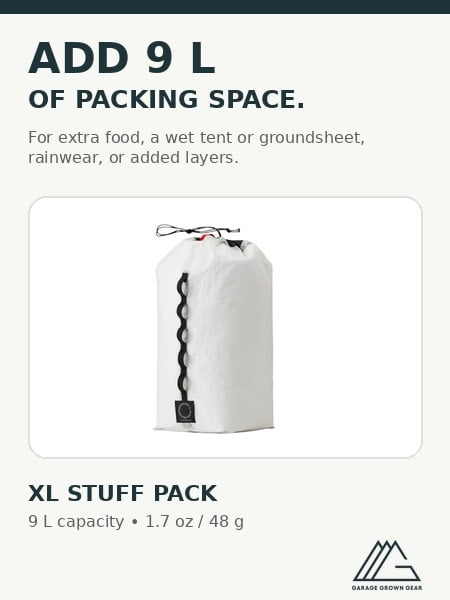 XL Stuff PackLightweight stuff pack designed to secure to the top of your backpack for carrying wet gear, extra food, rainwear, or layers.
 © Beartooth Media Group Inc.
 Loading...