Topic

Tyvek v Silinylon

  • This topic is empty.
Viewing 14 posts - 1 through 14 (of 14 total)
PostedSep 10, 2008 at 3:32 pm

I've been watching the TT Sublite threads with interest and thinking of buying one when I'm ready for a new tent.

I'm not clear on what varying qualities would make people buy a tyvek model or a silinylon model.

Tyvek may handle condensation better, sili is better in heavier rain, tyvek is a bit lighter, sili is more durable?

Also, does anyone know if a tyvek tent would pack down / roll up as small as a sili tent? I imagine tyvek as being bulkier but then again I haven't seen tyvek for 25 years!

Cheers, Ian

PostedSep 10, 2008 at 3:39 pm

The important difference, I'd think, is that silnylon is waterproof, and Tyvek is not. Then again, Black Diamond uses EPIC fabric for their tents and it's not waterproof. Personally, I would never use a tent that's not waterproof.

PostedSep 10, 2008 at 9:35 pm

Art and Ian,

No doubt you have read of my experience with the prototypes and I too would like to hear from some others. My last use of the Sublite was a month ago in the Mount Whitney-Mount Langley area and I suffered heavy [emphasis added] rain and hail for a little under two hours one day.

Another storm last winter in a Tyvek Contrail for approximately 45 minutes and, of course, the hose test has failed to produce any leaks. Here in the Sierras and the southwest, I am confident that Tyvek will keep me dry in an overnight rain. Henry has assured the same for this geographical area.

If the typical weather pattern for your hiking areas is common for rain for several days, e.g. the northwest, Tyvek tents may not be for you, from what others are saying. However I have not read of any actual experience with manufactured Tyvek tents except what I have read here regarding use by a limited number of folks of the Sublite. I am unaware of any other company that has sold a Tyvek tent so I am tad bit dubious of claims re: storm worthiness by those who have never used a Tyvek tent.

I am off tomorrow morning for a quick hike in the Sierras and I wanted to take a small Silnylon shelter for its ultra-light weight. I am taking the Sublite for the sole reason that forecast is for low temps below the dew-point. I expect to have less condensation with the Tyvek.

BPL will be doing a review on the Sublite and Ryan Jordan in a recent thread said he experienced leaks in his use of it but provided no details. I assume they will be included in the review or the reviewer will cover this characteristic.

If you are interested in a Tyvek shelter but are unsure it it meets your hiking profile, give Tarptent a call and speak to Henry. He is very approachable.

PostedSep 10, 2008 at 10:44 pm

Fair enough. It's true that I've never used a Tyvek tent. I'm just familiar with the material having used it as a groundcloth. It's impressive to me to hear that a Tyvek tent held out in an overnight rain. Though, I would be saying the same thing hearing that about an EPIC tent. I just don't see the reason behind using a Tyvek tarptent when fully waterproof alternatives exist that are lighter. For instance, pair a SMD Gatewood Cape with a Serenity net tent, or use a MLD bug bivy with a caternary-cut solo tarp. Add in a Gossamer Gear polycro groundcloth for good measure and it still weighs less..

On the other hand, if it really is as water resistant as you say it is, then I guess I could see how such a light fully enclosed shelter that is resistant to condensation and which is spacious could be an advantage, especially in the winter.

PostedSep 10, 2008 at 11:09 pm

One of the strong points in favour of Tyvek is that it "should" be cooler under the sun than silnylon or ( I think…) most other tent material. So from my point of view it would be ideal in arid or semi-arid areas. Not to be disregarded if you want/need to rest in the afternoon in an insect infested area ( most of Australia for example)

John
I have read comments from a guy that has made his own Tyvek tent and from a couple that use Tyvek tarps, they are all happy with the rain protection they get. Not that I am suggesting it for rain prone areas, but it appears to be more resistant than some think. We will see in a few months when more reports are posted.

Franco

PostedSep 11, 2008 at 12:24 am

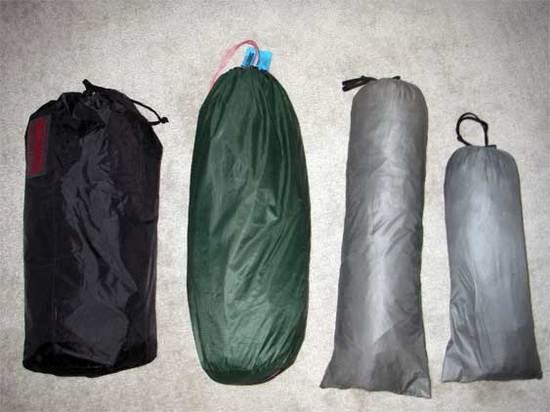
That is what I thought when I first was told about a Tyvek shelter, however the packed size of the Sublite is the same as the Contrail (14"x4") so it may be a bit bulkier but not as much as the material would suggest.
Franco
To illustrate
Bibler 2 person, Akto,Rainbow and ContrailSize matters

PostedSep 15, 2008 at 8:23 am

This past weekend in the Sierras again allowed further testing of this Tyvek prototype of the commercial version now on sale at Tarptent. No rain to further test water repellency but my use in early august has put this issue, as far as I am concerned, to sleep–no problem there.

There was no condensation inside or out on the walls of the tent. I had the tent nailed right down to the ground, mainly due to loose soil, so the ventilation was greatly reduced. The upper ¼ of my sleeping bag was pretty soggy each morning, I assume from my breathing and lack of ventilation. However several times I woke up with my face up against the wall of the tent but experienced no condensation on the side wall where my face and mouth was. Temps were below freezing in the high 20s both nights camping just above 11,000 feet.

This is somewhat difficult to understand as to why the walls of the tent would experience no condensation but the upper part of the sleeping bag did. Maybe someone can explain this to me. My hiking buddy using a double wall REI Quarter-Dome experienced only minimal condensation.

For those who may be considering the purchase of a Tyvek tent, my nearly one year use of these Tyvek prototypes has yet to produce any condensation on the walls of the tent in any of the conditions. All use has been here in California.

PostedSep 16, 2008 at 3:33 am

John, do you know which packs down smaller? I would think that tyvek may be bulier but I'm only presuming. The size of the packed tent is of interest to me if there is a noticeable difference.

For someone like me who would not be using the tent too much and would only be doing fair weather camping (but prepared for the unexpected) would the tyvek be the better choice for some reason?

Ian

J B BPL Member
PostedSep 16, 2008 at 5:38 am

I was looking for Tyvek clothes and came across the Tyvek Classic coverall. Is this what people are using as raingear?

PostedSep 16, 2008 at 8:57 am

Ian,

The two models being tested both have permanent poles at the foot preventing stuffing into a sack. But as far as I can tell there is little difference. Based on my experience with the safety clothing, there might be a slight edge to the Tyvek allowing a modest amount more of compression.

PostedSep 16, 2008 at 3:07 pm

Hi John, I know about the poles so not wanting to stuff it but roll it tight and use velcro or some simple system to keep it compact. If I ever get rich I'll buy both versions!

Ian

Viewing 14 posts - 1 through 14 (of 14 total)
Loading...