Topic

ankle support vs UL

  • This topic is empty.
Viewing 25 posts - 1 through 25 (of 30 total)
PostedAug 23, 2008 at 7:08 am

I have been packing steadily lighter over the years, managing to drop a few pounds each season. My heavy boots and my backpack are some of my last hold outs.

The reason for the boots is simple: I have a life long history of sprained ankles. I even have a history of a broken ankle/fibula/tibia on the rt leg, from an accident 18 years ago, unrelated to my weak ankles.

I have an upcoming Wind Rivers trip 2nd week of Sept. I remember well the misery of a sprained ankle on the 2nd day of a week long trip to the Winds a few years back. Thank goodness for my trekking pole which made a great crutch for several days!

My current heavy boots are Lowa with some kind of hi tech ankle support. They have been absolutely bomb proof as far as protecting my ankles even hopping through bolder fields with a 40 lb pack in the Winds. Even with my custom orthotic inserts which are thickly padded and raise my center of gravity in the boot, increasing risk of sprain. In addition, I was the only one on that trip ( and another) that was not complaining of blisters or other foot discomfort by the end of the trip. The boots are uber comfortable and give me much piece of mind re: my ankles.

They are great for my needs, but my size 13s are so darn heavy. And I do expect to be way under 40 lbs pack weight this next trip.

Any suggestions? There must be other folks with ankle problems who have been successfully using trail shoes, or even sandals? I do realize that getting the pack under 20 lbs will greatly reduce risk, but it is not like I have not sprained an ankle before with out any pack at all. I have. So I remain paranoid about ditching my heavy boots. But is there any light weight alternative that gives great ankle support?
Bill

Bill B BPL Member
PostedAug 23, 2008 at 11:58 am

With a trip that soon, I would not start experimenting with lighter boots given your history of ankle problems. Stick with what works, start rehabbing your ankles when you return and make reducing your footwear weight a longer term goal.

dan mchale BPL Member
PostedAug 23, 2008 at 4:39 pm

Give us a weight number. What does so darn heavy mean? Do they feel heavy when you use them or just when you weigh them? Almost anything in 13 is 'HEAVY'. I have big feet and even running shoes can weigh 2.5 lbs. Beware of peer pressure if you actually have an injury. The main thing is not getting into a situation where you are a burden to your friends.

PostedAug 23, 2008 at 5:26 pm

You need time+mileage and then time+mileage+weight to get your ankles in shape. Don't push your luck, take your time and you'll get the rewards. Too much too soon and it's injury and discomfort time.
Boots really are the root of all evil, and here in the UK we suffer from bad advice, irrelevant rquipment reviews and outdated views on the subject. Ankle support is just ankle restriction, if we needed support we'd have evolved a rigid foot not the marvel of articulated suspension we actually have.
I'd have everybody in trail shoes from day #1!
I was in trail shoes years ago, I believed the hype and moved to heavier and ever more sophisticated boots. My feet suffered, my knees suffered and now I've gone full circle again I'm enjoying my time in the hills more than ever.
My feet are evolving though, they've changed shape as they've gotten stronger, meaning a few changed in make of footwear.

dan mchale BPL Member
PostedAug 23, 2008 at 5:52 pm

There are many tools humans need when they go into alien environments. To say that if we did not evolve these into our being we don't need them is a bit off the mark. We don't need walking poles do we then? We don't need crampons, a motorcyclist does not need a helmut……

Does anyone know if Ryan Jordan came to any conclusions about the footwear he was wearing when he hurt his foot on the Arctic 1000 trip and had to drop out?

PostedAug 23, 2008 at 7:04 pm

Personally, I don't think hiking boots provide much real ankle support. If I want ankle support from boots I go with tight laced 8 or 9 inch leather boots – for trail work or off trail (paid) work.

When I'm hiking with a backpack (on or off trail) I prefer using hiking poles and wearing trail runners. I recently switched to BPL Stix and saved 13 ounces over the previous poles I used. I am much more careful hiking through rock fields wearing trail runners than when I wore full leather hiking boots.

That is just my opinion based on years of working and hiking in the woods.
I have to agree with Henry about not changing now.

Slosteppin

Roger Caffin BPL Member
PostedAug 24, 2008 at 3:16 am

Peter wrote:

> Boots really are the root of all evil, and here in the UK we suffer from bad advice, irrelevant equipment reviews and outdated views on the subject. Ankle support is just ankle restriction, if we needed support we'd have evolved a rigid foot not the marvel of articulated suspension we actually have.

Poetic, and imho utterly right.

> My feet are evolving though, they've changed shape as they've gotten stronger, meaning a few changes in make of footwear.
Yeah, this happens to lots of walkers. Many very experienced walkers here (Oz) travel in the lightest and softest possible shoes. We walk on our FEET, not on boots. The footwear is just there to keep the sticks and stones away!

But you will never convince the vendors of boots: the profit margin on them is far higher than on light joggers.

dan mchale BPL Member
PostedAug 24, 2008 at 11:16 am

People go through light joggers quicker than boots. You can't use the capitalist pig arguement here. I'm sure you will be pushing a sandal brand soon too.

This is the poster's situation:

"The reason for the boots is simple: I have a life long history of sprained ankles. I even have a history of a broken ankle/fibula/tibia on the rt leg, from an accident 18 years ago, unrelated to my weak ankles."

"The boots are uber comfortable and give me much piece of mind re: my ankles."

It does not sound like EVIL is at work here in this situation.. The evil must be somewhere else. It kind of moves around – is hard to pin down.

PostedAug 24, 2008 at 12:02 pm

You could try a high top trail shoe like the Montrail Hardrock Mid or the Inov-8 Rocklite 370. Both shoes have a trail runner chassis w/ extra ankle support while still being very light.

I personally use and love low-top trail runners while hiking and backpacking. For the first couple of trips that I used them, my ankles felt a little sore but since then I have had no problems. I have good ankles although I do wear orthotics. If I were you, I would try a supportive trail runner (such as the Montrail Hardrock) and VERY slowly build up on mileage around town and on day hikes and see how that goes.

PostedAug 24, 2008 at 1:06 pm

My mother has weak and easily-sprained ankles like yours. She prefers to wear light low-top hiking shoes, combined with rigid ankle braces. She's done this for years, and says it provides better support than heavy boots.

PostedAug 25, 2008 at 7:00 pm

So darn heavy means about 5 lbs per pair, counting 3 0z per boot of custom orthotic. But they get the job done like nothing else. And they are really the only boots I have found where I can wear these orthotics (which completely prevent my plantar fascitis) because the orthotics raise the center of gravity making me all the more prone to a sprain. In fact, the time I sprained that ankle in the Winds, I had a new pair of pretty heavy Asolo that looked really stout, but they could not keep my ankle from rolling with that insert in place. But I don't even come close ( so far ) with this Lowa tech Biomex vertec something or other. I think they have quit making them, as I can't find them.

I hiked today with a light pack and a pair of Vasque Sundowners with out the orthotic. These weigh a bit less than the Lowas, either 1/2 or 1 lb per pair less, I'm not sure. But it is obvious that, even with no orthotic, I can roll an ankle if I try to with these ( for testing, obviously I would not do that on purpose on the trail). But even with the insert, I really can't roll the ankle even on purpose with the Lowa.

Anyway, I hear what every one is saying, this is probably not the time to make a change. It would be nice if someone made a lighter boot with the hi tec ankle thingies that this boot has. Oh well, I'll huff and puff getting them up the hill, but at least my feet will be comfortable and I will be highly unlikely to twist an ankle.

PostedAug 25, 2008 at 7:14 pm

I said that that my boots AND backpack were my last holdouts as I reduce weight. Because my pack is so super comfortable with a light load and also handles a very heavy load also. Most comfortable pack I have used, and with lots of room so I don't have to stress about where to put something. But mainly the comfort, even with my lighter loads.

Dan, care to guess what brand my pack is? Hint: It was custom made in the great NW!
Bill

PS: But when you say: "shed the boots – be a man", is that joking, sarcasm or serious?

shed the boots – be a man Posted 08/24/2008 12:16:37 MDT by dan mchale (wildlife)

People go through light joggers quicker than boots. You can't use the capitalist pig arguement here. I'm sure you will be pushing a sandal brand soon too.

This is the poster's situation:

"The reason for the boots is simple: I have a life long history of sprained ankles. I even have a history of a broken ankle/fibula/tibia on the rt leg, from an accident 18 years ago, unrelated to my weak ankles."

"The boots are uber comfortable and give me much piece of mind re: my ankles."

It does not sound like EVIL is at work here in this situation.. The evil must be somewhere else. It kind of moves around – is hard to pin down.

PostedAug 25, 2008 at 7:18 pm

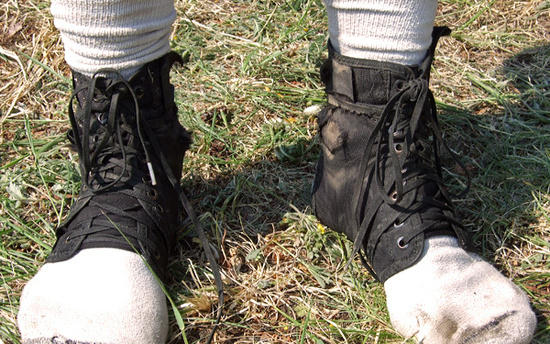
Erin and Will, these braces look like something really worth looking into.
Bill

PostedAug 25, 2008 at 7:23 pm

I must admit that, as a weak ankle guy who was following that trip, I also wondered if Ryan would have been better off with boots like mine at that time. Of course, I'm sure that if the forces were great enough, he could have still been injured with even stout foot wear, and my boots would have slowed him down, but I did wonder. Maybe Ryan will comment.
Bill

Wildlife wrote:"Does anyone know if Ryan Jordan came to any conclusions about the footwear he was wearing when he hurt his foot on the Arctic 1000 trip and had to drop out?"

PostedAug 25, 2008 at 9:18 pm

I'm pretty sure I remember Ryan commenting that the due to the nature of the injury, boots would not have prevented it. If I remember correctly, he fell through a deep patch of ice/snow. I don't think it was a matter of his ankle twisting or torquing, which is all that a boot could have prevented.

dan mchale BPL Member
PostedAug 25, 2008 at 9:47 pm

William, I'll get back in here when I have more time. Sorry if my editing confused things. I like those shoes Will is wearing!

Looking back through my posts here it looks like I inadvertently erased the fact that I trashed my left ankle real good the first day I learned to snowboard in 1990. I backpacked in running shoes for many years before that and never hurt myself (knocked on wood) but could not intelligently continue with that after my crash. I am like Allison and now NEED boots.

Before my running shoe days I went through a few pair of heavy Lowa Civettas and Alspitz boots and learned to appreciate boots in rugged alpine terrain. I even snowboard in tall telemark boots now and like the combination of flexibitlty and support. This nonsense about various people using running shoes in the snow etc. and etc. is silly. It like bragging you can eat a Big Mac in 2 bites. I think someone has climbing Mt Rainier in the nude and barefoot – SO WHAT!
That is intriuging but does that mean it is to be advocated. I think it was the owner of Early Winters that holds that honor, but it may have been that he climbed Rainier barefoot but was clothed otherwise. I think I could do that. I would be too self conscious in the nude with so many people around these days. Back in my firewalking days I used to go out in the cold and experiment with what bare feet could take in subfreezing temps to learn what we are capable of. We are capable of dealing with quite a bit. It comes down mostly to fear but it usually comes down to what is the most practical thing to do for a particular individual at a particlar time. Finding a pair of trail shoes is certainly easier than finding a pair of boots that work. For most people, shoes severly limit where the average person can venture off to…….even though Rainier has been climbing barefoot.

I baulk at the people that seem blind to your situation and go on with their mantra of running shoes runnning shoes running shoes.

PostedAug 26, 2008 at 7:41 am

Thanks. That answers that question. I had not read any discussion about it, other than he had an injury early on.

"Re: Re: sandals Posted 08/25/2008 22:18:08 MDT by Peter Laciano (pedro87)

I'm pretty sure I remember Ryan commenting that the due to the nature of the injury, boots would not have prevented it. If I remember correctly, he fell through a deep patch of ice/snow. I don't think it was a matter of his ankle twisting or torquing, which is all that a boot could have prevented."

Rog Tallbloke BPL Member
PostedAug 26, 2008 at 1:45 pm

> Many very experienced walkers here (Oz) travel in the lightest and softest possible shoes. We walk on our FEET, not on boots. The footwear is just there to keep the sticks and stones away!

Horses for courses. I use lightweight shoes or sandals for trekking in summer and dry climates, boots for mixed backpacking/scrambling. Boots make more sense in the British climate for going high/wet. I like warm dry feet when the weather is cold. I am considering trading the heavy full leather scarpa's for something with a gortex lining though. As for boot height, it's not so much for ankle support as far as I'm concerned, I tend to walk with my boots quite loosely laced unless making a steep descent. It's more about protecting vulnerable bones from getting bruised on rock and preventing the ingress of grit and gravel.

PostedAug 26, 2008 at 2:05 pm

I used to be a hill-runner/racer and have ran regularly over many Scottish mountains in lightweight trail shoes. I never suffered any injuries related to hill-running. I tore a hamstring road running though! I can't think of many injuries to fellow hill-runners either.
I think that lighter footwear actually prevents injuries, as your 'feel' for the ground lets you react quicker to any trips or stumbles before they develop into a fall. The same stumble in heavy boots, usually ends in a fall.
Also, on a long walk, you become more tired in heavy boots, increasing the chances of an accident.

Roger Caffin BPL Member
PostedAug 26, 2008 at 4:57 pm

> lighter footwear actually prevents injuries, as your 'feel' for the ground lets you react quicker to any trips or stumbles before they develop into a fall.
> The same stumble in heavy boots, usually ends in a fall.
> Also, on a long walk, you become more tired in heavy boots, increasing the chances of an accident.

Right on.

Cheers

PostedAug 26, 2008 at 6:19 pm

>> Boots really are the root of all evil, and here in the UK we suffer from bad advice, irrelevant equipment reviews and outdated views on the subject. Ankle support is just ankle restriction, if we needed support we'd have evolved a rigid foot not the marvel of articulated suspension we actually have.

>Poetic, and imho utterly right.

I agree it's more 'horses for courses'. I grew up barefoot and used to hike in mocassins. I had very strong feet and ankles, but one accident 19 years ago left me with a crushed ankle that also suffered a lot of ligament damage. All the barefoot walking in the world will not make this ankel strong again, so all I'm left with, if I wish to continue hiking, is solid ankle support. I have tried all manner of add-on braces such as Will posted, but I haven't found one yet that doesn't cause painful irritation if worn for more than a few hours (heaven forbid weeks at a time). A good pair of sturdy and tightly laced high top boots is the best solution I have found so far. So I say if the boot fits, wear it!

PostedAug 26, 2008 at 6:58 pm

Allison, I can relate to the crushed ankle thing, having suffered a similar injury. My accident was also about 19 years ago.

But I don't know what this "horses for courses" reference means. Use a horse if you need one therefore also use a boot if you need one? That is a new one for me.

"Re: Re: Ankles Posted 08/26/2008 19:19:57 MDT by allison miller (retropump)……………

I agree it's more 'horses for courses'. I grew up barefoot and used to hike in mocassins. I had very strong feet and ankles, but one accident 19 years ago left me with a crushed ankle that also suffered a lot of ligament damage. All the barefoot walking in the world will not make this ankel strong again, so all I'm left with, if I wish to continue hiking, is solid ankle support. I have tried all manner of add-on braces such as Will posted, but I haven't found one yet that doesn't cause painful irritation if worn for more than a few hours (heaven forbid weeks at a time). A good pair of sturdy and tightly laced high top boots is the best solution I have found so far. So I say if the boot fits, wear it!"

PostedAug 26, 2008 at 8:00 pm

Horses for courses…was in reference to " Boots really are the root of all evil, and here in the UK we suffer from bad advice, irrelevant equipment reviews and outdated views on the subject. Ankle support is just ankle restriction, if we needed support we'd have evolved a rigid foot not the marvel of articulated suspension we actually have.

>Poetic, and imho utterly right."

In other words, there ARE undeniably circumstances in which rigid ankle support is indicated, although I agree that most people encourage weak ankles due to their choice of footwear. MOST people, barring injury, or birth defect, do not need rigid ankle support.

Viewing 25 posts - 1 through 25 (of 30 total)
Loading...