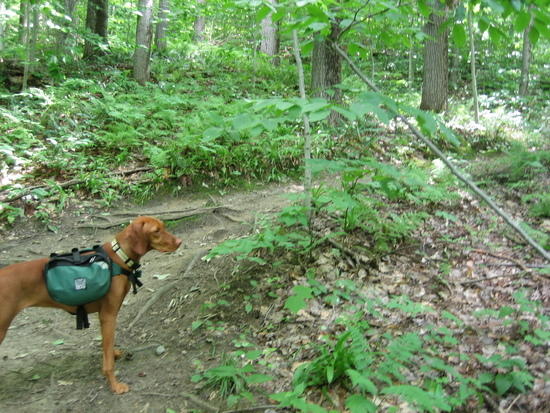
Used to take them along, when they were alive. Still would, “if”…
great companions.
Curt, your Lab looks great. I envy you.
For any “newbies” out there:
vritually w/o exception, you should keep your dog on a lease – either b/c of “lease rules” where you might be hiking, or b/c i’ve seen too many people loose their dogs. there are just so many things that can be a distraction to a dog when you are out in the woods.
generally, even though i had virtually total control over my dogs (i’ve trained many dogs for obedience, protection (only one dog – my Akita), and one for SAR (my Akita wasn’t very good at it other than tracking family members; so, while it accomplished what i was after, you could say i basically failed here), both on-lead and off-lead, voice, hand signals, and whisper commands – w/me out of sight) and could call my dogs off of a squirrel, rabbit, or deer with one “out” or “come” command (in either english or german) – did it many, many times in my backyard, i would follow the rules and keep them on lease.
any good pro. dog trainer will tell you that you can never assume that you have 100% control over your dog. at best for a highly trained dog: 99+% = yes; 100% = no.
after you believe your dog is sufficiently trained for off-lead obedience (in some ways VERY diff. from on-lead obedience), including 1) distraction training using, at least, balls, squirrels, & children running by or playing (“tussling”, for instance) as forms of distraction, 2) bolting off of a “sit-stay” through an open door (even after you walk away and leave the room), 3) begin feeding when their food is placed down in front of them without your ‘ok’ command ==>if you have to repeat a command (i.e., say it more than once – the initial command ONLY, NOT twice, i.e. one repetition) to keep them on a sit-stay or to come to you – YOU DO NOT HAVE SUFFICIENT CONTROL TO BE ASSURED THAT YOU WILL NOT LOOSE YOUR DOG IN THE FOREST (or wherever you hike).
while this level of training is NOT difficult to accomplish (even on your own, but it does take time & regular training sessions – it helps to understand canine/”pack” psychology and some training techniques & philosophy of training), i’m just guessing here, prob. <1% of dogs are this well trained. a well trained dog is a happy dog; the dog knows where it fits in in the "family pack".
my boss, last spring, lost his new dog. i see signs posted at trailheads all of the time = “Lost Dog…”.
make sure your dog has “dog tags” or some form of identifying info.
i’m NOT trying to discourage anyone fr/taking their dog(s) on the trail with them. it’s a wonderful experience for them, you, and your family to have “Man’s Best Friend” along. i just don’t want you to loose your dog.
50% of their body wt. is the generally recommended MAXIMUM that they should be expected to carry. some working dogs actually carry this much (e.g. some Maple Syrup farms in Northern New England use them this way when a wagon or cart can’t get to some of the trees due to terrain issues). of course, why don’t we apply the UL philosophy to them too, and lighten their load a bit!
remember, dogs need to get in shape for a Trek also – esp. since they will be carrying some wt (probably).
i would also suggest that you talk to your Vet for any advice he might have on the subject.
ok. ’nuff said.