Although it’s mid-winter here in the southern hemisphere, I have been doing some ‘backyard’ testing of the SMD cuben Refuge-X. Although preliminary, I thought it worthwhile to share my observations so far.
The first test I attempted was a wind stability test. The forecast was for gale-force gusts, so I rushed home to set the tent up. Unfortunately, by the time I got home, the wind had already picked up, and I struggled to try and pitch the tent by myself. Perhaps not surprising given this fabric was designed as sail-cloth! However I quickly abandoned this test as I was unable (unexperienced perhaps) to get a taught pitch and I feared I would completely lose the tent, so I took it down. This was also a difficult task in gusty winds!
The second test was a condensation test. My hopes (expectations) were that the upward slanting top vents would lead to less internal condensation on a cold night. This night was calm and got down to a low of -3 C (~25 F). I was the sole occupant of the tent. By the middle of the night the tent was completely saturated on the inside, from top to bottom. By morning I experienced the worst case of condensation I have ever seen, even with two people in a tarptent! As is usual after a good frost, the next day was clear and sunny, so I left the tent pitched on the back lawn to dry out. It rapidly dried on the outside, but amazingly it developed even MORE condensation on the inside. It seems that all the exposed mesh around the perimeter of the floor was allowing the damp lawn to evaporate into the tent in the sun’s heat.
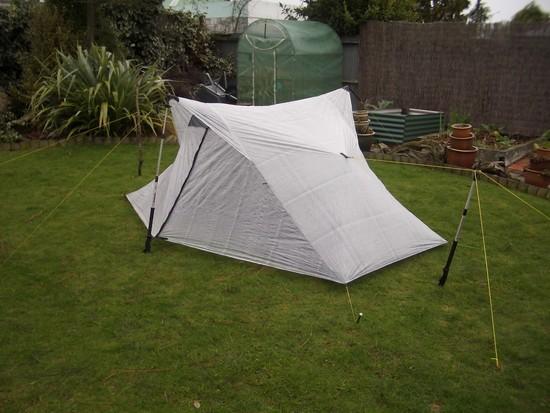
The third test was again precipitated by a really bad weather forecast. Many days of heavy rain and surface flooding followed as promised, and the tent was left standing out in this for 4 days. Here’s a picture of the tent as pitched just before the storm hit:
And here it is after 4 days of heavy rain and wind.
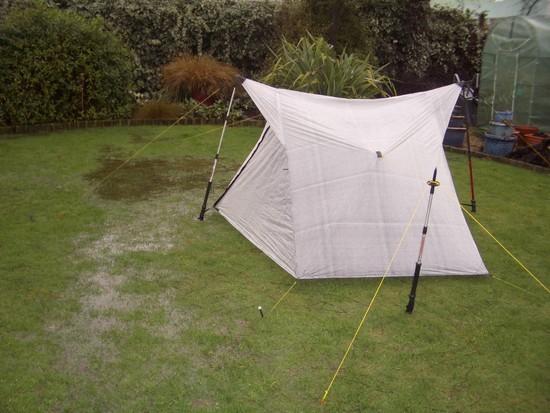
As you can see there is light surface flooding of the lawn. Inside, the tent faired better than I hoped, but there were some obvious weak points in the tents design. There was a little leakage were the side pull-outs attached. This I’m sure I can fix with another coat or two of silicone (the seams all had two coats of thinned sealant applied before these tsts). There was some spray that had come in through the vent on the windward side of the tent, but not too bad. If the winds had been stronger and closer to horizontal I think this would have been a very wet tent. There was no condensation on the inside of the tent, but that’s because there was no one inside generating heat.
A lot of the water that entered the tent was from the mesh floor perimeter. Although the floor itself was not submerged and the mesh was clear of the ground, the mesh wicked water in from where it attaches to the edge. Moving this seam back just a smidgen would have prevented this wicking, though require a bit more seam sealing and may weaken the fabric too much? You can see the tracks of the wicked water here, where they appear as snail-trails on the mesh.

But the worst water entry came from the door side of the tent where there was excess loose mesh hanging down, dipping into the wet grass and wicking. There was at least a cup of water pooled on the silnylon floor from this wicking (picture not shown for brevity).
All in all, the fabric itself was very waterproof, but the design could use some tweaking. I am going to add a bathtub floor, using cuben fiber to clip up over the mesh perimeter when needed. The vents don’t need to be slanted upwards, and bringing them down a notch would make it harder for rain to blow in, and possibly make the tent easier to achieve a taught pitch. I may be doing something wrong, but I was unable to get a truly tight pitch no matter how much fiddling I did. In the end I just pitched it exactly as per Ron’s instructions, even though this didn’t seem optimal. The 'sleeves' for the pole handles did not fit my poles. I'm guessing these sleeve were designed for the smaller foam grips found on UL CF poles. In the end I just wrapped the extra webbing around my pole handles (to stabilise the poles and pull the vestibules out) then ran a stake through the "sleeve".
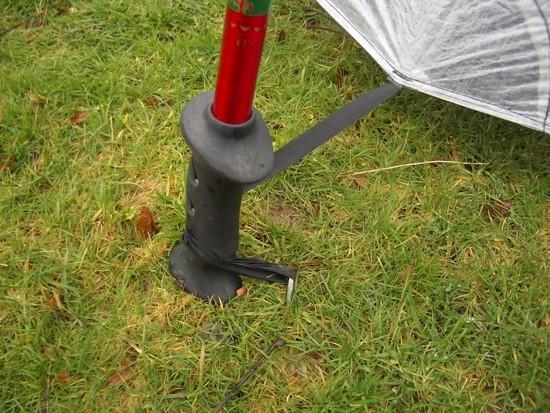
This actually felt more stable as it brought the poles in closer to the tent and more upright. When pitched as directed, the poles have an ungainly lean on them that felt a little unreliable. It was easier to put tension on the tent by bringing the poles in closer.
The last thing that bugged me (actually the first thing I noticed) was that the outer vestibule zipper stops well short of the top of the tent, even though the inner mesh zipper was full height. This makes entry and exit from the tent a limbo act that an extra couple of inches of zipper would solve. I am also contemplating a way to cover the top vents if necessary. The single vestibule is too small to attempt cooking inside, and maybe a small tarp could be pitched over the door for prolonged rainy weather.
Keep in mind that, including 4 guy-lines, this is a true one pound (456 grams on my scale) two person tent. It survived a deluge, though any occupants would have been kept busy mopping up drips and dribbles coming in, and my site selection was intentionally on the boggy side.
I’m still not confident that this tent will handle big winds, but time will tell. For three season one or two person use, I think it will be adequate in most situations, but I hope I don’t have to face a gale in it. Then again, that’s true of any tent!