Topic

Compass Recommendations

  • This topic is empty.
Viewing 25 posts - 1 through 25 (of 43 total)
Dean F. BPL Member
PostedAug 1, 2008 at 12:44 pm

I searched the forums, and found some information, but I don't think it was definitive. I'd like to hear thoughts on compasses.

I have a Suunto MC-2 that I LOVE. For me a large part of my enjoyment of hiking is orienteering off-trail, and the geek in me loves the challenge of using a compass well. I have taught land navigation in the military, and I am truly a compass snob. But the MC-2 weighs 2.7 ounces, and I'm hoping to save an ounce or so…

Here is my dilemma: I insist upon a full-function compass, by which I mean:
1) adjustable declination
2) a real sighting device (not looking down your finger)
3) one-degree accuracy
4) clear baseplate to ease taking map readings

The Suunto MCA and MCB come close, but don't have adjustable declinations, plus the MCB isn't clear. Similarly, there are several Brunton models (the 16-, 26- and 27- series) that lack either a clear baseplate and/or adjustable declination.

The Brunton 8040G seems to meet my criteria, and includes a thermometer, but sighting still seems a little primitive. Claimed 1.6 ounces.

The K&R Dakar seems to meet criteria as well, and is a true lensatic compass, but the company isn't well-known. Claimed 1.8 ounces.

The K&R Alpine Pro is obviously also not from a well-known company, and also seems to have primitive sighting. Claimed 1.7 ounces.

Has anyone used one of these last 3 candidates? Do they work as advertised? Are they rugged? Do any other models pop to mind?

PostedAug 1, 2008 at 1:25 pm

Dean, that K&R Dakar is an interesting compass. I don't personally have any experience with it but the fact that it's sold by Anti-Gravity Gear is a recommendation in itself.

I have an old, very cheap, engineer's sighting compass that is truly easy to use but the quality is trash. I use a Brunton 26DNL-CL model which is of excellent quality but, I miss the sighting functionality of the engineer's compass.

Hopefully, this Dakar is the best of both worlds and the price is more than reasonable if this is a quality instrument.

You are tempting me here!

PostedAug 1, 2008 at 2:02 pm

My Silva Ranger has all of your requirements plus an inclinometer except that it has only 2 degree markings/accuracy. That's PLENTY good accuracy for a hand-held compass.

Eric

PostedAug 1, 2008 at 2:59 pm

I also own the Suunto MC-2 Pro, and I just can't see how you can part with it! Mine weighs in at a hair over 2.4oz without the lanyard attached, and it is certainly one of my favorite sub-3oz items carried.

I ended up with the MC-2 because I couldn't find any lightweight, handheld compasses on the market as robust and versatile as this compass.

I've never heard of K&R, but they could be great — I don't know. I'd think for a compass snob like yourself that a compass without adjustable declination would immediately be eliminated. I'm sure you are well-aware that manual adjustments can be frustrating and inaccurate; and personally I don't think I'd be willing to go too far off-trail without pinpoint declination adjustments.

I would suggest you stick with what you love and keep the extra ounce; but if you end up with something lighter and equally great as the MC-2 be sure to let me know — I'm always looking to shave an ounce these days :)

CW BPL Member
PostedAug 1, 2008 at 3:11 pm

The Alpin Pro is what Ryan J and Ryan C both used on last years WTS 3 course.

Roger Caffin BPL Member
PostedAug 1, 2008 at 4:22 pm

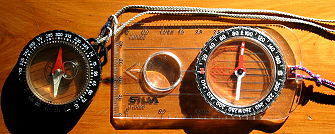
Compasses

My wife uses the Silva compass on the right: it is a basic model.
I use the round black one on the left. Unbranded, made in taiwan or china I think. I bought it in France from a newsagent when I lost my older compass. It is oil-filled: that I regard as an essential. It has a clear back through which I can see the grid lines on the topo map. But all the other fancy details … excess weight imho.

I find that the tiny little key-fob ones don't swing the needle freely enough, other wise I would use one of them.

My 2c.

Joe Kuster BPL Member
PostedAug 1, 2008 at 4:57 pm

Around this time last year my trusty silva developed a crack in it's base plate, enough that I was certain it would fail me in the field. Being a second hand compass I didn't want to mess with having it repaird so I bought the K&R Alpin Pro after seeing it listed here on the trekking school gear lists and doing a bit of research.

Even after a year of use I'm still finding the K&R Alpin Pro impressive. I print my own maps so I just started using magnetic north only and I haven't felt the need to go back to adjustable declination. As long as I remember to only orient off of that, I'm golden. It's interesting to have a compass that you can actually see down to 1/2 degree increments for signing. It really narrows down placement for triangulation.

My only complaint is that the manfication prisim on the hinge just seems to be begging to get broke in my pack. It comes with a belt style carry case but the case is heavier than the compass so I rarely consider taking it.

Bill B BPL Member
PostedAug 1, 2008 at 5:06 pm

I see that a number of you chose the K&R Alpin Pro and I'd like to hear your impressions of it. I bought one recently and returned it. My problem with it is that you cannot see through the compass card. You cannot place the compass on a map and line up N/S lines in the compass capsule with N/S lines on the map.

In order to get really accurate bearings from the map, I would think that you would have to use a separate tool like a protractor. It looks like an excellent compass for just taking sightings though.

Brunton's version of this compass has a see-through card and red N/S orienting lines in the capsule which seems much more practical. Although neither has adjustable declination.

PostedAug 1, 2008 at 6:06 pm

Dean,
No reasonably priced and reasonably sized compass will give 1 degree accuracy with any reliability, in my experience. Where are you hiking that you require such accuracy? In most backpacking areas, 5 degrees (2.5 plus and minus) is perfectly suitable. Many wilderlings get by with nothing more than a simple wrist or watchband unit. I carried a Silva Scout (2.5 inch base plate orienteering compass) for years as a wilderness group leader and practically never needed it. Orienting a map to the terrain was usually adequate. Going cross-country, one hikes the land, not the magnetic bearing. The exception is the big woods where even a minimal compass will do the job. Fanatic orienteers who, afterall, compete to hit unseen targets in unfamiliar terrain, use compasses with about 5 degree accuracy. Base plate orienteering units are light and well-tested. You might want to look at
http://www.wildco.com/vw_prdct_mdl.asp?prdct_mdl_cd=78530
as well as the Suntos and Brutons with adjustable declination.

If you really need a sighting compass, I agree with Greg's recommendation of the Silva Ranger. As he notes, it is good for 2 degrees plus or minus under ideal condition (with practice you can get 2.5 plus or minus with a regular base plate orienteering compass). Like I said, that's about as good as it gets.

PostedAug 1, 2008 at 9:31 pm

For years (1978-1998) I carried the Silva Ranger 15 (Azimuth), at work. It is graduated at 2° and is very easy to read to 1° accuracy. My Ranger finally developed a bubble that was a real problem at high altitude. I switched to the Suunto MC-2 and like it even more, due to the "window" in the bottom of the lid, which allows one to take a sight without looking over the top of the mirror. This allows for greater ease of use. Both compasses are top notch professional grade tools. The only hand held compass I've seen that's more accurate is the military "hand transit" compass, which must weigh a half a pound. It would be nice if the Silva or Suunto had a bullseye level, like the "transit". But with care, and long sighting distances, the Suunto and Silva do very well.

The sighting system I really like is the Brunton 8099, with overlayed circles instead of a compass needle. It's much easier to line up everything while taking a site. I bought one when they first came out but the accuracy of the degree marking is poor enough that it's unusable for serious work.

Dean F. BPL Member
PostedAug 2, 2008 at 1:42 am

Vick,

I readily admit that my compass obsession is irrational. But it is real.

As I mentioned, I learned land navigation in the military and my standard, I guess, is the military lensatic compass. That's a high standard. In addition to simply using it for navigation (which, honestly, I almost never do- I just use terrain association), I also just like to play with it, shoot back-azimuths, etc. Orienteering is a large part of my enjoyment of the outdoors, so this is simply something that I am willing to sacrifice weight to, in the same way that a photographer will be willing to cart along a monstrous SLR.

And, some of us CAN take advantage of 1-degree accuracy if properly motivated, such as by being lost. :-) Perhaps I should add a fifth criteria:

5) a sighting hole, instead of sighting over the lid or mirror, preferably.

Looking at the Silva website, I can't tell if the Ranger series has an adjustable declination. At least one model specifically does NOT. Hmm. I'm sure the Alpin Pro excells at any reasonable navigational accuracy but, as I said, I'm not reasonable. The sighting device looks too primitive for me- there is no mirror to allow sighting the needle and the target simultaneously.

Ultimately, I may end up taking Craig's advice, and just stick with the MC-2. Lord knows, I respect Suunto. Perhaps I could lose the lanyard? But if a rugged and reliable similarly-featured compass is available for a savings of one ounce, I'd probably buy it. Thus my interest in the K&R Dakar. I just don't know if it is well-built.

John G BPL Member
PostedAug 2, 2008 at 9:09 am

I particpate in orienteering meets, and the K&D & other moscow-needle compasses have a reputation for developing bubbles more often than Silva, Brunton, or Suunto. The bubble isn't usually a problem though, unless it gets huge.

For a mirror or lensatic sighting compass, the most important thing to look for is the mirror alignment (glued on flat, line/notch straight up/down) and hinge durability (stability over time). Holding a baseplate compass with your elbows locked to your sides will give most soldiers 2.5 degree accuracy (according to US Army navigation tests). The same study found one degree was possible with the lensatic, but only if it was held level and your eye was exactly behind the centerline (so there is no paralax error). Most soldiers were off 5-7 degrees with a lensatic held up to their eye. Parallax on a mirrored compass should be much worse if you make the exact same size mistakes. Note that a tilted mirror or non-vertical line/notch will cause errors bigger than the number of degrees they are off center & vertical.

ps: You don't need hyper accuracy for anything unless you are making maps or pin-pointing special tree locations as a forester, etc. When navigating, just match up the terrain features you see with the contour lines, landmarks, or even vegatation density shadings on your map. If you forget to keep track of where you are on the map for several hours while walking and need to triangulate – you can still use the terrain features on the map to fine-tune your exact position. Also, your biggest source of inaccuracy is usually drift caused by aiming to one side of a tree, or standing a little to the side or your mid-way aiming point on longer route legs. That's why you should intentionally aim-off to one side, proceed until you hit some easily recognizable terrain feature, and then follow it like a handrail to the spring (etc) you are looking for.

pps: I carry the 2.5×1.5" Silva because it fits in my pocket better than the 3×2" size and that makes it easier to check it more often in heavy forest areas. I do like a baseplate for map work but the longer baseplate doesn't add any advantages in any terrain I've encountered. I do notice that my Silva compass's needle jiggles less when I'm breathing heavy than my Suunto (the Suunto jiggle is about 1.5 degrees and VERY irratating to me). I think it's because the Silva oil is thicker – but my Silva is older so check in the store. Both brands seem to handle tilted bases without hanging up very well – even for my kids.

Rog Tallbloke BPL Member
PostedAug 2, 2008 at 11:14 am

I've got a Suunto lensatic which is unusually graduated. Looking through the top, the full circle is divided into 60. Scales along eaach side of the billet alloy body are in cm and 1:20,000. Looking through the lens, each 1/60th is subdivided by 10. This makes mapreading…. interesting. But it has a cool tritium lamp and is an uncool 3 3/4oz.

Any ideas? Military? Engineers?

Offers? :o)

John G BPL Member
PostedAug 2, 2008 at 12:04 pm

The land military uses grids (not longitude & latitude) to navigate. The grid has 90 degree corners, but latitudes & longitudes curve when shown on a flat map. On topo maps, this is the "GN" (grid north) deviation shown next to the magnetic deviation diagram on the map. The land military also doesn't use the naval military tradition of stating locations as lat/long degrees, minutes & seconds. The land military subdivides the grid into "mils" (or maybe it was radians ? – it's been a while…).

If you're really, really, really motivated to know the full story, see the US Army nav manual at: http:/www.globalsecurity.org/military/library/policy/army/fm/3-25-26/index.html

ps: The army study I found last year when teaching nav to a bunch of boyscouts advised using the waist-braced "center-hold" method I mentioned above for navigating, and only using the mirror/lensatically aimed "sighting" method for aiming artillary fire, etc.

Dean F. BPL Member
PostedAug 2, 2008 at 1:23 pm

If you try really hard, John, you can find rare UTM grids that are triangles. This is because the larger grid zones are arbitrary, and they try to fit grids of parallel lines onto the surface of a sphere. But many grid squares along the borders where grid zones meet aren't perfectly "square." Most are, but some aren't, and thus don't have 90-degree angles.

Since you posted it, see figure 4-11 in FM 3-25-26 for some insight on the non-square grid squares (though the figure is actually showing 100,000 meter squares).

This is all moot, though. I'm looking for help with compasses, not cartography… :-)

The bubble problem that you had with the K&R is just the dope I was looking for. Thanks.

Alvie Morton BPL Member
PostedAug 2, 2008 at 4:31 pm

I have a 15 year old ranger. It developed a bubble two years ago, but that has not affected the accuracy – I do not encounter higher elevations anymore. The Ranger is a sturdy peice of gear, and easy to use. My next one will be the MC2. I like the design and have heard from a friend that it is a little easier to use. I understand your facination with compasses- they are cool. You should get one of each and start a colllection. Combine your military training with a good collection and you might become the go-to guy for compass advice.

Joe Kuster BPL Member
PostedAug 2, 2008 at 6:37 pm

I routinley take my K&R up to 14,000 feet and down to sea level occasionally (I live at 5,000 ft). Major elevation changes are just a fact of life here. I've also been using it in sub zero (F) temps. So far, no bubbles yet in any of my compasses but I'm pretty sure most major companies will replace any quality compass that developes a bubble.

Dean F. BPL Member
PostedAug 3, 2008 at 3:21 am

Alvie,

I can't recommend the MC-2 enough! Really. It is an excellent compass that does everything I want of it. It only has 2-degree gradations, but for all practical purposes it can be read to 1-degree. I suppose that for the functionality 2.7 ounces really isn't a lot, but I'm trying to shave every ounce that I can at this point while still supporting my little peculiarities.

The Ranger 515 series does have an adjustable declination, with 2-degree gradations. However, at 2.4 oz they aren't a big improvement over my Suunto. So I don't think they are a good contender for what i want.

It might all depend upon $/oz or $/function. I may keep the MC-2. But the K&R Dakar is looking VERY tempting, especially with it's 1-degree gradations and lensatic functionality. If only it had a mirror it would be perfect!

Bill B BPL Member
PostedAug 3, 2008 at 6:52 am

Dean,
I hate to sound like a broken record on this issue, but the Dakar (like the Alpin Pro) does not have lines on the bottom of the capsule to line up with meridians on the map. You have to eyeball north on the compass with the meridians on the map in order to get a bearing from the map. To me, that negates the 1 deg. accuracy that you supposedly get from this compass. The only way around this problem is to use a protractor to get bearings from the map.

PostedAug 3, 2008 at 7:38 am

I'm a compass newbie but how does the 54LU compare to the rest of the compasses being compared here ?
I'm also in the market for a compass.

Dean F. BPL Member
PostedAug 3, 2008 at 2:32 pm

Bill,

Sorry. I thought you were only talking about the Alpin Pro. (I'm not ignoring you- honest.)

When you say "capsule" do you mean the fluid-filled disk in which the needle or card sits? Because I see meridian lines on the bottom of the compass, just none under the needle/card "capsule". To get the 1-degree gradations a solid card is needed (I assume) and it is hard to see lines through a solid card.

But, that is why I carry my 0.12 ounce (IIRC) protractor. I'm sort of a slave to my training, that way. A decently sized protractor will give better measurements than some tiny compass bezel, as far as getting azimuths off of a map.

But I think what YOU want is a K&R Horizon, which is a Alpin Pro with a needle instead of a card, and lines under the capsule.

Bill B BPL Member
PostedAug 3, 2008 at 6:24 pm

Dean,
I mean the fluid filled capsule. On Silva/Brunton and Suunto compasses, there are red lines on the bottom of the capsule that you line up with the meridian lines on your map to get a bearing. The Alpin Pro has a solid card so that you cannot see under the card to line up the compass capsule with the meridian lines. The Brunton 54LU uses a transparent card which eliminates this problem. It appears from photos of the Dakar, that there are no lines on the bottom of the capsule at all. So I would assume that when you place the compass on the map and rotate the capsule to line up with the map’s meridian lines, you do not have an accurate way of lining up north/south on the capsule with N/S on the map. That would inevitably introduce some error, so what would be the point of having a compass that takes bearings to 1deg. accuracy if you lose the accuracy when transferring a bearing to a map. Your carrying a protractor would eliminate this problem.

PostedAug 3, 2008 at 8:01 pm

My compass is lighter: a magnetized needle, which I put on a tiny stick or leaf and float in a cup of water.

Dean F. BPL Member
PostedAug 4, 2008 at 12:55 am

Bill,

Yes, having "grown up" in the military always using protractors I have never considered the lines under the capsule very useful. They are kind of short to try and get perfectly parallel with a fix you've drawn on the map. I will grant that moving the protractor off of a grid-line to center it on your fix isn't exactly precision, either. Still, how do you use the capsule lines to chart a back azimuth? Slip a piece of paper (map edge?) under the compass? I guess I'm still carrying my protractor.

Still, the K&R Horizon seems to fix your problem, if you otherwise liked the Alpin Pro.

Robert,

Amateur. I navigate by the sun, using my watch, which I am already carrying, so net weight is zero. Stop lugging that excess needle-weight around!

Viewing 25 posts - 1 through 25 (of 43 total)
Loading...