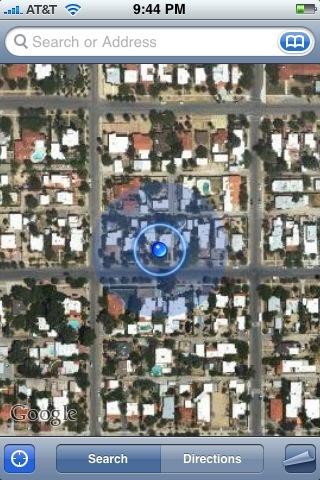
I was one of the fortunate few who obtained an iPhone Friday morning, and I had a chance to test out the GPS over the weekend.
One of the big unanswered questions of the past few months is whether it would have a true GPS or A-GPS. The terminology is confusing; for some phones, A-GPS means it is a very limited GPS that requires cell phones to find a lock. Other A-GPSs are dedicated GPSs which use cell towers to enhance the signal. Obviously for backpacking, a phone must be able to obtain GPS and maps with no cellular connection. It also needs to be very accurate; some of the street mapping GPSs can get away with a less sensitive GPS because they can 'lock' the GPS marker to the road, making an otherwise erratic signal look straight and on target.
I am happy to report that the iPhone indeed has a dedicated GPS, and it appears to be a good one. I was able to test this on a trip through the northern Rockies, where I was in the mountains, just off the freeway, in a creek with steep mountains nearby. I did have clear view of the sky, but only above me. I had no cellular signal. When I open Google maps, all I have to do is tap the button in the lower left corner, and it turns the GPS on. No messing with com ports or bluetooth settings. It was able to lock in about 45 seconds–typical of a good GPS. Fortunately Google had cached its maps, so I was still able to use the maps. By walking around a bit, I was able to move the GPS marker around 'off the grid' — that is, the marker did not try to lock to a road, but instead followed me around on the white space between roads.
Here's where it gets really cool: sometimes there is a light blue circle around the GPS marker that varies in size. This indicates how accurate the signal is, so that as the signal gets weaker, the circle gets larger. This gives you an estimate of signal accuracy, and visually lets you know that you are probably in the center–but could be anywhere within–the circle.
I am also happy to report that, with all radios turned off except GPS (cellular, wi-fi, bluetooth), and the brightness turned down, the battery lasts a VERY long time. I can't give estimates, but I think it's the longest-lived PDA-phone battery I've used (I've owned a Pocket PC, a Smartphone, and a Palm). This is combined with the fact that when I close Google maps, the GPS is turned off. When I open Google maps, I simply push a button to turn it back on. This is far more power efficient than turning on and off a bluetooth/GPS switch that is usually buried illogically in some sub-menu.
As a side note, for those concerned about a field-replaceable battery, check out the Mophie juice pack. This is an external battery sleeve/protective case that triples battery life, and they've got a 3G version coming soon:
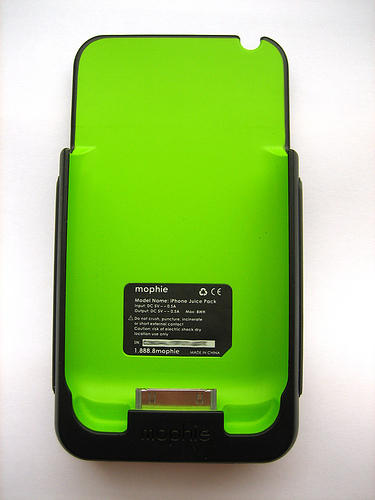
Based on my experience with my wife's 1st gen iPhone (I can usually browse the internet for 4-5 hours on hers and still have a half-full battery) I feel very good that this would get you through to your next resupply point, assuming you do not leave the GPS on for tracking.
Anyway, back to the pre-review: The phone itself feels twice as thin as the original. Even though it is basically the same thickness in the middle, the tapered edges make a huge differences in feel. And the plastic back is a very hard, strong plastic. The screen is of course optical quality glass, not a fragile touch screen of other PDAs. The Garmin models will always be more waterproof/ruggedized, but the iPhone is one of the strongest-feeling phones I've ever handled. Add a protective case an an Aloksack and you can handle serious weather. The only downside might be that you have to take gloves off to use the touch screen; I have not tested this.
Of course the one big glaring problem is that there are no topographic maps for the iPhone yet! =). That's why this is a mini-review. However, two big navigation companies (Tom Tom and TeleNav) have plans to create street maps, so it is only a matter of time before we see topo software.
And this is, to me, the most significant reason to use a PDA Phone instead of a Garmin/Magellan: For years PDA phones have had access to full, detailed 1:24,000 (7.5 minute) topo map images. These are scanned images of the actual USGS maps. So what you see on your PDA is what you see on your paper map. Pocket PCs, Smartphones, and Palm devices have all had software to do this for years, whereas the Garmin and Mgellan units still only use digitized versions (raster maps) at 1:100,000 zoom. For some, 1:100,000 may be sufficient, but I can think of 4 times where having a 1:24,000 map on my GPS got me back on track faster than the 1:100,000 zoom level would have. This was what pushed me over to PDA GPSs 4 years ago, and why I used to tolerate all the problems associated with PDA GPSs vs dedicated devices. It lets me use the device as my main navigator with the paper maps as a backup, rather than the other way around. but far more important to me is that I DON'T HAVE TO PRE-INPUT MY WAYPOINTS. If I decide to change my route plans, I don't have to worry that my GPS is no longer tracking to the next waypoint. I just change plans and go. Sure, it takes a lot of device memory to do this, but with a 16GB model, you could load entire mountain ranges of high-quality scanned maps into an iPhone.
There are already some very useful apps available to download. There is a star chart that combines the GPS with the accelerometer so that you simply point the device towards the sky and the program displays what you are looking at. There is also a sunrise/sunset app as well as a great weather app with live animated radar maps coming soon (though you need an internet connection for that). And there is a really cool app that lets you find other iPhone users on Google maps, much like a homing device. Unfortunately the app is buggy and you need an internet connection, but this has real potential in some outdoor situations. Downloading these apps directly onto my phone has exceeded my expectations for simplicity.
Anyway, I've had high hopes for this device for some time, and have been anxious about the lack of info about the GPS. I would have been really disappointed if the GPS was crippled. The iPhone 3G has exceeded my expectations. Once a topo map software program comes out, I will do a full review in the reviews section. But at least on the hardware side of things, I see no reason to use a dedicated GPS device anymore.