I just built a new 3 piece wood stove (see photos). The stove is designed for high efficiency, wind performance, leave no trace and safety. The firebox is fully enclosed and baffled so sparks can't escape. The stove won't scorch whatever it sits on and retains ash in a removable ash bin in accordance with the leave no trace ethic.
Materials: Firebox, ash drop and base are 0.01" stainless steel. Chimney is tinned steel. Outer wall and top of firebox, 0.01" aluminum. Pot is two liter black anodized aluminum.
It weights about 14 oz. It was sized for a big pot for cooking for two or three people. A one man stove would weigh much less.
The firebox is insulated to enhance efficiency and to reduce outside surface temperatures. It's still too hot to hold by the sides, but it won't brand you or set your clothes on fire. The pot sits in the chimney to maximize heat extraction from escaping gases. Fuel is added by lifting the pot every few minutes.
It boils 0.47 liters (2 cups) of 17C water using about 73 grams of wood. Based on the average energy content of wood by weight (which is fairly uniform across species, that works out to about 69% efficiency.
The average heat transfer to the pot is about 590 Watts, which is quite a bit higher than an alcohol stove and a fair amount less than a canister stove.
I believe it is important to characterize wood stoves by their wattage and specific fuel consumption because it allows quantitative comparisons between stoves. I'm a lot more concerned with speed and efficiency than whether a stove is a gasifier or if it keeps my pot clean. Note that the pot stores inside the chimney, so soot on the pot isn't much of an issue for me.
The stove continues to cook in wind and rain although there is a noticeable drop in cooking speed with cold air blowing on it so it's best to seek a partially sheltered location in windy conditions.
I tested the stove with wet wood. I placed a quarter of a paper towel in the fire box and added four drops of kerosene to the towel. I lit it, and then I shook the water off a handful of twigs I'd hosed down, dropped them on top and set the pot over the fire. I didn't measure any drop in efficiency, but that just means I need more sensitive instrumentation. There was no problem keeping the fire going with wet wood.
The stove smokes whenever fresh wood is added. This turns out to be a convenient feature. Since the flame is out of sight, the absence of smoke is what tells me it's time to drop more wood in the fire box. A couple of ounces of wood need to be added about every two or three minutes.
One neat thing I hadn't expected is the simmer capability. After cooking on high for eight or so minutes, the charcoal accumulation is sufficient to simmer for another ten minutes.
Features I think are most important are safety; No open flame, or scorched earth; and leave no trace; once cooled,
retained ashes can be carried out or burried.
The feature I like best? I cook as long and as much as I want. More coffee? No problem. Another pot-baked muffin? Coming right up. I've yet to have to walk more than ten feet from the stove to find all the fuel I need.
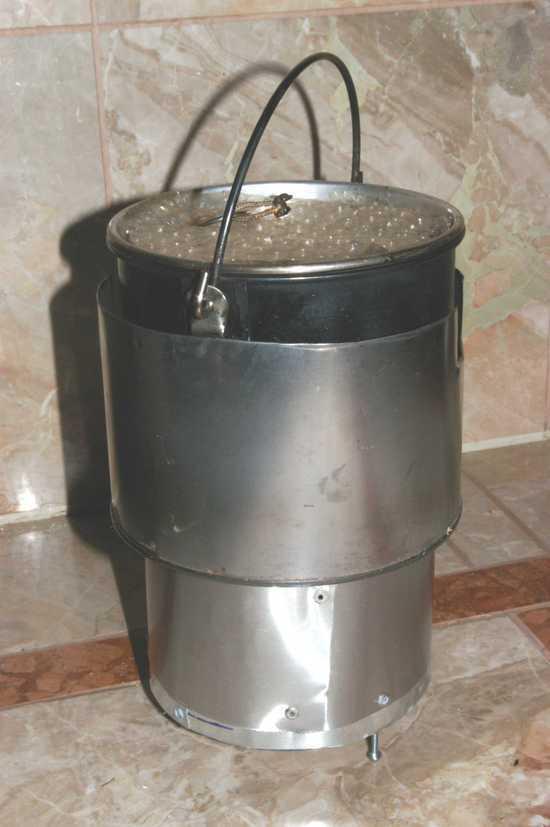
ready to cook

Bottom view of firebox. Air enters around ash pan.

Ash pan, firebox (bottom view again), and chimney.

Stove components and pot nested for transport.