


Richard or anyone else that's tried a similar thing, how much less warm would I be sleeping in a pair of Cocoon pants vs using an Arc AT quilt. I will have a Cocoon hoody on top either way.
Topic
Become a member to post in the forums.
Richard or anyone else that's tried a similar thing, how much less warm would I be sleeping in a pair of Cocoon pants vs using an Arc AT quilt. I will have a Cocoon hoody on top either way.
Christopher and Robert,
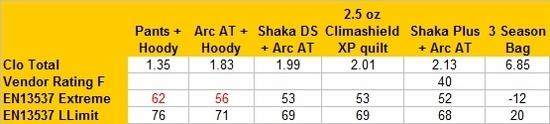
This post reflects the update prompted by Robert's post. I rechecked my calculations and discovered that I forgot to add the 6% foot coverage for the Arc that is not provided by the Cocoon pants.
There is a ~6F difference in the temperature ratings for the two combinations you are considering.
Richard,
Thanks so much for the response. I don't think I was totally clear.
How warm would I be in some method of measuring sleeping in
Bivy sack, Cocoon hoody, cocoon pants
vs
Bivy sack, cocoon hoody, arc AT
This will be a nonstandard application meaning I'm not trying to sleep comfortably for 8 hour at a time or anything.
EDIT: Considering I own both items I am just going to try it as well, but I was curious if the pants will be much worse than the quilt inside the bivy. For this application they certainly save significant weight and make getting packed up much easier.
Thanks,
Chris
Will you need more sleeping footwear with the pants than you would with the Arc AT?
Robert,
Thank you. Your post diplomatically pointed out to me that I forgot to add the 6% body surface increase for the ARC AT foot coverage. I will update my table and repost it to reflect that fact.
Yes, you will get localized cooling of your feet (Cocoon pants only) and hands because they have less insulation. You may find the localized coolness uncomfortable, but it will not result in your core temperature lowering to a hypothermic level. This assumes you follow the EN Extreme temperature guidelines for your .6 clo base layer, have an adequate pad, and use the clothing combo for naps less than 6 hours each. Putting your hands in your arm pits and your feet in your pack are examples of no-weight ways to decrease localized cooling.
Would the following be worth weighing as an option, to pair with the pants? (I have no financial interest in Nunatak.)
“We wanted a warm, ultralight way to get out of sweaty hiking boots when the evening chill descends on camp, but something comfortable enough to wear in the sleeping bag during cold spells. The Teanaway weigh less than a quarter pound in size medium, of which nearly 2 ounces is down fill. Best of all, these slippers pack so small that they seem to disappear into one's pack.”
Robert,
4 oz booties aren't the most weight efficient incremental insulation option to guard against hypothermia for Christopher's scenario. The head is the most critical body area, followed by the trunk. The addition of a balaclava for the head or trunk insulation like, the Mont-bell UL Down inner series vest, at 5 oz, are better choices.
My gut feeling is that you are absolutely correct. My analytical brain (such as it is) says that the logical reason is that booties use a lot of fabric, plus a foot bed, to cover skin area that is more efficiently covered with a simple bag shape. Another reason is that more heat is lost through the head. Applying the same reasoning to pants, I would guess that they use a lot of fabric to cover skin area that is more efficiently covered with the simple bag shape of the Arc AT. CONCLUSION: the most efficient combination is the Arc AT, NOT the pants, plus the hooded jacket? Besides, the pants option forces one to suffer cold feet?
Yup
Richard,
Love the info, just what I wanted and also filled in the feet/hands stuff I didn't think about. I'm interested in this enough to give it a good demo and see if it works for me.
Without a doubt, I would "normally" take the quilt over the pants. However in this case I have warmer gloves and a way to keep my feet warm due to clothing I must carry for riding temperature variations. Plus the pants and jacket being synthetic makes them useable not only for sleeping but also moving if necessary and they will keep me warm while getting ready for bed and packing up camp afterwards. And getting puffy items wet is a distinct possibility for this outing so that would be another strike against the down arc AT.
I will be able to sleep in hotels now and then to get more rest and dry out gear. More testing required but the idea has promise!
Richard … wonderful chart. If I read this correctly, the Arc AT and Shaka plus have a similar clo rating to 2.5 oz per square yard XP?
The lighter option then would be a MLD 12 oz XP quilt, but are you saying that a clo of 2.13 is only good to 52 degrees?
I'm afraid I don't understand the EN13537 standard, and you elaborate?
Mark,
A 2.5 oz XP quilt, without a hood, provides 2.01 clo and with a comparable hood, 2.16 clo. So yes, the clothing combination you mentioned and the 2.5 oz quilt are comparable. Typically with a quilt, the UL backpacker would wear his clothing insulation layer to augment the quilt insulation and so the total would be higher with the quilt. I updated the chart to show this additional option.
The higher EN13537 LLimit rating means that the average male is thermo neutral. This means that you could sleep more than 8 hours and your body would not lower or raise its core temp.
2.13 clo is only good to 52F degrees for an EN13537 TExtreme rating. This rating is for the average woman; so it provides a small safety tolerance for the average male. The TExtreme rating means that you loose more heat than you generate and the difference will result in shivering after 6 hours which will prevent you from additional sleep. Christopher defined a scenario in which TExtreme best models. The average male’s body has 2,034C of heat stored in it. A loss of ~80C over 6 hours determines the TExtreme rating.
An excellent summary of EN13357 can be found at Sleep Well
Richard … thanks for the wealth of info.
I'll pour through this this weekend, but from a glancing read, if I understand this right, the 52 degree temperature would assume that you have a minimum of underwear on …. virtually bare skin under the insulation.
Given that CLO is defined as the clothing for one to be comfortable at 21 degrees C, or the weight of one standard business suit, then what CLO value would, say, hiking pants, wool socks, and a tee shirt provide? 0.5 CLO?
How about a silk weight base layer?
…. so, if we assume that one were to wear clothing to bed, then we can see an additive effect to the insulation of between 0.5 and 1.0?
This would take XP 2.5 from 2 to 2.5? Is that how they get the 40 degree rating?
This would make sense to me …. I've worn long johns to bed with a 5.0 weight XP quilt and been comfy at 25 degrees, but the same quilt with shorts on and I froze.
Become a member to post in the forums.
 Creamy Dijon ChickenCook-in-the-bag chicken, tarragon, and rice backcountry meal with 2 servings. Net weight 5.7oz | 162g
 © Beartooth Media Group Inc.
 Loading...