Topic

montbell jackets — rough idea of comparitive warmth?

  • This topic is empty.
Viewing 16 posts - 1 through 16 (of 16 total)
PostedMay 19, 2008 at 7:13 pm

Montbell has the following jackets in their lineup (unless I've missed some!):

Alpine Down Jacket 15.7 oz
Alpine Light Down Jacket 11.3 oz
UL Thermawrap Jacket 8.8 oz
UL Down Inner Jacket 6.9 oz

I was wondering whether anyone could have a stab at suggesting the lowest temperature you would consider "warm" wearing each of these jackets (plus a baselayer).

To stay warm at around 20F (not moving) do you need to go for the Alpine Down Jacket, or can you get away with the Light? I'm also assuming that the ultralight jackets (down inner and thermawrap) are roughly as warm as a heavy fleece… is that correct?

Thanks in advance…. =-)

PostedMay 19, 2008 at 8:46 pm

It's like asking a group of mathematicians what something divided by zero is. Pretty much impossible to nail each jacket to a specific temperature rating that would hold for all people in all situations. Also, not all fleeces are equal so that's not a useful benchmark.

For myself, I would go with the Alpine for 20F not moving, but it wouldn't be enough by itself for sleeping, just sitting, and preferably when I had plenty of food in my stomach. On cold mornings, before I get breakfast, even something like the Alpine jacket isn't enough for me.

Stumphges BPL Member
PostedMay 19, 2008 at 8:58 pm

For being relatively idle at 20 deg. F you'll need the Alpine – assuming you'll be wearing just that over your base – Period.

And you'll probably need more than that – on your legs and head.

Take a look at Richard Nisley's excellent thread on clothing combos and temp/activity levels:

http://www.backpackinglight.com/cgi-bin/backpackinglight/xdpy/forum_thread/9378/index.html

You'll notice that Richard's representative clothing selections include Patagonia's Micro Puff pieces. According to BPL's excellent State of the Market reports on lightweight synthetic-fill jackets these pieces have .6" of loft. The Montbell Thermawrap jacket has .3" of loft. I believe there are reviews on this site for the other MontBell pieces you asked about. I think the Alpine light down jacket has about 1-1.3" of loft – but not sure – that's just an estimation.

With this type of info you should be able to extrapolate and make use of the graph.

Hopefully, Richard Nisley will reply – he gives very solid answers to these types of questions, and/or folks with more experience with these garments.

EndoftheTrail BPL Member
PostedMay 19, 2008 at 10:44 pm

I have both the UL down and the Thermawrap jacket. MontBell markets both as comparable in warmth. However, I find the UL down a bit warmer.

For me, not moving, the UL down is good to 40F; the Thermwawrap, around 42-43F.

Richard Nisley BPL Member
PostedMay 19, 2008 at 11:44 pm

Ashley,

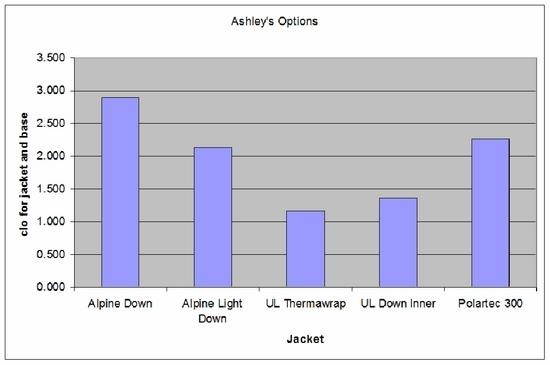
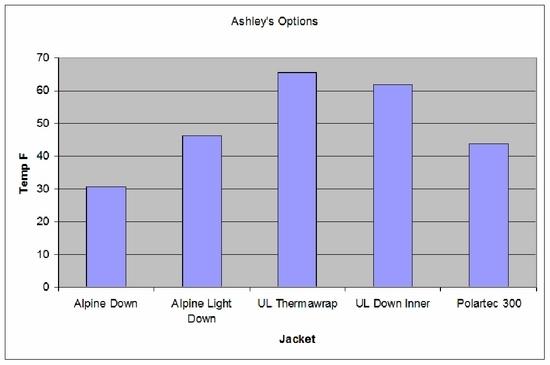
You asked, "To stay warm at around 20F (not moving) do you need to go for the Alpine Down Jacket, or can you get away with the Light?" The answer, for the avg. 30 yr old male, is they would need the Alpine Down jacket and a hat.

You also said, "I'm also assuming that the ultralight jackets (down inner and thermawrap) are roughly as warm as a heavy fleece… is that correct?" The answer is no. Polartec 300 is warmer than these two options. It is roughly as warm as the Alpine Light Down Jacket.

I used thermal physics to calculate the thermo neutral temperature for an average 30 yr old male wearing, sitting and reading, sheltered from the wind, no hat or scarf, and .6 clo of base layer clothing wearing each of the jackets you specified. Thermo neutral means that he could perform the sitting and reading function indefinitely without decreasing his core temperature. The relative warmth of the jackets is determined by thermal physics and is the same for everyone… that is the most important thing to focus on.

The thermo neutral temperature rating is variable. It is determined primarily by the amount of hours you need to maintain thermo neutrality, your gender, age, weight, and height. Regarding the number of hours you need to stay warm, the EN13537 lower limit (thermo neutral) and extreme ratings (heat loss not critical for 6 hours) is significant. There is an even bigger difference if you only have to stay warm for an hour or so in the morning before hiking or in the evening before retiring.

Ben's relative warmth assessment between his UL Thermawrap and UL Down Inner is in sync with my thermal physics calculations. Ben's 40F comfort level for the UL Down Inner is a good example of the comfort temperature variability range between an avg. 30 year old male who needs thermo neutral comfort versus a young athletic male who only needs to not feel cold an hour or so while inactive (~1.6 MET). I also think that Art and Joshua's comments are also spot on.

Jacket clo

Ashley

PostedMay 20, 2008 at 4:49 am

Richard,

I want to start with saying that it's always a pleasure to read your answers. I am very grateful for the amount of time and great knowledge you put into your posts. You are real asset to this board and your fellow hikers. Thank you very much Richard!

In the below example you specify "no hat or scarf", so my question is how important is the head and neck gear for increasing the warmth?

"I used thermal physics to calculate the thermo neutral temperature for an average 30 yr old male wearing, sitting and reading, sheltered from the wind, no hat or scarf, and .6 clo of base layer clothing wearing each of the jackets you specified."

For example the U.L.Down Inner Jacket M's weight (size med) is 6.9 oz and the U.L.Down Inner Parka M's weight (size med) is 7.4 oz. The weight difference is only 0.5 oz, how much difference does it make to have the hood?

There are also other "light" head and neck gear available, for example the Cocoon PRO 90 Balaclava (Insulation: 90g/sq. m Polarguard Delta) for 2.0 oz and Nunatak down balaclava (Pertex Quantum and 2+ ounces of 800+ fill power down) for 3.0 oz.

So we have 3 options for the head and neck that compared to the weight of the "jacket" are very light, how much difference does they make?

An other question is what would happen if you increased the length of those jackets and installed an option so you could seal of between the legs (it's like getting a pair of insulated short pants or "diapers"). I have a jacket like this and when I close it between the legs in the winter it feels much warmer, but on a scientific level how much does it help?

PostedMay 20, 2008 at 7:26 am

Ashley, Rich's analysis is spot on, and archival information. Personal experience confirms his analysis- I was shivering at 'thermo neutral' at 20F in the MB Light Alpine jacket last winter; standing around waiting for my turn on a climb. (wool 1 base layer and a DIAD jacket) My shell pants had been 'borrowed', and my poly glove liners had melted on the lodge stove the night before. Since a true UL'er carries enough clothing for the worst expected conditions, and no spares, I was a little short on clo's.

But anyway, at that temp you need the Alpine jacket, and a quality base and shell layer.
MB quality is top notch; I think you will be happy with the Alpine.

Guys, Polartec 300 jackets are $45 at Cabella's now if you want the warmth of the light alpine at a lower cost.

Richard Nisley BPL Member
PostedMay 20, 2008 at 11:53 pm

Ulrika,

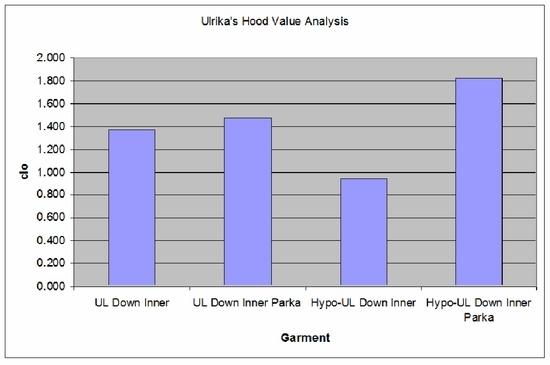
If you are not hypothermic and wear a balaclava of comparable material and thickness to the jacket, you would increase the covered body surface area (BSA) by ~7% as well as the clo. If you are not hypothermic and added a hat with flaps, you would increase the covered BSA by ~4% as well as the clo. If you increased the length of a jacket to seal between the legs you would increase the covered BSA by ~4.5% as well as the clo. When you are shivering, the heat loss through your head increases from 7% to 55% but it doesn't change for the area covered by the diaper shaped insulation.

The primary defense against the cold and hypothermia is vasoconstriction of the peripheral circulation from the normal ~ 4 quarts/min. to .02 quarts/min (99% reduction). This shunts blood to the core, reduces circulation to the skin, and increases the percent of heat loss through the head. The blood flow to the brain does not change as the demand for oxygen is constant.

When you are shivering, you are exercising, but you do not vasodilate the peripheral circulation like you do during normal exercise to keep the head heat loss at 7%. The shivering muscles increase metabolic demand and cardiac demand so you increase your cardiac output and the % of blood heat loss through your head to about 55%.

Hood

In summary, adding a hood to the UL Down Inner increases the weight by ~7% and increases the warmth 7% when you are not shivering. When your core temp starts to drop, the value of the hood reduces your chances of hypothermia more effectively than any other option.

PostedMay 20, 2008 at 11:58 pm

Wow. What a fantastic set of responses, and Richard thanks for the extra effort you took to generate those graphs! I was really surprised to hear that Polartec 300 is warmer than the light down jacket. Much heavier and bulkier of course, but I was imagining the light down jacket would still be warmer. Some websites (eg. campsaver.com) even describe the U.L. down jacket as being "warmer than most heavy fleece jackets". I guess not!! Or maybe they are referring to 200 weight fleece. Whereabouts on your clo/temp charts would 200 weight sit? (I find the comparison with fleece very useful because that's what I am used to wearing).

PostedMay 21, 2008 at 11:05 am

Any opinion would be appreciated concerning the sufficiency of the Cocoon Pro 60 Parka combined with a Montbell Down Inner Jacket (older snap version) for camp activities in the mid to low 30s. I do at least one or two winter trips where the nighttime temps can descend to the 0° to 15°F range and would use one of the two to supplement my sleeping bag. I was considering the Alpine Down but I believe the above set-up should would give more flexibilty for sleeping? Thanks for any comments,

John

PostedMay 21, 2008 at 11:25 am

Richard,

Once again thank you for a well written response, the amount of knowledge inside your brain is amazing.

If I have understood everything correct the important things are basically the covered body surface area and the total clo value, (if you are not hypothermic and sheltered from the wind) it doesn't really matter where on the body you put the extra insulation, for example if you put on a hat on a naked head (increase covered BSA + increase total clo) or if you change your jacket for a warmer one (only increase clo) if the total clo increase is the same?

One benefit of taking a hat/balaclava instead of a warmer jacket is of course the extra safety if you get hypothermic and the easier venting options.

Richard Nisley BPL Member
PostedMay 21, 2008 at 12:26 pm

John,

Your proposed combo is close to the optimal solution possible for the following reasons:

1. These two light garments allow incremental layering to match an extremely wide range of temperatures.
2. The quilting valleys of the Mont-bell Inner Jacket allows for a weight free additional .8 clo of air gap insulation between its outer surface and a properly sized Cocoon Pro 60 Parka inner surface.
3. The temperature gradient will insure that any moisture that is in your base layer or MB Down Inner layer will be pushed out to the Cocoon Pro 60 Parka where it will have negligible adverse impact on the insulation value.
4. The Cocoon Pro Parka allows you to best seal any air leaks around your neck and head to maximize warmth retention
5. The Cocoon Pro Parka hood provides an enclosure to stuff additional insulation if required for a hypothermic situation
6. The Cocoon Pro Parka will protect the MB Down Inner from outside moisture

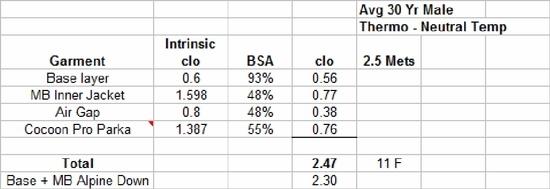
The combination you described will provide ~2.47 clo of insulation versus 2.30 for the MB Alpine Down alternative. Camp chores average 2.5 METs and so this combo is good to 11F for the average age 30 male.

Combo

PostedMay 21, 2008 at 1:31 pm

Richard,

Thank you very much for your detailed and understandable explanation. You have not only provdided warm comfort but, owning both of these jackets, have saved me some significant money as well. It just never occurred to me until this thread that I could use them together.

PostedAug 6, 2008 at 8:42 pm

Any opinion on the following sleep system for possible temps down to mid-20F would be appreciated:

Tent – Gossamer Gear "One"
Bag – Marmot Pounder (Synthetic – rated 40F; "comfortable" to 50F)
Pad – Termarest Prolite 3.0 Small
Sub-Pad – Gossamer Gear Thinlight 1/8"
Sleeping Pants – Montbell U.L. Down Inner Pants
Sleeping Vest – Montbell U.L.Down Inner Vest
Sleeping Jacket – Patagonia Micro-D-Luxe Hoody
Sleeping Socks – Montrail Bivouac (400 g. Primaloft)
Sleeping Hat – Northface fleece hat

I'm nervous about going with the Marmot Pounder, but chose it over down for safety in wetter conditions (September in the Adirondacks), but in combination with all of the down sleeping clothes, seems like it should be warm enough.

Again, any feedback would be appreciated.

Brad Rogers BPL Member
PostedOct 23, 2008 at 6:28 am

Richard, Thank you for your informative post as always. It would be great if BPL could put together a database to include the relative warmth of insulation layers as to better compare and find the lightest alternatives.

Viewing 16 posts - 1 through 16 (of 16 total)
Loading...