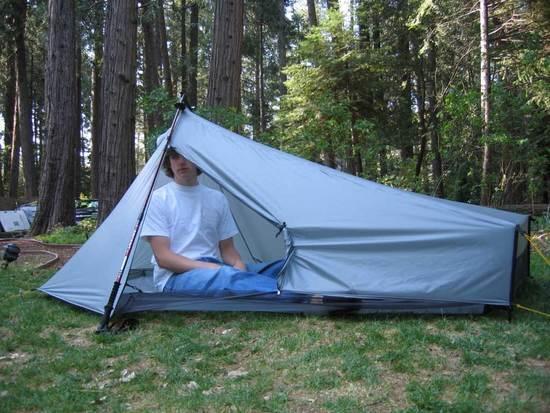
Please note just how close to the ground this Sublite prototype by Tarptent is pitched . The pitch reduced the ventilation during this mid-April trip to the Southern Sierra cutting off any significant circulation. The earth was very soft requiring the tent pegs be driven level to the ground to remain upright. Reducing the ventilation also allowed a pretty good test of the limits of Tyvek’s breathability. There was no noticeable condensation on either night.
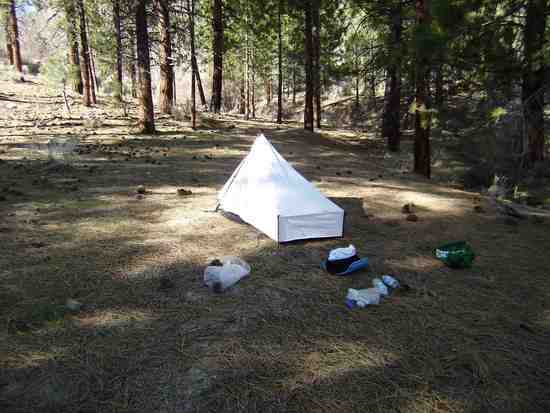
I have been testing a slightly smaller Tyvek Contrail since last fall and the latest roomier model, the Sublite, discussed in another thread, is a side-entry design that provides easy access and exit. In my continued testing I have yet to experience any noticeable condensation even with the Contrail version pitched in an open meadow last February. The tent walls were dry in the early morning but objects inside the tent including my sleeping bag were wet with condensation. There was no moisture dripping from the ceiling during the night and I have no explanation for it.
The Tyvek is a slightly heavier grade than that used in safety clothing. The seam sealing process utilizes glue that will allow the fabric to retain its flexibility. Although not recommended because it dries stiff, Elmer’s Glue will work as a field repair for leaks. This Sublite prototype weighs approximately 17 ozs, and, as already mentioned, has more room than an ordinary Contrail.
A change in my normal nighttime behavior illustrates the side entry convenience. I have for some time used a bottle to obviate leaving the tent at night, but this side entry model allows me to effortlessly roll out with much less fuss than fumbling with a bottle.
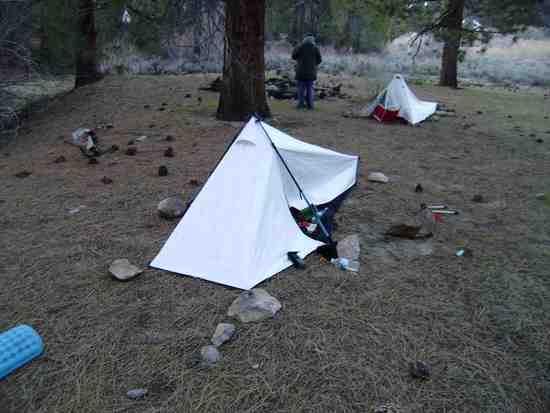
The mesh that connects the canopy to the bathtub floor completely surrounds the circumference of the tent with the closure below the tent door. The production model will use a zipper connection to form a complete seal of the mesh. There is also an adjustment just in from the pole holster along with the familiar Tarptent adjustments at each end to allow a taut pitch on the bathtub floor.
The tent can be pitched allowing for 360º of ventilation but, as pointed out, can be nailed right to the ground so that venting is cut-off. In fact I have urged Henry to manufacture a completely enclosed tent without mesh but he has ignored that request. The material behaves somewhat similar to ToddTex fabric used in Bibler tents with the inside surface being slightly textured which I believe absorbs moisture and expels it.
The tent material is the big news for me. It weighs less than Sil and is considerably less expensive. After the initial release, Henry plans to ramp up production as demand dictates. The introduction of the Sublite will allow us ultra-lighters to have practically everything we desire in a shelter: a lightweight, breathable, waterproof, inexpensive fabric that provides protection.
As a lightweight backpacker, I have a personal interest in the success of the Sublite. This tent answers my need for a small footprint, lightweight, SINGLE-WALL tent that will allow me a night of sheltered sleeping without being rained on by my own condensation. I am hoping that the success of the Sublite will spawn a whole line of excellent lightweight inexpensive tents. Not only would these tents be highly functional, but will provide a shelter that can affordably be replaced when the seduction of new designs lures me back to the marketplace.
I would like to see a fully enclosed 4-season version for cold breezy nights. Both prototypes mentioned above have been tested in the rain. I have given them the garden hose test and pitched the Contrail version in a storm last February and it remained completely dry inside. Henry recently had the Sublite pitched overnight in rain and reported that the inside was dry in the morning. Another very positive characteristic of Tyvek is the lack of sag or dip as experienced with Sil-nylon with cooler, damp evening air. Once pitched in a taut fashion, Tyvek remains tight.
In spite of the testing, Tarptent will most likely not recommend this Tyvek line of tents for regions that experience regular periods of prolonged rain. For climes that experience storms of limited duration in three-season use such as the Sierras and Southwest, it will be highly recommended. I urge anyone who wants a lightweight, breathable shelter to snatch this tent up as soon as it becomes available. Special attention should be given to the new Sublite by prospective through-hikers this summer. If you are a PCTer you are most likely are already on the trail but if you are gearing up for the John Muir Trail you should really consider taking the Sublite as your shelter this summer.