Topic

Is humidity/fog enough to completely collapse down loft?

  • This topic is empty.
Viewing 25 posts - 1 through 25 (of 29 total)
PostedApr 6, 2008 at 4:08 pm

I've read the horror stories of down collapsing in wet weather. Specifically, if one is caught in a multi-day storm, reports describe watching the down slowly collapsing. And I've seen my own down bags become somewhat damp.

However, would humidity/perspiration/dampness alone be enough to completely lose all loft, as if it were soaked in a river for an hour? I can't imagine this to be the case. Are we talking half the loft, most of it, or just a bit? Or will more and more loft be lost the longer one goes until it is completely sandwiched flat?

Is there any consensus on how much 800 fill down loft could be lost in 3-5 days of continuous use in continuous cold rain?

I am asking because I use a GoLite Ultra 20 quilt with a pair of Cocoon hoody and pants, and a cocoon 60 balaclava. Therefore I have synthetic clothing as a backup to an already warm quilt. However, I backpack in the Pacific Northwest, and am considering this combination for the rainy season.

With the synthetic clothing, I could get by with a Cocoon 180 quilt (same weight as the Golite Ultra). But the Golite will be substantially warmer and more packable (I presume), whereas I'd be pushing the limits near freezing with the 180 according to reports from this site. So for the same weight as the 180, I get the luxurious loft of the Golite Ultra.

So let's say I'm caught in an emergency situation, hunkered down for 3-5 days in heavy rain, unable to return due to heavy flooding of the rivers (not an unlikely scenario on Mt. Hood in November). But even if I lost, say, half the loft in my down bag, I should still have an inch of down loft plus my Cocoon loft. This would give me the same loft as a Cocoon 180 quilt at the beginning of the storm.

For complete safety I could get the upcoming 240g/sm XP Cocoon quilt coming out in June/July, but I expect this to add another half pound at least, plus considerable bulk.

I should mention I rarely backpack for more than 3 nights; I am referring here to more of a safety margin if I am stuck for a few nights waiting for rescue with a proper shelter (thus my concerns are with rain spray and general dampness, not with direct rain on the bag).

I can understand being concerned if my down bag was my main source of insulation, or if I were using a summer weight bag that I was pushing the limits of. I'm just wondering if, with my current situation, I'll still be okay, if a little cool, or if we're talking emergency hypothermia here. Based on how warm my Cocoon suit keeps me, I find it hard to believe I could reach a hypothermic state in anything above freezing (assuming enough food and water to keep my metabolism normal), but then I've never been hypothermic, so I wouldn't know.

EDIT: I should mention I am talking about a single emergency wait-out, which is different than packing a damp bag into a stuffsack and expecting it to loft back up. Here is where down really takes a beating vs. Synthetic. So I guess my 'nightmare scenario' ought to include being in rainy weather for 3 days, with an already damp bag that's been stuffed while damp most of the time, and THEN getting stuck by a flooded river or injury for a few days. Hmm, that 240XP is looking a bit better in this scenario'…
John G BPL Member
PostedApr 6, 2008 at 6:22 pm

Just because the down quilt looses loft and then becomes the same thickness as the synthetic quilt doesn't mean they will be the same warmth. If I understand correctly, the synthetic will be warmer per inch of thickness, but less warm per ounce. (Search under CLO values for more info).

I've also been struggling with the same question you have. Here's what I've learned so far:

Some sources say even damp down is warmer than an equal weight (not loft) of synthetic. More sources say their down lost almost all of it's loft and completely failed in humid + near freezing conditions. Even more sources say you can protect a down bag from external moisture, and air it out to dry the insensible perspiration – so down is not a problem for careful / experienced hikers even after many days of humid rainy conditions. Those sources also assume a careful / experienced hiker picks a good campsite where their single wall shelter has a good breeze going through it to reduce the humidity buildup, but that no spray or splash gets in. These assumptions all seemed very reasonable for experienced hikers under normal conditions – but may not fit an emergency / hunker down to wait out a suprise storm that blew in quickly scenario.

Almost all sources seemed to agree that a damp (not wet) synthetic bag will dry from body heat when protected from rain / spray by a tent. Only a few sources say a "damp enough to feel cold" down bag will dry from body heat. Most say you need several (5-6) hours + sunshine / heat or wind to dry damp down.

PostedApr 6, 2008 at 9:24 pm

Thanks for the helpful replies. I think the ability of synthetic to dry out through body heat better than down is probably the best argument I've heard for synthetic in these conditions.

I left out the choice of shelter because I have personally found that dense fog blowing through a tarp can be just as damp as a fully enclosed shelter, and a momentum bivy will only go so far to protect in that situation. Nevertheless, I usually use a pyramid-shaped tarp with peak vents (GoLite Hex 3 or SMD Wild Oasis).

Ross Bleakney BPL Member
PostedApr 6, 2008 at 9:39 pm

I think there was someone who posted similar questions about gear for a beach hike. I think the consensus was to either go with a double wall tent (which would reduce condensation) or all synthetic (or both). I think I would definitely go with all synthetic in the Fall in the Northwest. The weight penalty is probably pretty minor (for a synthetic quilt). Even if down "works" (is reasonably warm) it will probably lose its weight advantage on one foggy day (and lose more every day).

Richard D. BPL Member
PostedApr 6, 2008 at 11:15 pm

I have not read this anywhere, but is it not possible to take any down bag in the worst weather conditions and just slip it into some waterproof, non-breathable cover out of, say, cuben fiber or silnylon, and just tolerate a lack of breathability in your quilt/sleeping bag, while thankfully keeping it absolutely dry? Anyone tried this?

Adrian B BPL Member
PostedApr 6, 2008 at 11:18 pm

I don't know about the cuben but surely the pressure from stuffing would be enough to force the water through thin silnylon.

Plus you'd need air bleeding valves to stuff it and then let it re-loft. Might end up lighter to just take a second bag.

Rog Tallbloke BPL Member
PostedApr 7, 2008 at 12:13 am

If you have to carry a damp down bag for another nights use, drop it into a trash sack and stuff it as lightly as possible into the top of your rucksack to keep the weight of your other kit off it.

PostedApr 7, 2008 at 12:20 am

Adrian,

That's a helpful link; I usually check RyanJordan.com but missed that blog. 80% loss of down loft is more than I am willing to accept. Looks like ol' Ray Jardine was (is) right all along. =)

Also, I think rick was referring to putting a cuben slip cover over a down bag, not constructing a down bag made with cuben fabric. I think the effect would be similar to VB clothing, except you couldn't wear it under your base layer, so your clothes would get sweat soaked.

Thanks for all the info everyone; I know synthetic vs. down has been beaten to death in these forums, but I hadn't come across actual loss of loft percentage points. The Ryan Jordan blog says it all, though.

PostedApr 7, 2008 at 6:31 am

Adrian, what do you Kiwi's use for sleeping gear in NZ, or is it all hut hiking?

PostedApr 7, 2008 at 1:23 pm

Rick, the waterproof cover would be a disaster as your own body moisture would quickly saturate the down because it couldn't escape. You would be better off using the waterproof fabric as a VBL to reduce the amount of moisture going into the bag.

Steve, I suspect Kiwis are like everyone else-some use synthetics, some use down. I have never had a problem with down, but humidity is not often a problem here on the South Island, and when it is, it's usually cold enough that I'll be in my bivy bag generating a nice drying heat gradient. If it's REALLY REALLY cold I use a VBL. If it's warm humidity, I'm not too concerned as a bivy bag and synthetic clothing will be enough to keep me warm and my bag can stay in it's stuff sack. Experience is important, and most novice hikers would be better off with synthetics until they get the hang of it IMHO…

PostedApr 7, 2008 at 4:08 pm

Allison,

Again, I think Rick was talking about a complete cover on both sides of the bag, like sticking it in a very large trash bag and then draping it over you. It would be a wp bivy that you slept under rather than inside. In other words, it's a vapor barrier for your bag rather than for your body. Perhaps Rick should clarify.

Still, you'd have to sleep nude to avoid sweat-soaking your clothes, However, in an emergency some wet clothes would be better than a wet sleeping bag, so he may have a point…

This could actually provide an interesting application for those mylar emergency bags. You could use it for your sleeping bag, rather than yourself. Sure you'd be uncomfortable, but it technically should keep moisture in the air from entering and collapsing the bag (particularly if you taped it shut). Could this possibly be a survival tool?

PostedApr 7, 2008 at 4:27 pm

Re: the EDIT from my first post, I re-read Ryan Jordan's blog and noticed that he said that in the morning the bag hadn't lost much loft; it was after packing it up and then opening it back up in town that he noticed the loss of loft. So it would seem that in an emergency, one should have a few days, but once one has packed up one's bag, you'd better be able to get out of the storm that day.

I also noticed Ryan was in a fully enclosed Epic tent with some snow load, and was therefore probably breathing poorly at 32 degrees. I also assume he was not using a bivy inside the tent. So it seems there are many variables to his situation.

Ryan speculates that moisture entered the bag from being stuffed with a wet shell. Was he not able to dry off the surface? I'm inclined to believe the down had gotten a little damp while in use, but was able to maintain it's structure pretty well, and then when all the down was compressed, the feathers were a little sticky from being damp, and therefore did not loft back up.

I'm also a bit surprised Ryan expects the synthetics to fail as well, when neither the bag or jacket lost more than 10% of it's loft. I thought synthetics could only lose a certain amount of their loft before the stiffness and length of the fibers maintained a minimum sponginess no matter how damp. I think a good parallel would be a sponge vs. a paper towel, am I right?

PostedApr 7, 2008 at 4:58 pm

I think there comes a point of saturation where no synthetic will keep you warm. As for moisture from the shell, this is a possibility, as Ryan's "surface-to-down" ratio was pretty high, ie it would not take a lot of moisture to wet out such a small amount of down, given the area of fabric cover. This would be less noticeable with higher fill weights. And as you point out, this only becomes a big problem when you pack up the bag. As long as you stay in your bag and maintain a temperature gradient, the surface water will be less inclined to move inwards.

As for wrapping your bag in plastic, I am intrigued. This could indeed be a good way of maintaining warmth and loft in seriously damp conditions. Kind of like using a bivy bag AND a VBL, which I am inclined to do in winter conditions anyway. It would take a lot of plastic/cuben to do this though.

PostedApr 7, 2008 at 8:33 pm

For What It's Worth (not much since there are few details): “After the exhausting bout (the cold, black ice was brittle and very hard to penetrate) we stopped atop a large snow mushroom and under another. We anchored here, mostly sheltered from frequent spindrift avalanches. Around 1 a.m. we were settled in for the cold night. Our down sleeping bags were slightly wet, but we hoped not to spend another night on the mountain; that hope would not come to fruition…. The descent gully we chose eventually intersected a large ledge system and snowfield. There we had to make a decision: continue into the unknown darkness or bivy again with little food and wet, useless sleeping bags. We decided to stay put and shiver through it. It was miserable…. Shortly after daybreak, we got out of our flat, frozen bags…” From March 26-28, 2008, Vince Anderson and Steve House committed to new ground on the serious, rarely climbed north face of Mt. Alberta (3619m).

PostedApr 8, 2008 at 1:17 pm

Sounds like one of those situations Ryan referred to where even synthetics would reach their limit of usefullness.

A lesson I learned early on, which is why I always carry a bivy bag, even on trips where I don't expect to spend a nighht out (yes, day trips). Maybe not the cutting edge of UL, but it wieghs very little for the extra safety margin it provides. That, and a few plastic bags which can be used as VBL on feet, head and hands, and I'm good for most unplanned emergencies (Actually I often carry latex surgical gloves as VBL/rain/wind/blood protection, but these are devilishly hard to get on if your hands are already wet).

Jason Brinkman BPL Member
PostedApr 8, 2008 at 9:18 pm

Rick, please don't try that.

At night, even while you are still and asleep, your body gives off moisture (all over). I've heard that it's around 1 liter per night, but some of that is exhausted in your breath. If you go to bed with wet or sweaty clothes on it will be more. So even if you can eliminate external moisture completely, you still have the moisture that your body gives off, and any you bring in with you, to deal with.

If you wrap or cover the outside of an ordinary down bag with an nonbreathable/impermeable layer (such as silnylon, mylar, plastic, etc.) and do NOT utilize a nonbreathable/impermeable layer on the inside (commonly called a vapor barrier liner or VBL), you WILL wet the insulation from the moisture you give off, and over time this could cause the down to collapse!

Obviously the use of a vapor barrier liner is going to trap moisture too – it's designed to. That's why they are usually only used in very cold conditions. But the slight claminess and discomfort that you feel could save you from much greater discomfort.

Think about it… if it was as simple as wrapping a down bag is something nonbreathable and waterproof, wouldn't somebody have already come up with that?

Richard Nisley BPL Member
PostedApr 8, 2008 at 9:44 pm

Carter,

You asked, “…would humidity/perspiration/dampness alone be enough to completely lose all loft, as if it were soaked in a river for an hour?… Are we talking half the loft, most of it, or just a bit? Or will more and more loft be lost the longer one goes until it is completely sandwiched flat?”

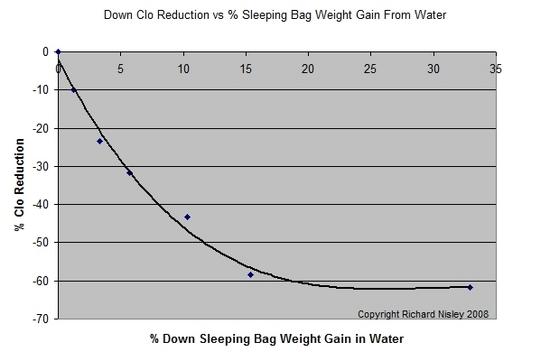
Down clo reduction when wet

The answer is that you will theoretically loose no more than 60% of your down insulation value worst case. Offsetting this risk, there are many mitigation options to drive moisture out of the down. A brief recap of the options include: putting synthetic insulation (bag or clothing) on top of the down layer to insure the dew point into the synthetic layer; sleeping under foliage, tents, or tarps to reduce IR radiation losses to the night sky; blocking the wind to reduce convection losses; using an adequate pad to allow a higher percentage of your body heat to drive moisture through the bag rather than heat the ground; food thermogenises from protein prior to sleeping to generate more body heat; highly breathable bivies and shelters to reduce moisture transport resistance; drying the bag surface with a pack towel prior to stuffing; drying the bag periodically; using a VBL in sub freezing temps; etc,

Jason Brinkman BPL Member
PostedApr 8, 2008 at 9:59 pm

Carter,

You asked, “…would humidity/perspiration/dampness alone be enough to completely lose all loft, as if it were soaked in a river for an hour?… Are we talking half the loft, most of it, or just a bit? Or will more and more loft be lost the longer one goes until it is completely sandwiched flat?”

It seems unlikely that you would lose "all loft" (i.e. 60% clo ~ thanks Richard!) from just humidity/perspiration/dampness unless it was sufficiently cold out so that the dew point occurring within the down, you did not use a VBL, and you experienced the same conditions for multiple nights without drying the bag. Seems like an improbable sequence of events.

I can not speculate on what percentage you could potentially lose, but I doubt it would be all loft under most conditions.

John G BPL Member
PostedApr 9, 2008 at 7:47 am

Wow ! With only 5% moisture, a down bag loses 25% of it's warmth. With 10% it loses 45% and 15% it loses 60%.

I didn't realize the CLO loss was that severe at low moisture levels – or that the curve was so steep.

Thanks Richard !

Richard Nisley BPL Member
PostedApr 9, 2008 at 8:04 am

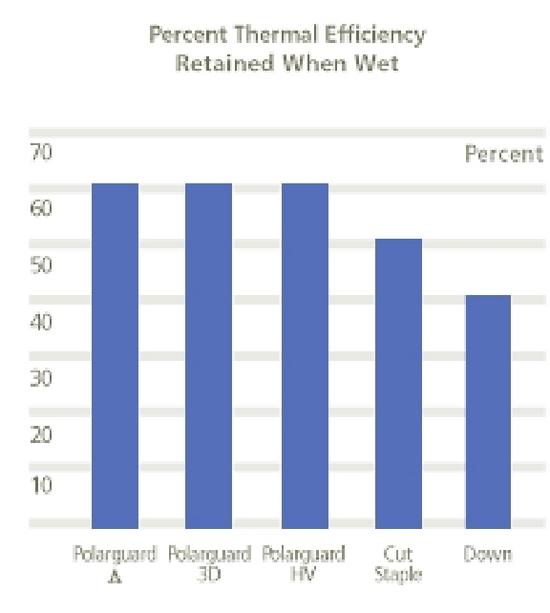
Most of the moisture mitigation methods I mentioned are also applicable to synthetics. Most synthetics (Primaloft excepted) used in sleeping bags and quilts are not warm when wet. They typically give you only a 20% warmth margin over down when wet.

The following is a chart from the Polarguard site that is no longer posted. The 40% thermal efficiency retained when wet for down is the same as the 60% maximum thermal efficiency lost that was detailed in my prior post’s chart. This compares to Polarguard Delta’s 40% maximum reduction.

PD when wet

Ross Bleakney BPL Member
PostedApr 9, 2008 at 8:27 am

Regarding Rick's idea (and Jason's comment):

Couldn't you have a vapor barrier on the inside as well? Wouldn't that do the trick (although you would get awfully clammy)? Of course, at that point (when you are carrying two liner bags, one for the inside and one for the outside) it is probably better to come up with a different insulation system.

Richard D. BPL Member
PostedApr 9, 2008 at 12:29 pm

I was talking about making a waterproof, nonbreathable quilt slip for the down bag or quilt and inserting ONLY the down bag/quilt in it. The backpacker would sleep underneath all of that, OUTSIDE of the slip. There would be some sweating, but nothing disastrous, I think. It would be easy to ventilate (operating as an overbag), and if much colder than freezing, VB clothing could be worn (such as a tyvek coverall, which weighs 5 oz) to minimize sweating against the down bag wrapped in nonbreathable fabric. I don't see any holes in this idea personally, and I've experimented with vapor barriers and sleeping under space blankets, so I know what degree of sweat to expect (less than most people would imagine).

Jcarter: Yeah, you could take a mylar emergency bivy, turn it inside out, stick your down bag in it, and sleep under it. That's exactly the kind of thing I was talking about.

PostedApr 9, 2008 at 12:41 pm

I think I now see the point of some of our confusion; some of us are talking about a bag, others a quilt. I was referring to a quilt, so a single mylar/cuben sack could be sufficient. With a full bag you'd need an inner and outer sack, so you'd be better off with emergency VB clothing.

That really interesting about the 60% loft loss, and at such small moisture intake. The big question, though, is will it loft back up to 60% after stuffing it away all day? That's probably why Ryan Jordan lost 80% of his loft AFTER taking out of its stuff sack at the end of the trip.

Still, it is encouraging to know that, for a 3-day trip, I'd probably be okay with down, since the forecast should be accurate enough that I should know if I'm walking into large storm. Thus if any unexpected weather arrived (heavy multi-day rainstorm), it would be towards the end of my trip, where I can wait it out and then walk out in one day. This starts to get in to the 'how much risk are you willing to accept' that we all balance with lighter gear, and I think this is an unlikely enough scenario that I am comfortable with the level of risk. i.e. I don't really see myself intentionally heading out into a multi-day rain storm with a down bag.

Viewing 25 posts - 1 through 25 (of 29 total)
Loading...