Topic

3 season Tarptent use above treeline – do I need a bivy bag?

  • This topic is empty.
Viewing 23 posts - 1 through 23 (of 23 total)
Gustav Bostrom BPL Member
PostedMar 12, 2008 at 7:06 am

Hi!

I bought a Cloudburst Tarptent a while ago. I haven't had time to test it that much yet. I've only tested it in forested terrain in temperatures around around 5-10 degrees celsius. I'm mostly used to sleeping in a tent and I'm wondering whether the good ventilation(read draft) in the tarptent will make my sleeping bag perform badly in moderate to high winds. I have a MEC Merlin sleeping bag rated to -3 celsius.
I would like to use my tarptent above the treeline in Scandinavia. We get a lot of rain and most of the campsites will probably be above the treeline. Temperatures can easily drop below freezing even in the middle of the summer. It can also be quite windy.
Does anyone how experience in using a tarptent in similar conditions?

I'm wondering if I need to complement my shelter with a bivybag for these conditions. Alternatively I'm thinking of maybe modifying my tarptent by creating a small lightweight windscreen for the mesh at the rear.

PostedMar 12, 2008 at 7:35 am

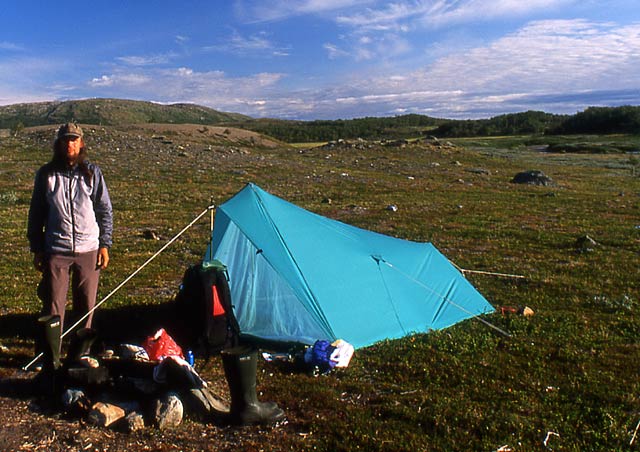
I used a homemade tarptent in 2003 on the Nordkalottleden. It was a rather warm summer, but we had a few very windy and rainy nights, two nights around -4°C. I found the moskitonetting did a good job in keeping the warmth in.

We used ME Glacier 500 Bags, which have a comfort rating of -3°C.

I do not think you will need a bivy bag there. If the weather got worse I spent a great part of the afternoon watching the clouds, wind directions and so on. Then I decided where and how to set up camp. Only one night out of 50 I misscalculated somewhat, and the wind turned 180° in the night, which meant, it came through the entrance in the morning – but the sun was shining.

Gustav Bostrom BPL Member
PostedMar 12, 2008 at 7:49 am

Thanks!
That's excellent information and good news for me as those are the exact conditions I'm thinking of. I would like to make a quick trip to Rapadalen in Sarek this summer. I'm thinking that with lightweight gear I should be able to reach Rapadalen i 2 days.

By the way I'm also thinking of skipping my rubber
boots and to use trailrunners instead. Do you have any experience with that?

PostedMar 12, 2008 at 9:26 am

If you're really worried, you could try a wp/b Montbell UL Dry-Tec overbag. Search for reviews of this bivy on these forums. Regular is just over 6oz, long & wide is 8.3oz. It's not quite as breathable as eVent, but reports here claim it is very close, and way better than Gore-tex.

It's a bit heavier than the lightest pertex bivies, but it would give you peace of mind if you were worried about tarp failure above treeline, as you'd have a fully-waterproof (taped seams) emergency shelter. Also, you wouldn't need it to be as breathable as Pertex, since you'd presumably only use the bivy in high winds, which should make condensation a non-issue with this fabric.

You can use the bivy as your stuff-sack for all of your insulating gear to save weight on stuff sacks, further justifying the weight. And if you gain enough confidence with the Tarptent that you don't feel you need the bivy, then you can remove it from your gearlist in the future. But 6oz is not that much weight for the substantially added piece of mind. Besides, on calm, clear nights you could sleep under the stars with it! At US $110 for regular, it's quite reasonably priced for such a high-tech fabric.

I've personally started thinking about using the Montbell overbag with a SMD Wild Oasis, as I'd get the benefit of a full-coverage tarp, perimeter mosquito netting, and yet still have a fully wp/b bivy for complete protection. This would weigh in at 19-22oz. It wouldn't be a fully enclosed shelter like the Contrail, though.

PostedMar 12, 2008 at 10:45 am

Gustav, I agree with David on bivy use. I also am new to my tarptent (contrail), but in my limited use at elevations of ~3300M I found even small amoounts of air movement made me cold with just my down sleeping bag.

t.darrah BPL Member
PostedMar 12, 2008 at 11:39 am

I think my concept of a tyvek bivy / overbag will work great with a tarptent/ single wall type shelter. The bag (see early prototype pictures posted on this site by Casey) will add warmth by controling air flowing into the shelter and also protect the sleeping bag from moisture due to condensation build up within the shelter. I will be sending out three test bivys to BPL members for testing next week and they each will be posting their findings on this site. The ideal use will be with a tarp where the bivy will act as ground cover and bivy combined in one piece of gear.

PostedMar 12, 2008 at 1:14 pm

Hi Gustav

My partner and I used a Cloudburst for a few years, and loved it, as can be seen above treeline in this thread:

http://www.backpackinglight.com/cgi-bin/backpackinglight/xdpy/forum_thread/11542/index.html

The two biggest problems we had were wind and condensation. The condensation may not be a big problem if you are using it solo, but with two people it is not easy to avoid brushing up against the sides. And there is no way to keep blustery winds from cutting through the tent. The upshot of this is that we always carry bivy bags. These bags do not need to be completely waterproof on the top, so they are very light and breathable things to have along (180 grams each I think). They also block the wind. YMMV

Mark Verber BPL Member
PostedMar 12, 2008 at 5:52 pm

I have been mostly using tarptents since 2002. "Typical" bad conditions were elevation 11k ft (3.5k m), temp down to around 32F (0C), winds to 20mph(32 kph), and moderate precipitation. No problem. On various trips I had use Henry's tarptents in conditions that went down to 10F (-12C), winds up to 45mph, heavy rains, and light snow, at elevations which varied from between 13ft (4m) and 13k ft (4k m) and lived to tell about it.

My recommendation would be to skip a bivy if you are using one of henry's tarptents. Provided you aren't over stretching the tarptent beyond it's ability(monsoon storms, floodplanes, heavy snowfall, etc) you don't have to worry about moisture being a major issue. If you are pushing into those sorts of conditions you might want to think about a different shelter. Yes, you can get condensation… but that is completely manageable.

So what's left is protection against wind. Tarptents provide (even in lock down pitches) only the most limited protection from wind. The Double Rainbow is the best in my experience. Pitching behind a big rock wil typically give as much protection as the tarptent.

Would a bivy help you stay warm in the wind which whips through the tarptent? If you are using a traditional sleeping bag… not that much. Most sleeping bags use fairly windproof shells. So long as you have the bag closed well (and ideally with a good draft collar) wind isn't going to be a huge factor. People using quilts might depending on how well they are able to seal their quilt. 5oz of extra down would do a lot more to keep you warm than 5oz worth of fabric in a bivy.

–Mark

PostedMar 12, 2008 at 7:18 pm

Given Gustav's expected conditions, which include strong winds and below freezing temps, I would definitely recommend either a bivy bag, or taking a more traditional (heavier) tent. My down sleeping bag is not really very good at cutting out strong-gail force winds that whip through a Cloudburst, even though the tent itself may stand up to these winds. I agree the Double Rainbow offers better wind protection in these conditions, but Gustav already owns the Cloudburst, so he needs to decide if it's worth the extra weight of carrying a bivy or risking being frozen, or carrying a heavier tent. These are really just the same decisions we all make when we plan for trips with unpredictable conditions…to carry more or possibly be less comfortable. I have 'survived' cold, exposed and extreme windy conditions without a bivy bag, it's just not something I would willingly choose to risk again. But then I'm just a chick and feel the cold a lot more than many guys ;)

PostedMar 12, 2008 at 7:26 pm

If you're really concerned about drafts from the rear, pile some stuff up in front of the mesh (like a pack or something else). The Cloudburst isn't as drafty IMO. I've used mine at over 10K elevation in pretty gusty winds and didn't notice wind gusts penetrating the tent. Much better to use tent placement, the existing side storm flaps, natural windbreaks, etc. to compensate rather than bringing your bivy.

PostedMar 12, 2008 at 8:59 pm

Yep: the first word in tarptent is still tarp.

In high/cold/exposed conditions, treat it like a tarp. Make site selection a careful, considered activity and be willing to walk some extra miles in order to find the right depression/knoll/whatever to protect your pitch. That will make you more comfortable and more tolerant of weather events.

I think that this would be much better than huddling in a bivy bag while a freezing wind blows through your shelter all night.

I made such a site selection error in the summer of 2004 and I hope never to repeat it. I pitched on a rise looking out over the lake and mountains — in preparation for my obligatory sunrise-framed-by-a-tent-door photo. My Big Agnes tent is "drafty", anyway," and a sub-freezing wind blew off the lake and through my tent all night. My -7 down bag was stripped of its' heat and I f-r-o-z-e; you can see it in my face in photos from that morning. (The sand was covered in frost until the sun came out.)

Lesson learned: a sheltered pitch is even important in a double-walled tent — never mind a tarptent.

PostedMar 13, 2008 at 1:32 am

We also piled gear on the low end of the tent, and looked carefully for the right place to camp.

>By the way I’m also thinking of skipping my rubber
>boots and to use trailrunners instead. Do you have any >experience with that?

I used rubber boots, but most people we saw up there used normal hiking boots. But I have not been in the Sarek.
With a break every 1.5 hours and then airing the boots out helped very much to keep moistness and stink in the rubber boots under control.

On Inaki Diaz de Etura´s page you can read his account on hiking the Nordkalottleden with lightweight, lowcut shoes.

Gustav Bostrom BPL Member
PostedMar 13, 2008 at 7:07 am

Wow!
I did not imagine I could get so much good help from the forum so fast. Thanks!

It seems that opinions are a bit divided on this issue. I think that for my peace of mind I will be a bit cautious the first time and bring a lighweight bivy. I could always use it in conjunction with a tarp as well some other time.

The next question is then which one I should choose. The selection of bivy sacks in the shops in Sweden is poor to say the least. There is the Haglöfs sleeping bag cover at , Polyester top,nylon bottom, 330g, 50$. Then there is the Hiker simple all nylon bivy , (Light, thin fabric on top and thicker more water resistant on the bottom.), 30$. You can also get a whole range of expensive sacks in goretex etc. The price for these start at 350$, but these are definetely out of the question. In general the price of outdoor equipment in Sweden is about the double of the US price.

The Hikers bivy seems OK, but it's hard for me to judge if it is good enough. It seemed to weigh around 200-300g. I wonder if the thin nylon on top is breathable enough though. If someone has positive experiences with this one I will probably go with it because of the good price.

The Montbell bivy sounded very interesting, but If I have to get it ordered over the internet the price including taxes and shipping will probably end up somewhere in the neighborhood of 150$. The Oware bivies also seem very appealing, espcially since they are incredibly light, but the price is also a bit high. If anyone has a used ,good enough, bivy I'm very interested in buying it. I will take a look at the gear swap forum.

I was also thinking of sewing one myself, but it's almost impossible to get fabrics here. I'd have to order from thru-hiker.com and then the price starts to approach 100$ very quickly if I use the same material as Oware.

Thom, is the Tyvek bivy you mentioned for sale or is it a MYOG-project? Sounds like a very interesting idea.

PostedMar 13, 2008 at 7:47 am

hey, I was about plugging my website in but I see I'm late :)
I've only been in the area once so what do I know… but I tried to approach my Nordkalottleden trip from a lightweight perspective which, it seems, not many people do so I think I can contribute something here.
Harald was brave enough to take a tarptent up there. I wasn't. I had been using tarps and tarptents for years and I didn't even own a proper tent for solo use (so I had to buy one) but I didn't dare to show up there with a frameless (or barely framed) shelter. As I write on the trip report, I'm aware it can be done but at the time of planning I wasn't sure (didn't know the area at all and it was tricky to find info in something I could read). Once there, I saw it was perfectly possible but I was still glad to have my tent as it provided me that security margin, as much psychological as physical, of knowing I was gonna be ok no matter what.
In my opinion, the main problem up there is wind and exposure. Harald's pic says it all well. To be above treeline is not an option but a given. Trees are only found below 500 m. approx. It's like being in a mountain with no valley to go down to so you have to take the weather as it comes. And the relief is so smooth it's not so straightforward to find a sheltered spot. I could definitely relate to what Harald was saying about watching the clouds and wind for the later part of the day. I was doing that myself even if I had a bombproof tent and I tried to imagine how it'd had been to go through it all with a tarptent… be sure to feel confident in your tarptent, watch the conditions all the time and be ready to take your time to find a spot when the wind blows hard. The Cloudburst is supposed to take some good wind if properly oriented. Legend says Henry Shires got inspired by the Stephensons Warmlite tents (the one I was using) design and the Cloudburst looks quite like those. I'd say as long as your shelter stands, you'll be fine even without a bivy which to me seems quite redundant. I've done the windscreen on the back thing for a Tarptent Rainshadow I had and I guess it made some difference but didn't have it in really high winds. I think finding as much as possible a sheltered spot and blocking the gaps with extra gear should work.
As for the shoes, I'm so used to them I find boots so heavy, bulky and uncomfortable I try to avoid them, even ligthweight ones so this one was clear to me. Rubber boots were so out of the question I didn't even know people would hike in them until I saw it :)
The only problem up there for shoes is wetness. The terrain (in Nordkalottleden at least) was quite easy going so running shoes work perfectly well. Don't know about Sarek but I guess it shouldn't be much different. Then, I spent nearly a month with a varying degree of permanently wet feet. Sometimes it wasn't nice but it was never a real problem. I'd keep a dry set of socks for night time and would sleep with the daytime socks tucked in my clothes if they were too wet. That is, just the usual stuff you'll find here at BPL and similar resources. It seemed to me fighting the wet was a lost battle in the long run no matter the footwear so using non-waterproof trail runners was an early way of accepting defeat and learning to live with it. You can find a good report of what it means to use trail runners in a similar (actually harder) environment in the Arctic1000 expedition from this very site.
I didn't even bother with waterproof or waterproof/breathable socks which could also be useful but I'd probably take a pair of waterproof ones if I was expecting below freezing temps regularly.

Mark Verber BPL Member
PostedMar 13, 2008 at 10:58 am

David, can you give me a reference for the European studies about the benefits of the bivy. That is pretty close to traditional rule of thumb for what you can get from an enclosed tent or bivy. It would be nice to have the hard data to compliment conventional wisdom. The number seems a bit high from my experience (I would have thought it was a 5-10F advantage) *once* I was inside the sleeping bag with a good shell because I would already have significant protection from convection cooling, but I had not studied or measured the real impact.

I would like to try to clarify my earlier statement about the value of a bivy. Yes, it will add warmth. It can give protection from moisture. But if all you care about is warmth / weight, there are better options. Lets say bivy will an extra 7C (~12F) improvement over sleeping in the open. Lets say you are doing a 5oz bivy. Yes, there are bivys that are lighter than that, but most are heavier. If you put the same weight into your fill… or say add a high loft garment like any ultralight down vest or jacket when in the bag (layered over you rather than worn) then you will get as much (or more) insulation value for your weight. For example, in the nunatak's arc quilt like, 3oz fill difference between the specialist and alphinist results in a 12F rating difference.

Earlier in this thread someone asked if a bivy would make a significant difference. I said not significant, because to me, 7C isn't significant. It's noticeable, I typically budget that sort of margin (expected conditions + margin) for what I can sleep comfortable at… and it is also less than the margin which goes from comfortable sleeping to uncomfortable, but not life threatening.

On thing I forgot to mention… while I have used tarptents in high winds… I would not choose to do that unless I was explicitly seeing how far I could push myself and my gear. When I expect winds to be more than 20mph (32kph) I start to think about using something else. If I expect winds to be more than 35mph (56kph) I definitely would switch to something that would give me better wind protection. For me, that is typically a shaped tarp which can me pitched flush to the ground.

–Mark

Gustav Bostrom BPL Member
PostedMar 13, 2008 at 1:58 pm

Ola Inaki!

I read your account of your thru-hike on Nordkalottleden (Perhaps it could be translated to The Northern Scandinavia Trail.). That was great stuff! Thanks for writing it. It was the best account of a long lightweight trip in the Scandinavian mountains that I have read. I especially liked that you elaborated on the reasons behind your gear choices. Too bad you had such lousy weather all the time. All of my backpacking has been done in this region (Northern Sweden) and while I think you have to count with such conditions, a more normal outcome would be rain perhaps just half of the time (I'm no expert in weather though.).

The conditions in Sarek are probably a bit different than on Nordkalottleden. Mainly because there is not a single marked trail in the entire national park. Consequently one probably has to count with more difficult terrain.
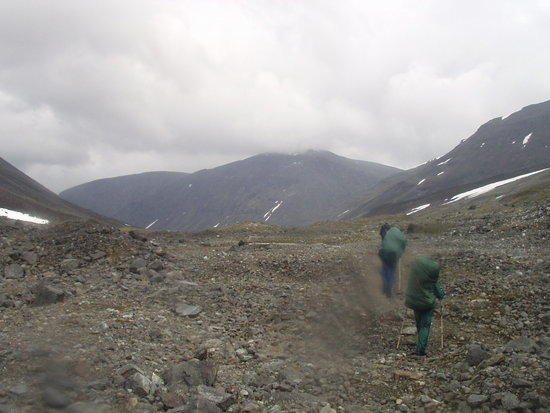
Here is photo from a previous , very heavyweight, trip through Sarek. There was quite a bit of this stony terrain. It wasn't too bad , but at times it made me wish for sturdy boots instead of my rubber boots.
Somewhat stony terrain in the Basstavagge valley
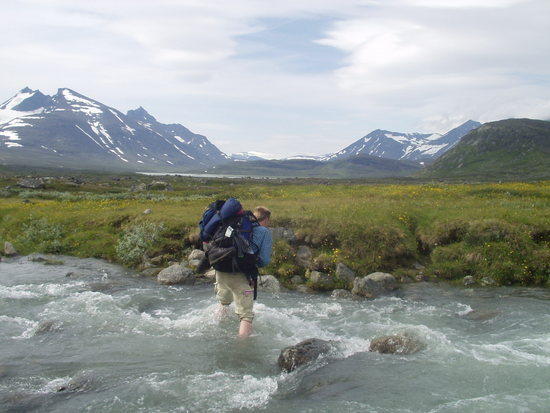
On the other hand we had quite a few fords every day and with rubber boots the vast majority of them could be managed without getting my feet wet.
Typical ford near Lietjitjaure
Eventually however everyone in our group, including me, got our boots completely soaked. After that experience I realized that you can in fact survive this condition and that your feet get warm pretty soon afterwards anyway. Consequently I'd like to try using trailrunners instead. I'm more concerned about the risk of twisting an ankle in difficult terrain. As you said on your webpage however, the only answer is probably that I have to try this out myself. Normally it takes two days of hiking just to get into the national park and it's probably best to try this out somewhere closer to civilisation though.

I really loved Sarek and judging from your post I think it ought to be something for you since you liked real wilderness. Sarek, is a huge wilderness. And it's as good as it gets. It normally takes around two weeks to walk through it. Here you can find more information on the area:
http://www.laponia.nu

Gustav Bostrom BPL Member
PostedMar 13, 2008 at 2:09 pm

Miguel,

Those links are indeed very useful. I've looked at Anders site before and that's where I found a good bivy pattern. It's a truly great site for MYOG-ers. I haven't seen the Shelby site before though and it could be a really good idea since they only need to ship from Finland. Thanks!

PostedMar 13, 2008 at 2:36 pm

I sewed my tarptent somewhat after the plans of Henry Shires, but with some modifications. So I am able to set it up much lower, just like a tarp, the lowest would be one part of a 3 part leki hiking-stick in the back and one and a half part of the second hiking stick in the front. The moskitonetting adapts to all different widths and heights.

So we have been able to use this tent in winds (on the Nordkalottleden) where you had difficulties to stand stable.

Maybe this is not possible with the Cloudburst. Gustav, you could try the Cloudburst on some islands in Stockholm´s skärgarden, there should be some windy weather in spring. Then you have more experience for a decision.

PostedMar 13, 2008 at 3:05 pm

hey Gustav,

I was about to add it felt weird for me to be talking about that area to someone from Sweden :)
obviously you know about the place much better than I do.
It can be done in lightweight style, I'm sure. You just have to trust your gear and know its limits. A potential source of problems is if you're hiking with somebody else who's not going lightweight because the lightweight approach success depends a lot on hiking style and this may fail somewhat if one has to adapt to others' hiking style. But you probably are already aware of this too.
Sarek is definitely a place in the list. Someday.

PostedMar 13, 2008 at 3:36 pm

Local knowledge of the weather patterns should help you make your decision. The coldest I have been in the Cloudburst was in the "lee" of a mountain, by the side of a tarn where the very strong to gale force winds were swirling around and hitting the tent from all directions. Merely blocking off the foot of the tent was totally ineffective, and most of the wind came through the sides of the tent as the floor lifted with each gust.

Now, in NZ, this weather is not uncommon, and unpredictable even a day in advance of a trip, which means taking a bivy makes sense. But honestly, if I KNEW I was going into these conditions, I would have taken the Nallo 2 instead. If you KNOW you are going to be in extreme, variable and unpredictable weather above tree line, then you may want to reconsider your tent choice.

I have no 'data', just personal experience on the benefits of a bivy bag in a Cloudburst. In windy weather, I am far warmer with my WM POD 30 (450g) plus bivy (180 g) than I am in either my WM POD 15 (790g) or WM Versalite (900g). I don't know why…

Viewing 23 posts - 1 through 23 (of 23 total)
Loading...