Topic

Closed cell or inflatable?

  • This topic is empty.
Viewing 15 posts - 1 through 15 (of 15 total)
PostedFeb 21, 2008 at 5:54 pm

I am working towards a sub-10 lb. pack for a hike this summer. I had originally planned to use the 8 oz. Therm-a-Rest RidgeRest closed cell pad in a 3/4 length. However, after a salesman at my local mountaineering shop pointed out, sleeping on that will not feel the best after more than a few nights. He suggested that I get the ProLite 3 short length inflatable pad. Actually, they have "long-cut" pads there – the outer seam was trimmed about 1/2 cm too long, so it is selling at $20 off which brings down the price considerably.

Now, I was also planning to use my closed cell pad as a frame for the GoLite Jam2 that I am getting. I have seen partially inflated pads used as a pack frame as well, but I don't know how well these would hold up to a 30 lb. load (which I might have at times).

Furthermore, I am using a 45F Mountain Hardware Phantom down bag in northern MN in the summer – a choice I made based on weight and added clothing for warmth. I want a pad that will be warm as well as comfortable – warmth is my greatest factor here.

So, what are your opinions on the closed/inflatable pad debate? Is it worth the extra money to get a pad that will last a few years longer (or more) for more money but at the same time add another 8-9 oz to my pack weight?

Charles Grier BPL Member
PostedFeb 21, 2008 at 6:20 pm

I have a Thermarest Prolite 3 and have used it for about 18 months now. It weighs 13.2 oz in a silnylon stow sack I made. It is warmer and softer than the 3/8" blue foam pad I used before even if I pump it up fairly stiff. I did have a puncture with it in the field; I was able to locate and repair the leak using a lake for a bubble tank; I had a Thermarest repair kit along (much recommended). They are not real warm or soft when they go flat. I have never used it as a pack support; the pack I use has an internal frame and stays so I can't comment on that function. Overall, I'm glad I got it.

PostedFeb 21, 2008 at 6:42 pm

I've used a Prolite 3 as a virtual frame in a Granite Gear Virga pack. The pack has no stays, and the Prolite 3 worked fine as a back pad/frame for loads up to the 20-pound recommended limit of the pack. I found that if I inflated it (usually lightly – just a breath or two), it worked really well. I tried it with a 25 pound load, and I think it was fine. However, I can't swear to it because the pack was very uncomfortable at that weight; I think the problem was the hipbelt, not the backpad. The belt was a narrow belt of plain, unpadded webbing and the load simply folded it over and forced it to slide down.

A couple of times, I did try stiffening it with a virtual "stay." Once, I simply put my tent pole bag (Seedhouse SL1) between the folds; that was a little too stiff because of the number of pole sections. Another time, I simply folded my chair kit in half, then rolled it to the width I wanted (creating two stays, a few inches apart.) I placed this between the folds, lightly inflated the pad, and it worked really well with the 23 pound load I was trying. (I still got some slippage with the belt, though.)

I've also tried a closed-cell pad (Z-rest 3/4) and really didn't like it at all. It wasn't nearly as comfortable as the Prolite 3 as a sleeping pad, nor was it as comfortable when used as a virtual frame in the Virga pack.

So, yes, I think a Prolite 3 will work as a virtual frame. If you need stays, use the chair kit trick – it even lets you sit in a camp chair with a smug look on your face: the chair isn't a luxury, it's an essential part of your frame! (Rationalization and compound interest are the two greatest inventions of the human mind.)

PostedFeb 21, 2008 at 7:14 pm

Rationalization and compound interest are the two greatest inventions of the human mind.

Indeed they are. Especially compound interest; it makes my money worth more while I spend it on ultralite gear.

I was looking at other threads on BPL and found the Montbell sleeping system (the pillow and a 120). Their setup looks great for what I would like to do, however I already have the Therm-a-rest medium compressible pillow. At much as I would love to drop another 6 oz from my pack weight, I don't have all that much money right now to spend. My though was to use Velcro and an adhesive to attach the pillow to the pad, much like Montbell has with their locking system. Just attach two strips of Velcro to the pad with an adhesive, then sew the appropriate other side to the pillow, thus allowing it to stick to the Velcro and the pad so it won't slip.

Thoughts on that? Will a permanent adhesive on a ProLite 3 ruin the surface of it? And is it plausible to sew an adhesive strip to a Therm-a-rest pillow and expect it to stay on there for a while?

Philip Werner BPL Member
PostedFeb 21, 2008 at 7:59 pm

Have you looked at the Gossamer Gear nightlight? It's a 3.2 oz, 3/4 egg shell pad. I use it as a framesheet for my six moon designs starlite with loads as high as 35lbs. It's a perfectly good summer pad with an R value that is almost identical to a thermarest zlite which weighs 10.2 oz…I think. It costs around $15.

Jason Brinkman BPL Member
PostedFeb 21, 2008 at 8:54 pm

"Is it worth the money to get a pad that will last a few years longer…?"

There is certainly no guarantee that a ProLite will last longer than a RidgeRest. Apples and oranges depending on use and conditions.

It is difficult to say if either a closed cell or a self inflater will work better as a virtual pack frame. Again, apples and oranges depending on your pack style, weight, and use.

I believe that you will find that closed cell pads like the RidgeRest, Nightlight, REI Blue Foam, etc. are consistently lighter for the warmth. But they are also bulkier and less comfortable for most people. However, if you can comfortably sleep on a closed cell pad, they are nearly fool proof.

PostedFeb 21, 2008 at 9:13 pm

My Prolite 3 Short developed a leak at the beginning of a thru-hike and Thermarest repaired it for a price. Even though it has been repaired I am just a tad bit distrustful of using it. I was very careful with it and don’t how it could have developed all of the holes that were patched.

I was thinking of a combination of a regular a Ridgerest together with a Thinlite or one of my older thinner pads. Any suggestions or comments on this approach?

PostedFeb 22, 2008 at 3:07 am

> sleeping on that will not feel the best after more than a few nights

nobody but you can make such assumption. And you'd have to try to find out. I sleep perfectly well on closed cell foam and I'd actually say it gets better after a few days because I adapt to sleeping some differently as I do at home, I also adapt to trail life schedules and I'm probably more tired… but everyone's different here. It's common that somebody who can't sleep well on foam thinks nobody can. Don't trust anybody but you on this.

John G BPL Member
PostedFeb 22, 2008 at 6:36 am

I think if you sleep on your back, then usually a foam pad is just as comfortable, and durable enough to sit/lay on at rest stops or lunch without worrying. I also find the foam pad more comfortable than a thin inflator (ie: less than 1.5") when there are roots or embedded rocks under you.

If you sleep on your side, the softer inflatable allows the points of your hips & shoulders to sink in and be quite a bit more comfortable. Some women also find the inflatable is more comfortable, even when sleeping on their back, since they have a lot of inward curve in their lower back and their butt needs to sink into the pad in order for their lower back to be supported.

As far as testing, try sleeping in a carpeted floor (pile not berber) at home. If you wake up without sore hips then a foam pad should work just fine for you. If you wake up with a sore lower back then you probably need something thicker than the PL3 and should consider a DAM (down filled air matress) for more warmth & less weight than thicker self inflators.

PostedFeb 22, 2008 at 10:48 am

I've moved back to a 10mm closed cell from inflatable for out-of-summer use. I find the inflatables far too cold when the temperatures are in the 30-40F range.

It's then just a case of making sure that you avoid sleeping on concrete….

It's also a bit of a mental thing. If you believe the ground is hard it will be.

I've slept quite happily on all sorts of oddly shaped pieces of ground. The body will adapt to the lumps and bumps if you let it and don't try and convince it that you really want a nice soft bed.

PostedFeb 22, 2008 at 12:44 pm

I don't have too much to add, except to say that I find the RidgeRest to be the most comfortable of the closed cell foam mats. I have one cut down to torso-size that is just fine for 3 season use.

IF you go with an inflatable, you might want to try them out before they end up in your pack. I suggest you try them WITH THE VALVE OPEN to see what the worst case scenario would feel like. I have done this with a Stephenson's DAM, a Torsolite, and the MontBell UL 90. From my 'tests' I have found that, if you get a puncture in the night, the Torsolite will still provide you with OK insulation. The DAM and UL 90 become almost worthless. All things to consider, plus you really should add the weight of a repair kit to your final pack weight if you decide to carry an inflatable.

PostedFeb 23, 2008 at 8:40 am

Well, after reading your ideas, I am headed out to the local outfitter here to try both of the pads with my sleeping bag. I'll see what hard stuff I can stick under each of them to emulate rocks and roots.

I can usually tell quickly which one will work the best. To be honest, I usually sleep on my side when camping, but I wake up a large pain in my hips due to the inflatable pad. I'll have to test that idea and see if deflating the pad works at all.

Thanks for the insight! I'll let you guys know what I decide on later today.

Al Shaver BPL Member
PostedFeb 23, 2008 at 8:04 pm

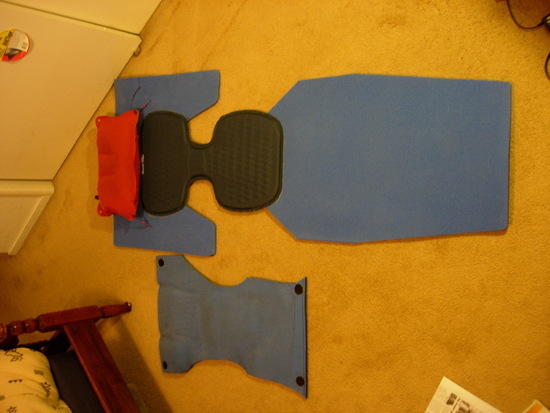
Back when I was a young buck, a 6oz .35" thick, full length closed cell foam pad did the job. As I aged, I moved up to a .55" torso Barge cemented to a .35" leg section at 7.2 oz. At 50 years I decided that the longer and sounder sleep afforded by an inflatible torso section was worth the weight.

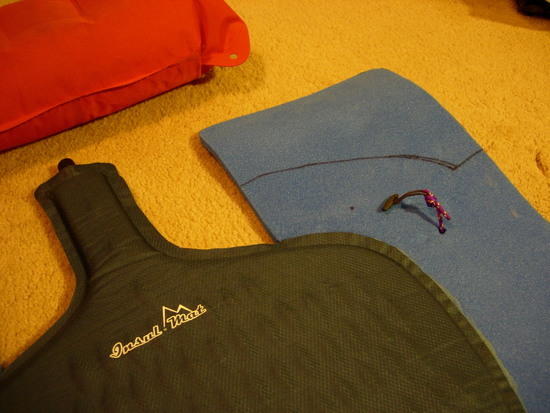
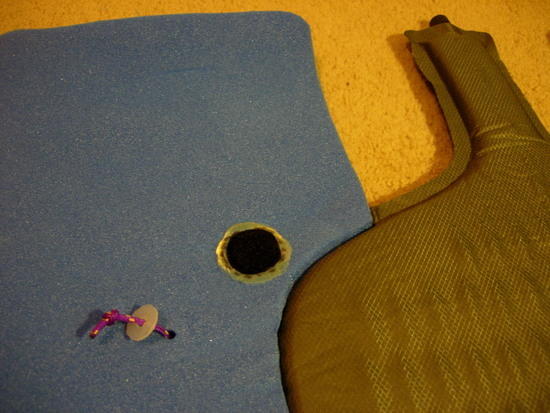
I just finished construction of a hybrid system based on the Pacific Outdoor Equipment Insul Mat Uber-lite, $49 from backcountrygear.com. After trimming excess fabric it comes in at 8.6 oz. It is hourglass shaped to fit the bodies' needs and nothing more.
.35" blue foam for legs and "wings" for my forearms when I side sleep and elbows when I back sleep adds another 5.6 oz.
Montbell UL comfort system pillow kicks in an additional 2.5 oz for a total 3 season sytem of 17 oz.

Admittedly this system weighs almost as much as my sleeping bag, but the solid night's rest makes it worth it.
For winter I velcro a .35" thick hourglass shaped foam pad under the inflatible POE Uber-lite @ 2.7 oz.

Complete system with winter upgrade pad alongsidePlastic toggle (provided with pillow) is inserted through hole in pillow flange to locate pillow.Backside detail with pillow attachment backing plate and winter pad velcro patch

PostedFeb 24, 2008 at 10:18 am

Use a UL 3/4 length Thermarest, etc. for your torso & a closed cell for your lower legs. Sew toggles (from a fabric shop) with light cord like Triptease to the bottom corners of your Thermarest.

Then duct tape reinforce the corners of the closed cell pad (I suggest Gorilla Tape) and melt holes through just big enough to pass the toggles. Now you have a sit pad for day & "leg mattress" for night, thus satisfying the UL mantra of dual purpose items.

Eric

PostedFeb 24, 2008 at 7:34 pm

After going to the local shop and trying out the options, I think I have a solution.

The Therm-a-rest Z-lite is a very comfortable pad that weights only 15 oz for the entire body. The best part is it comes in conveniently sectioned off folding areas. This means that paring it down by 5 of the 14 folding sections to make it the same length at the Ridgerest is really easy. And it would weight only 10 oz then. The extra 2 oz is worth the additional comfort it gives. Now, I just have to train myself to be a back sleeper and I am fine.

Note: this is tentative right now. I will consider a hybrid system as well, but I think this Z-lite with some anchor points will work the best.

Viewing 15 posts - 1 through 15 (of 15 total)
Loading...