Topic

11g Infrared beacon, a lighweight emergency beacon

Viewing 21 posts - 1 through 21 (of 21 total)
Marcus BPL Member
PostedMar 5, 2021 at 6:43 pm

I picked up one of these after watching Coast Guard Astoria (basically ‘cops’, but they follow the CG while they rescue people either in Miami, Astoria (portland) and one other place im forgetting). In one of the astoria shows a boater capsized but had an IR beacon and the CG chopper’s FLIR picked it up like it was as bright as a bonfire from a few miles out. Chopper flew right to the boat, everyone rescued. It stuck out to me because they had one of the easiest times locating the swimmer out of all the rescues I watched (which was almost every episode).


Most IR beacons are large, but I stumbled across the Nitecore that only weighs 10.5g

https://flashlight.nitecore.com/product/nu05mi

I have other emergency signaling equipment, but for 11g its nice to know a chopper with FLIR or night vision will see me like One World Trade Center when they do the Column Of Light, should things ever turn horrible.  After watching the rescues on that show it really beat into my head if you dont have a good signaling device, they can be very close to you in a chopper and never see you.

Figured I’d mention it here because its cheap ($30) and light insurance policy, which I will probably never ever use, but with adventure comes uncertainty and I prefer to have a backup plan within reason.
Josh J BPL Member
PostedMar 7, 2021 at 6:30 pm

Very interesting,  I can see that being a good compliment to a backpacker with a inReach or similar. Wonder how well it would cut through trees if your in a forest or does it need direct sky view? But as long as someone has night vision it could definitely help find you

Jenny A BPL Member
PostedMar 17, 2021 at 5:49 pm

Being a sucker for light, cheap, and potentially lifesaving, I ordered one.  It just arrived and I’m charging it.  Impressively light:  0.3 oz, 0.7 oz with the little clip dealio.  I could see it being a great complement to the InReach or a PLB as Josh J mentioned.  If the poop ever hits the fan, it couldn’t hurt to appeal to as many different rescue technologies as possible.  And with the InReach, one could alert the rescuers that you had an IR light.  Now to find someone with night vision goggles to see the beam….

Jenny A BPL Member
PostedMar 17, 2021 at 7:47 pm

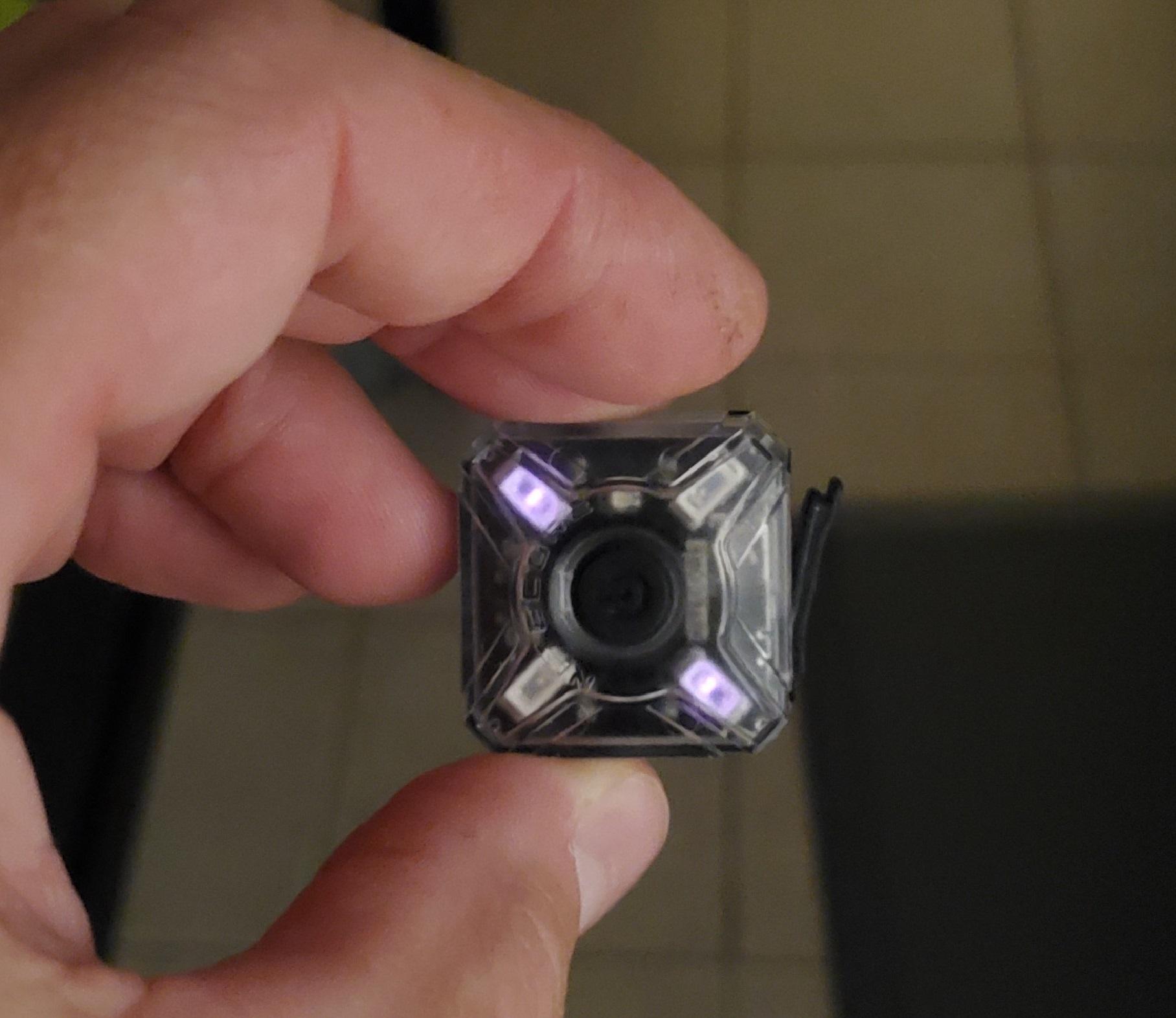
Well, I just found a slick way to see the IR feature on the Nitecore.  I was having trouble understanding how the light cycled through its modes because I couldn’t see the IR light.  But it turns out that if you turn the video camera on an iphone toward yourself and shine the light at it, you can see the faint violet lights that indicate the IR flashing and constant beam modes.  There is a filter on the regular lens that blocks IR, but the screen side has no such filter.  Heh heh….

Still need to find someone with night vision goggles to see the beam.  But I am feeling very clever right now.

Marcus BPL Member
PostedMar 17, 2021 at 9:36 pm

Jenny, that is a great idea and worked perfectly on my Samsung S10! Here’s the view form the front camera, no flash, filters or anything else, just a auto-shot. (The S10 cam must not the same filter?). To my eye there was no discernible light as expected.

This light signals are confusing and mine was actually dead because I accidentally left it on! I charged it and tried out your phone camera method and it seems to work great. I will definitely use this to confirm on/off status in the future.

For reference, as the manual is large for such a small device

Once you’ve selected IR as the function (as opposed to blinking green light)-

To turn ON – Hold Button until red light flashes quickly for 3 seconds

To Turn OFF – Hold button until red light quickly flashes once

If you short-tap the button while OFF you get 3 slow flashes

If you short tap the button while ON you get 3 seconds of fast flashing.

I’m sure I’ll forget this soon and just use my camera as you discovered, or reference my cheat sheet here. lol. Kudos for a good find

Josh J BPL Member
PostedMar 18, 2021 at 5:54 am

There might even be an app out there that would let you see the light

Jenny A BPL Member
PostedMar 18, 2021 at 7:41 am

Marcus, nice.  I am not very tech-savvy but I am good at googling questions. :>). It seems that on many if not most or all iphones, Apple filters out infrared because they feel that makes for better photos.  But apparently that filter is only on the main lens.

Nitecore  has a video where the woman explains how she reverses the camera on the phone.  That was clarified when I googled “how to see infrared light with an iphone,” which pulled up a more detailed explanation that my brain understood.  I did this to prevent exactly what happened to you, i.e. the unit being on but you unable to see it and the batteries draining.  Now that I have seen the lights, the button pattern makes sense.

David Thomas BPL Member
PostedMar 18, 2021 at 2:55 pm

Wouldn’t a Bic lighter be a much brighter source of IR?
And something I’m going to be carrying anyway.

Does emitting more IR broadcast to the mosquitos and rattlesnakes, “Hey, there’s a warm-blooded critter here!”?

Stephen Seeber BPL Member
PostedMar 5, 2022 at 12:12 pm

I just purchased the Nitecore device.  I am skeptical that it can do what it claims, so I will let you know.  I doubt this produces high enough heat and has a large enough heat source to be resolved by a thermal imager mounted on a helicopter flying at 1000-2000 feet.  I will report back once it arrives.  I also suspect the wave length at which it operates to be the wrong choice for the type of IR cameras mounted on a helicopter.

Josh J BPL Member
PostedMar 5, 2022 at 3:41 pm

Interested in the results.  I’d also like to know about the gaudrian version

Stephen Seeber BPL Member
PostedMar 7, 2022 at 8:49 pm

I received the device and could see the beacon with my phone but not my thermal imager.  Then, I revisited the websites and figured out what they are supposed to do. The original poster assumed this device is similar to the IR beacon in the rescue he described.  It is not.  It is a signal light designed to be detected by a night vision imager, not a thermal imager.  The same is true for the Guardian device.  A night vision imager is a light amplification device. Night vision devices can also image UV and some IR wavelengths.  Many SAR helicopters are equipped with thermal imagers.   These imagers will not detect emissions from the Nitecore or Guardian devices.  Typical commercial and SAR thermal imagers detect infrared at longer wavelengths than those produced by the two signal lights.

Paul Wagner BPL Member
PostedMar 8, 2022 at 7:20 am

Sounds like a tea candle might be a better solution…tying this to another thread.  ;>)

Josh J BPL Member
PostedMar 8, 2022 at 7:50 am

Stephen,

Thanks for the reply!  It’d be nice to have a small device to help SAR helicopter pin point your location from a distance even if it’s a half mile

Roger Caffin BPL Member
PostedMar 8, 2022 at 2:48 pm

a small device to help SAR helicopter pin point your location from a distance even if it’s a half mile
Yes, that would really help with a rescue.

In fact, modern PLBs include this feature automatically.
They start with a GPS receiver to get the current coords, then they send the SOS signal at 406 MHz. Every commercial airliner and some private ones carry a monitor for this band. A group of satellites also monitor this band. The SOS is sent even if the GPS receiver fails. This system works right around the world.

The 406 MHz signal is the new frequency, replacing the older 121 MHz frequency. But modern PLBs have kept the 121 MHz transmitter which they use to transmit a homing signal on. SAR units carry a tracker for this frequency and can home in on it.

Some PLBs also include a high-intensity strobe light as well.

You buy the PLB yourself. Then you register it with the international SAR authorities via your national SAR authority. Registration is free for you, monitoring of the 406 MHz band is free for you, and in general a PLB-activated rescue is free. There are NO extra charges after the purchase.

Cheers

Josh J BPL Member
PostedMar 8, 2022 at 7:38 pm

True, but I was thinking cheaper and even lighter.  Something to compliment a satellite messenger like an InReach.

PLB are in the $$$ range and 4oz plus.  The appeal to the guardian and nitecore is they are less than $100 and weigh an ounce or less

Chris R BPL Member
PostedMar 8, 2022 at 8:24 pm

Maybe a simple rear bike lamp with a strobe function?

Arthur BPL Member
PostedMar 8, 2022 at 8:59 pm

I read an interview with a Colorado SARs member who said that the inReach has made their missions easy. They go to the coordinates and the victim is just feet away.  No elaborate searches.

Stephen Seeber BPL Member
PostedMar 9, 2022 at 7:52 am

I sent an email to the NiteCore.  Here is their response:

The 300 feet you mentioned, which is circa 91 meters, this distance is too long for the NU05 MI IR light to be detected. 

The NU05 MI is a mini infrared IR and green signal light specifically designed for law enforcement and military applications to use with night vision devices, it is for operations in dark environments (mainly for close search and rescue) and enables quick identification or location on different team members. 

Hope this helps, any questions please let me know. 

Yours sincerely, 

NITECORE Support Center

This response says that an aerial SAR will not see the beacon.  It is designed for use with a night vision device (not a thermal imager) and is designed for close in identification of “team members”.  So,  it is not designed nor intended for the use the OP and various responders would like.

Marcus BPL Member
PostedMar 9, 2022 at 5:48 pm

As usual Stephen, you are the local god of infrared light. Thanks for correcting this!

Viewing 21 posts - 1 through 21 (of 21 total)
Loading...