Topic

Sleeping bag cover

  • This topic is empty.
Viewing 9 posts - 1 through 9 (of 9 total)
PostedJan 11, 2008 at 11:03 am

Lots of good info here… I've enjoyed lurking around the forums for a while and finally ponied up the subscription fee so I could have access to all the articles.

My question is regarding sleeping bag covers.

I'm switching from a synthetic bag to a down bag for the weight savings but I'm paranoid about the bag becoming wet and thus useless.

The bag I'm buying is the Mont-Bell U.L. Super Stretch Down Hugger #2. Lo and behold, MB also sells a Breeze Dry-Tec U.L. Sleeping Bag Cover. (http://www.montbell.us/products/disp.php?p_id=2321027).

Does anyone know anything about this cover? I really, really don't want to have a wet down bag on a 15-20 degree night.

Thanks
Thomas

Steven Evans BPL Member
PostedJan 11, 2008 at 11:14 am

Thomas,
Which moisture are you concerend about? From the tent walls or condensation? Or is this for your bag under a tarp?

PostedJan 11, 2008 at 11:24 am

I'm worried about any form of moisture that could affect the performance of the bag. The referenced cover looks like it's designed specifically for this purpose but I can't find any 3rd party commentary on how well (or if) it works.

Thanks
Thomas

(edited to correct spelling)

Steven Evans BPL Member
PostedJan 11, 2008 at 11:54 am

Ahhh, I get it. FWIW – I have no experince with the MB, but since it is a bag cover, it won't help keeping your bag dry from the moisture coming off your body. I have found that to be a larger factor (in winter) then keeping the outside dry (as long as I'm in a tent). Under a tarp, I use a bivy and a VBL.

PostedJan 11, 2008 at 7:32 pm

There are others more knowledgeable about this than me but what you're talking about is really a bivy. From what I've heard the poster above is right, this type of thing would probably make matters worse (assuming you're using a tent) by keeping moisture coming from your body inside the bivy. If you're using a tarp then it's another question altogether. You may want to look at something that's more breathable but not so waterproof, like the new Oware bivy that's made of nylon with a durable water repellent coating.

Tony Wong BPL Member
PostedJan 11, 2008 at 11:11 pm

Thomas,

I had your same concerns when I moved from a synthetic bag to a down bag.

When I was in college, I had an experience sleeping in a down bag that got soaked by water entering the tent I was in. It was a long and miserable night.

I ended up going with a 15 degree Marmot Helium EQ sleeping bag that I then seam sealed.

The bag weighs 2 lbs 3 oz.

Great bag, but was expensive at a little over $400.00 a year ago.

I posted a story just a few days ago regarding my experience with the Helium EQ.

See posting: Rab Q600 or Marmot Helium?

Basically, I slept in my collapsed tent in about a half inch of water.

I stayed completely dry and warm.

I can not say enough good things about the Helium EQ.

To give you an idea how paranoid I am about getting my bag wet, not only have I seam sealed my sleeping bag, I also bought the MLD Soul Side Zip with the eVEnt top.

Kinda over kill, but I would rather carry a few extra ounces and be "bullet proof" with my bag.

PostedJan 13, 2008 at 10:45 am

Welcome Thomas –
You’d be better served by letting us know the climate, seasons, and/or kinds of weather conditions that you see most often.

For the high Sierra in late summer, a down bag in a fully-waterproof bivy may well be a ‘bullet proof’ system for keeping out environmental moisture like rain, with or without a tarp. But in the soggy Northwest in October, it would be a pretty sure bet for trapping interior moisture IN (from damp clothing, perspiration, respiration). Excellent in one scenario, potentially disastrous in another. Particularly concerning marginally breathable waterproofs like Breeze Dry-Tec.

In general, it is easy to over-estimate the threat of external moisture, and to under-estimate the dangers of internal condensation buildup.

In my neck of the woods, managing internal condensation buildup, with infrequent opportunities to sun-dry your gear, is by far the more difficult challenge. As much as I like eVent for other applications (and it IS an exceptionally breathable waterproof fabric), it is just not breathable enough for a sleep system over multiple nights in the damp cold conditions I most often see. Here, an ultra-breathable, non-waterproof bivy (with a shell fabric like Pertex Quantum or Momentum 90) is a better supplement to a tarp and a down bag, and is reliably drier overall. For relentlessly wet/cold weather, I use the MLD Soul bivy under a big, well-ventilated tarp.

Edit: Some classic BPL articles which unfortunately are not visible enough right now:
Clothing & Sleep Systems
Unconventional Sleep Systems
Bivy Sacks SOMR

I’d also recommend Mike Martin’s excellent article ‘Staying Dry in a Bivy Sack’ in BPL Print issue 7, which covers both waterproof and water-resistant bivies.

Jamie Shortt BPL Member
PostedJan 20, 2008 at 7:30 am

Well here goes my first post…

Thomas, I too had the same questions and had trouble finding first hand experience so I will share mine… though its limited.

Wanting to take the next step into lightweight backpacking I wanted to drop my tent…MSR Hubba… which I love by the way so it was a hard decision. So I set out researching tarps and bivy's. The tarp was fairly easy I went with an integral designs silnylon 5×8 tarp weighing in at 7.15 oz with stuffsack. I added spectra line and 8 Ti stakes for another 3 oz.

So now for the Bivy. The advice here seemed to encourage breathable top/waterproof bottom, but I was drawn into looking at the Montbell Dry-Tec. At 6.5 oz and just over 100 bucks could this work.

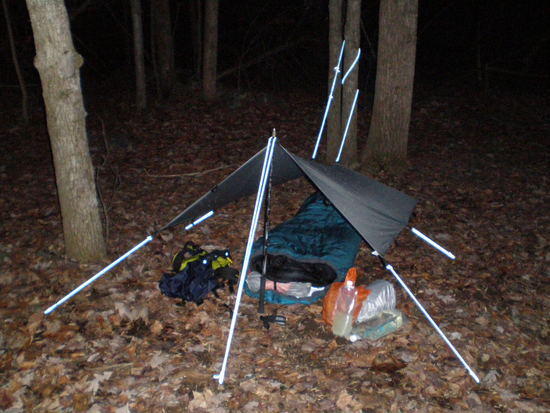
I decided to give it a try and here is what I found. Last weekend I spent 2 nights in Shenandoah National Park covering around 35 miles including Old Rag. The night weather dropped to 35 the first night with wind gusts and 23 the second night, but was calm. There was no precipitation. With the tarp and cover I was using a Marmot Hydrogen rated to 30 (23.5 oz) with a Montbell 90 sleeping pad inside the cover (10 oz) and a GG 3/8 inch floam pad on the ground (3/4 length – 5.7 oz).

Both nights I slept exceptionally well and was warm though I dig snug the hood around my face. I was wearing REI lightweight synthetic LS top (6.6 oz), Columbia Silver ridge pants (13.25 oz), socks and a fleece beanie.

Now the question you want answered…how about condensation? The first monring I could find absolutely nothing! I ran my hand inside the bivy looking for something and I checked the tarp. Both seemed dry as did the sleeping bag. I am use to waking up in simliar conditions and my hubba fly inside is soaking wet. The second night was almost the same. On the inside of the tarp near the peak were ice cystals and I was able to find a few ice crystals on the top of the toe box of the Marmot, but still could not find any moisture inside the bivy. Nothing scientific but I feel the bivy added significant warmth to the bag.

The downside…there is not a lot of room in the bivy, it just fits over the bag and has no zipper. For colder conditions this works great. But I think this bivy might be too warm for me during warming months. So now I am shopping for a lighter bag…an Atom or a quilt.

Hope this helps,
Jamie (note all weights are my own no manu listed)

First night using tarp and bivy.

Jamie Shortt BPL Member
PostedJan 20, 2008 at 6:08 pm

correction…the sleeping bag I was using was not a Helium it was a Marmot Hydrogen.

Viewing 9 posts - 1 through 9 (of 9 total)
Loading...