


I am starting the AT in March 2008, which is about a month earlier than originally planned. I now need to get a warmer sleeping bag, and I am trying to go ultralight. Any suggestions? Thanks.
Topic
Become a member to post in the forums.
I am starting the AT in March 2008, which is about a month earlier than originally planned. I now need to get a warmer sleeping bag, and I am trying to go ultralight. Any suggestions? Thanks.
If you plan on early March your "winter gear" will just weigh more, starting with your bag and insulating clothing, especially your outer layer or parka. In general you will be adding an extra layer. So, let your goal be to make that extra layer as light as possible without sacrificing the warmth you need. (windshirt , vest, mittens, wool hat, gaiters, etc.) Consider your raingear to be a warm layer also which is why I would recommend rainpants. rain pants over long underwear can be worn both during the day and into the sleeping bag. Lightweight w/b raingear is four season gear. The coldest times you need to be prepared for is when you have stopped hiking for the day and are settling into your campsite or shelter. tha is when you wear the parker. Remember, too, that you will not be needing the extra layers too long into your hike as spring arrives. So, a 0-degree bag will be 2+ pounds with the lightest option being down. Check out Western Mountaineering and Feathered Friends for description of down bags. A bivy will add further warmth. Most of my comments are not about bags, but about going lightweight in winter. Lightweight is a relative term. The gear you need for winter adds weight and bulk to your pack, but work on keeping it to a minimum. Look for lightweight winter gear.
Look over into whiteblaze.net for a more AT specific forum including gear selections.
Ultra-light 0*F bags tend to be ultra-heavy on the pocketbook and are desirable in only a narrow range of climate conditions. Assuming that you already have a bag and guessing that it is rated for 30*F, lets think about dual use alternatives that would cost less than buying a second bag:
1)warmer insulated clothing will be desirable for cold mornings and evenings and could be worn inside the 30*F bag to handle the coldest nights and left in your pack on the not so cold nights.
2)Use a 40*F quilt as a top bag over the 30*F bag. Also, such a quilt might be more desirable than a 30*F bag during the warmest summer months. Quilts like the JRB "stealth" and "no sniveler" can double as wearable insulation on the coldest evenings/mornings.
If you already have a 30F bag and a down jacket you are using, think about adding a pair of down pants to help go lower into the temps. Cabelas makes a decent one for $50 that you can modify slightly so that it will only weigh about 10 oz.
Wow, thanks for the other options to consider rather than laying out mega $$ for a zero degree bag! I know my wife will appreciate them!
Will these options work for a 40 degree Marmot Atom? I know it probably depends on how tolerate you are to cold, but how many days on avg does it get bitter cold at night on the trail? I am prepping myself that it will probably snow on me. I plan to alternate half the time in the shelters and half the time in a tarp. Thanks so much!

I often use a combination of clothing to supplement my quilt or sleeping bag… but keep in mind that the amount of insulation you need to sleep is 2x the amount of insulation you need when stand around, and 7x what you need when you are working hard. Clothing sufficient to keep you warm down to say 0-10F with a the Atom might be too warm for wearing when doing camp chores except on the coldest days.
–mark
Become a member to post in the forums.
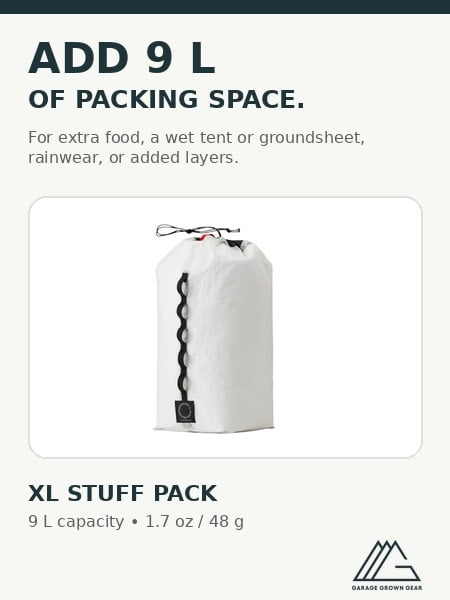 XL Stuff PackLightweight stuff pack designed to secure to the top of your backpack for carrying wet gear, extra food, rainwear, or layers.
 © Beartooth Media Group Inc.
 Loading...