


All, How hard is it to add mid line guy out points on 30d Sil? Lets say the extent of my sewing ability it buttons. Thanks!
Topic
Become a member to post in the forums.
All, How hard is it to add mid line guy out points on 30d Sil? Lets say the extent of my sewing ability it buttons. Thanks!
The simplest, no sew solution I can think of: Add a tarp tie out point with just a piece of cord. If you wanted to make it more durable then a patch of Tenacious Tape would probably do the trick.
I was pretty vague in the first post.. my fault! Will the tape work well for mid panel points? I have an oppurtinity to buy a BD Mega Light but am hesitant due to the lack of panel guy outs. Want to see if it would be worth my time/$$ to add them.
With what I was thinking you wouldn't have a loop at all. In the video a knot in the cord holds the string, instead you could use a rock or other small, smooth item. The tape simply re-enforces that bit of material. The problem, of course, is that when pitched it wouldn't be smooth because the pinched material deforms the panel. It's a quick and dirty solution. Not elegant, but effective. In the long run a sewn in loop would probably be better.
My google is down at my current location. With the sewn patch I assume that a small square of webbing (or similiar material) needs to be sandwiched inside and out in order to provide strength? Would I be able to just sew the perimeter or does it need an X or Z stitch through the middle? I appreciate your patience with my incredible lack of knowledge.
Well, I am not very good at sewing. I believe buttons are my grand achievement too! So, I'm curious to see what others have to say too.
You can make tieout points that glue on rather than sew. I have made them by cutting a three to four inch diameter patch of uncoated nylon fabric and sewing a loop of grosgrain ribbon to the patch. I lay the tent or tarp fabric on a piece of foam with a piece of freezer paper directly under the fabric. The freezer paper is to keep the fabric from sticking if any glue bleeds through. Having previously located the point that the tieout is to be attached, I spread some silicone glue, usually thinned about 3 to 1 with mineral spirits, on the fabric and place the tieout patch on the glue. Another piece of freezer paper goes on top followed by a piece of foam and finally a gallon jug of water for a weight. The glue cures for 24 to 48 hours and the patch is uncovered. The glue will penetrate the patch and grosgrain, so some scraps of freezer paper may be used to keep the grosgrain loop from being glued to the patch. Silicone glue is pretty sticky and the parts not to be glued need to be protected from it. There is no guarantee that the patch won't come loose, but it won't damage the fabric if it does. It's a really good idea to try this with some scrap fabric before attempting the real thing. Once the patches are glued on, it is possible to add some stitching, by hand or machine, to reinforce the attachment. Some fabrics may not glue well, others will. I use 100% clear silicone, what ever I can find cheapest.
There's a good article on this site about bonding silnylon.
Solid info William, thanks for that! Is there any benefit to using shock cord v grosgrain to mitigate some of the strain applied directly to the patch? Or is it easier just to sew the loop? Todd Thanks for the point in the right direction, its nice to have some specific key words to look for! I'm having issue with the search function (host country internet issues) but hopefully it will clear up soon.
It doesn't require a lot of skill, and can be done adequately by hand with a little patience. Your mod', on your 'mid: http://www.backpackinglight.com/cgi-bin/backpackinglight/forums/thread_display.html?forum_thread_id=74906 This was 2.5 years ago. Looks like the seller's last forum post was 2 months ago, so you might be able to get in touch with him. I agree with his method, although you probably won't want to sew that vertical strip of webbing on by hand – it may help, but I wouldn't say it's required. By bonding a patch to the inside and then sewing through from the outside, you pull the patch against the panel instead of away from it, and the heavy threads of the patch protect the delicate threads of the panel from the load applied by your stitches. The seam between the blue and grey panels is double stitched and has a double layer of fabric in the middle – sew through that. Putting the patch on the inside also protects the bond from weathering. Since this is a mid-panel guy-out, the load will be directed away from the plane of the panel (that's the whole point of the location). If you were to use a box stitch or similar, the 'bottom of the box', where the loop is pulled away from the panel, would have the highest load and be the failure point. So there's not much benefit to a full box stitch. A heavy bar tack, as the seller made, is all you need, and that's an easy task for hand stitching. Use a 100% polyester thread (no rot, no stretch when wet) and make a *lot* of stitches. Pending what type of bonding agent you use to apply the patch, it may be difficult to get the needle through it, so you might want to pick up a thimble when you're at the fabric store. Don't forget to seal the stitch from the inside when done.
I don't use shock cord in my tieouts because the elastic eventually goes bad. I make shock cord or rubber tubing tensioners in my guy lines. The guy line is not cut, so that an elastic failure won't sever the guy line. I often put loops of shock cord in my stake loops. The stake can be passed through the shock cord loop or directly through the stake loop. I use firm grosgrain ribbon and I always loop it in a "U" so that it is attached at each end.
Makes sense. Thanks all for the wealth of info!
Joshua, I don't think that sewing guy outs is that much more difficult than buttons to be honest. Adding reinforcements and the webbing is very straight forward….just sew around the perimeter of the webbing and then sew as X through it. The trick to this is that this is hard on the current plastic geared sewing machines. If you have an older machine with metal gears then you'll be fine. Bonding should work just fine as well but it's not something I have experience with. If you're still worried, I'd be happy to do it for you…I'd just ask for $10 to cover the cost of materials (you'd pay shipping too). -Jordan
Rene, I was able to get a hold of the OP who provided me with some more info on how he did his upgrades, thanks for the link! Jordan My sewing machine is… handheld… I'll see if any of my friends have one I could use haha. Thanks for the offer, for the time being I think I would like to try to do it myself. If I hit the frustration wall I will deffinitley take you up on it though.
I definitely encourage you to try it yourself…MYOG has taught me more about gear use/functionality than about gear making itself. My offer still stands and if you run into any issues, feel free to PM me and I'll help out however I can.
Become a member to post in the forums.
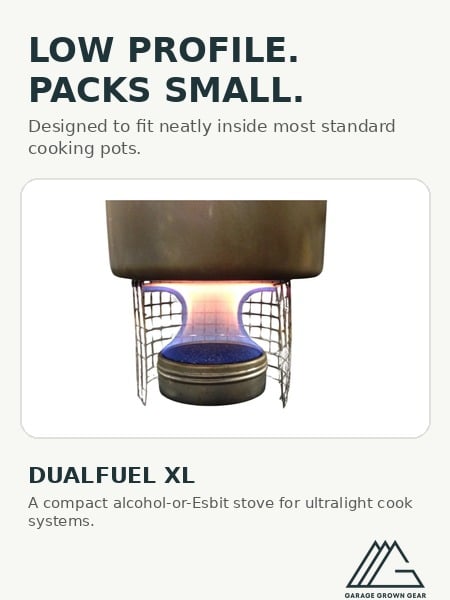 DualFuel XLCompact alcohol-or-Esbit stove with a low-profile design that fits inside most standard cooking pots.
 © Beartooth Media Group Inc.
 Loading...