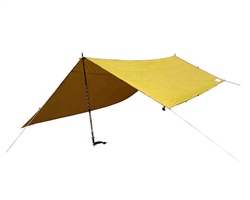
Hi All I was wondering what suggestions people would have for a rain tarp. I've been doing a lot more off season, and monsoon season trips recently, and have been experiencing a lot more rain. In the past, when rain has gotten bad, I have always just bunkered down in my tent. But, it would be nice to have a tarp for a communal place to hang out/ cook with friends when its raining. On my most recent trip in Zion last week we got hammered with rain every day. Luckily a friend of mine brought a cheapo blue plastic tarp (bulky and heavy). But it came in VERY handy to put up between trees and with trekking poles to make a nice group hang out shelter from the rain. Are there any lightweight, waterproof tarps out there that would work for this? Ideally something that could have up to 4 people hanging out under it and not feeling cramped. THanks!!
Topic
Rain tarp
Become a member to post in the forums.
- This topic is empty.
I assume you don't want to spend the high dollar for cuben fiber, but if you do ZPacks has an 8.5' X 10' for $255 (6.7 oz) and an 8.5' X 11' for $275 (7.2 oz). Brooks Range Mountaineering makes the Guide Tarp (9' X 8") at 12.5 oz and the Guide + Tarp (10' X 10") at 15.5 oz. Each have 16 tie-outs which is much better for what you have in mind, They're also made from 20d nylon so the Guide Tarps are a few oz lighter than 30d nylon. They're a little expensive at $159 and $189, but right now you can go to campsaver.com and use code Fallfest20 and get 20% off.
Backcountry has the Rab Siltarp 2 on sale for $104 (8' X 10') at 14 oz and the Siltarp 3 (10' X 12') at 21 oz for $160. You could also check out Oware tarps at bivysack.com. They offer a 10' X 10' 30d silnylon tarp (18.5 oz) for $125 free shipping.
Oware’s tarps seem to be well liked around here, affordable, and come with plenty tie-out points by default.
Im not super savvy on material types. Looking at the Oware Flat Tarps…is 30d silnylon a durable material? Would I need to worry about it tearing in heavy winds? How water proof/ resistant is it?
Just a thought here but instead of carrying a tarp and your tent have you thought about getting a big mid and using it for both? While a 10×10 mid is overkill for sleeping one, it's a palace and has plenty of room in the rain, to cook (in non griz country), or to hang out and play cards. It also has tons of room to stand (at least close to it), change wet clothes etc. In Alaska this summer we used a big mid as a cook tent since we didn't want to cook in camp and it was nice to have in the rain, snow, and high winds we experienced.
In "significant" bear country do you want all your buddies spilling their food in your mid and you sleep in it after they are finished….not me.
" is 30d silnylon a durable material?" It is the standard for most lightweight silnylon tents/tarps, plenty enough for the purpose. No one is making these out of 70d afaik, due to the weight penalty and because it is unnecessary in this application. p.s. not talking about mainstream products here of course, but about specialist high quality cottage manufacturers.
30D silnylon is fine for tarps. Durable and waterproof, been used for many years – I would have no concerns about it tearing. 30D silnylon is the material almost all silnylon "cottage" shelters are made out of (Tarptent, MLD, Oware, Six Moon Designs, etc) My recommendation would be a large flat tarp. I think it's nice to be able to set it up high and have a view when it's raining (if there's not much wind)
"In "significant" bear country do you want all your buddies spilling their food in your mid and you sleep in it after they are finished….not me." No I wouldn't recommend that in "significant" bear country and I even recommend eating away from your camp in some locations but in some areas I have no problems cooking in my tent. My comfort level varies from Alaska to the Winds to the AT to the Cumberland Plateau. A flat tarp allows a reprieve from the rain and a great open space for eating and hanging out in rainy mild weather. It would work great many places below tree line. In high winds and really nasty weather above tree line or in really cold temps an enclosed hang out shelter is nice IMO.
Almost all of the canoe campers I know bring tarps for just this purpose. Probably the most respected maker of such tarps among that community is Dan Cooke of Cooke Custom Sewing, which is a family owned cottage company in Minnesota. He carries tarps using either 1.1 or 1.9 oz/sq yd sil nylon. These tarps are extremely well made and have numerous tie outs, but mine have come in over the advertised weight, which canoe campers do not obsess over like backpackers.
I’ve seen Dan Cooke’s tarps, they are very very well made. The construction techniques evolved from sewing for folks doing multi-week and multi-month canoe trips north of the treeline in Canada where there can be no shelter your side of the horizon. Sturdy in the extreme (and very well field tested) but certainly not in the gram weeny weight class. A bit heavier than other manufacturers of silnylon tents. So it will depend on how important a few ounces is to you.
…an ID Silwing fits this role nicely. I have one, and I like the way it sheds the wind that so often accompanies rain, and it can be pitched with a sort-of porch to keep wet boots out of the way.
If I only have a catenary cut tarp, would it still be useful in this application?
Pitch it high and wide and it would work well for your average rain. If it's a storm you would obviously need to drop it down. You would lose a little room, but it would still work and be better than being isolated from your friends in your own tents. Your cat cut tarp should work well for this purpose.
“Ideally something that could have up to 4 people hanging out under it…” Four people standing or 4 people sitting? How you pitch and how you accomplish that goes into deciding on size. A lot of consideration needs to go into pitching “high and nearly flat”. Tall supports are needed (trees), and pooling water can be an issue. The higher you go the more tarp you need to avoid blow-in. My wife and I use trekking poles adjustable to 54″. We don’t have to worry about finding a grove of trees or makeshift pole. For us, efficiency matters. If you intend to use trekking poles, give some thought to “pole pockets” to keep handles out of the mud and to prevent puncturing the tarp when the wind lifts the grommet off the pole tip and sets it down to the “inside”. I made these for our tarps –
Note the LineLock. I tie a simple loop on the far end for the stake. This speeds setup, and allows me to trim/tighten from under the tarp, not out in the rain messing with a rain swollen knot. Shortly after I posted mine, Zpacks started to offer These –
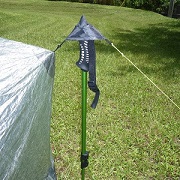
For a first tarp I’d give a Lot of consideration to the abundance of tie-outs found on something like an Oware –

Once you learn what works for you, your next one could include less, but having the options is nice. We pitch a “nearly vertical” back wall, with a sloping “roof”. Those tie-outs in the middle hold the back wall in a prevailing wind, and help distribute the load. Recognizing that the “edges” will be susceptible to blown-in rain, we can shelter 4 with a 12′ wide tarp. For my wife and I a 10’x10′ will keep us dry no matter what. Sil works fine, and is reasonably priced.
I would get an 8×10 or 10×10 flat tarp. Either can be piched many ways and you will find all kinds of uses for it. Silnylon is fine. Cuben would be great if your budget can handle it. Think about guy lines and stakes, whicn can add up in weight and dollars. The cheapest poly tarps can be surprising light if you are on a budget. You can get green or brown ones that are more pleasing to the eye.
My hiking partner surprised me on a trip this year by announcing that he had brought a tarp to sit under. We typically don't bring a "hang-out" tarp on our trips but I have to say, if it hadn't been for that tarp, we would have bailed a few days early on our trip. His tarp is a Kelty Noah's Tarp 12 (12 ft X 12 ft) made of polyester which makes it quite affordable (ie. $70 at REI). This tarp could easily keep 4-5 people dry. This thing held up to some very strong winds and days of driving rain. Here's a shot of one of our setups. The log wind break was courtesy of some previous backpackers and the beach furniture was provided by the ample flotsam and jetsam on the Cape Scott/North Coast trail. 
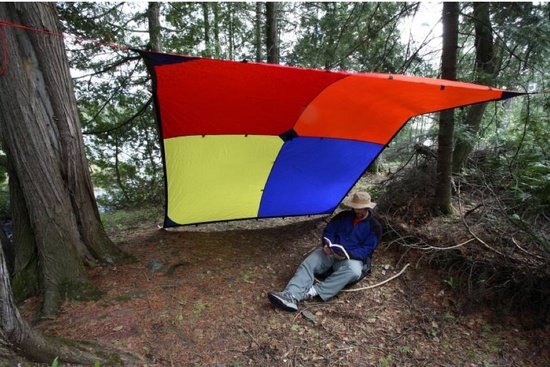
My next tarp will be a Tundra tarp from Cooke Custom Sewing (CCS). Reports from guides in the BWCAW are that the multi color option has had more positive effects on people's moods when huddled under the tarp. I suppose it doesn't look the greatest from a distance, but it's a rain tarp if you choose. I have met Dan the owner, and he's a class act. My current large rain tarp is a 10×16 from from Borah Gear. I have been very pleased with what I got. Borah was the best price when I compared 2 years ago. 
One of the things I love about hammock camping is my huge Superfly tarp. I've crowded ten people under it during a thunderstorm. I've been thinking about carrying a secondary tarp when I'm not packing my hammock. It's hard to justify the weight but I'd probably bring it on the right trip.
Become a member to post in the forums.