Here is 30 seconds of diversionary reading that seems not to fit into any of the placement categories. A few years ago I was day hiking on USFS land just south of Glacier Park. I enjoy fiddling with my compass and was toying with it while the group was stopped for a water and snack break. Our small group picked up, moved on and found a nice spot for lunch. After lunch I looked for my compass and realized that I had left it about two miles back down the trail at the snack stop location. I knew exactly where it was but I was too lazy to retrieve it. The hike was a loop trip, no retracing was planned, though I certainly could have retraced. Fast forward to the following summer. I received an offer to do that same hike again and couldn't resist the opportunity to look for my compass and to enjoy the walk itself. It was easy to find the compass. It was about six feet off the trail in some rocks, difficult to see unless you knew where to look. After being exposed to the sun, snow, rain it no longer looked the same. Here is a picture of how it looks now (on the right). The other compass is my current favorite. I am not suggesting the Silva looked as good as the Brunton before being weathered; it is just a visual reference.
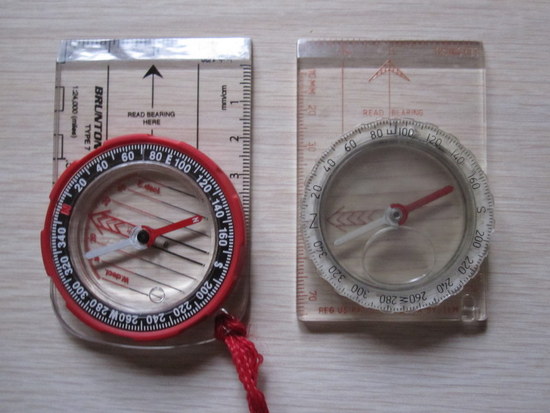
The weather had taken a toll. The compass, a Silva 7NL, about 40 years old, was now cloudy and dull, the lettering faded, though it still worked. Difficult to read it has now been retired. I lost a similar compass in Glacier Park about 10 years ago. I wonder what that instrument looks like after 10 years of weathering?
Topic
A Weathered Compass Story
Become a member to post in the forums.
- This topic is empty.
All in all, it looks rather okay. Amazing it was still there, though. I once lost my father-in-law's marine-compass in the woods. He was not too happy about it. I did went back, but failed to retrieve it. Taken by the woods, I guess :)
Numerous YouTube videos show how to clear cloudy plastic headlight covers with a solution of baking soda or toothpaste plus elbow grease. I suspect it would help the weathered compass.
I'd say the bigger concern might be the air bubble in the capsule. It may effect the needle's ability to move freeze. Do I see a small air bubble in the Brunton as well?
Thanks for the comments. I had not considered trying to rejuvenate it via car headlight cover restoration techniques though it would still have the large air bubble and faded numerals on the bezel. It has a certain "patina" that makes it appear that I have hiked even more than I have! It probably deserves to be displayed in a place of honor next to my wood-handled ice axe and my multi C-celled (or is it D?) headlamp. Yes, the Brunton also has a small air bubble. I have not found small air bubbles to be a problem. I vaguely remember BPL threads about air bubbles but don't remember the conclusions. Edit to add word.
I think the small air bubble is a feature, not a bug – it helps you to judge whether you are holding the compass flat.
Good find John. Not compasses, and not my own, but I have now found 4 watches while on trips. Well actually my wife found the latest one in Glacier last week. My best find was a Swiss Army watch at a lake in Wyoming. Completely buried but a piece of red from the band showing thru the sand and rubble. It would be nice to find a "Presidential" with all the diamonds my wife jokes. Ya…no such luck. jimmyb
Thanks for the thought about the air bubble, Ralph. It makes sense. On a somewhat related note I have an electronic compass which is built into an inexpensive GPS. It never seemed very accurate until I learned that it needed to be very carefully leveled before taking a reading. In fact it has a virtual bubble level in two dimensions to aid in holding it properly. Now I get respectable readings after having learned how to use it!
I'd say if the bubble helps you keep it level, that's just lucky. There's no guarantee the face of the housing is itself parallel to the needle or convex so the bubble would rise to the right spot when level. I've never seen a compass that came (intentionally) with a bubble and some mfrs will replace a compass that forms one. I think often a sudden change in pressure (carrying it to very high altitude) will cause a bubble to form. Sometimes it goes away when you come down; sometimes not. I hate bubbles.
Compass looks fine to me. A good model. > I have now found 4 watches while on trips If you want to find gear, the place to look is under the path of the ski lifts when the snow has just melted. A small fortune can sometimes be collected. But it will be a race against the lifties. Cheers
A timely story as I am looking into purchasing as good a quality traditional compass to augment the Garmen Foretrex 401 I just purchased at REI. I was looking at the Suunto MC-2G as it is on sale for $68 on Campsaver, but some reviews make it sound like it isn't accurate at all. How is the Silva? Or do you prefer the Brunton? Any suggestions welcomed! Eric
Eric, I took an introductory compass and navigation course decades ago so I am not the best one to answer your question. I learned how to compensate for declination the old fashioned way and that is how I continue today. No built-in declination adjustment compasses for me! That probably puts me out of touch with most modern navigators. I would rate the needle action of both the Silva and Brunton the same. It would probably be a good idea to look at several at your local store and see which one appeals to your sense of taste and has easy-to-read numbers. Choose one that has repeatable needle readings without having to dislodge a sticky needle by tapping on the case (I hope none of those exist). A transparent base is a necessity (I would guess this would be a standard feature of all hiking compasses on the market). The compass is just a brute force instrument. Just as, or more important, is reading the topo map and forming an image of the route in your head. I admit to being average at best at that skill. I have a friend who can peruse a map for a few minutes then navigate off-trail without a compass for 1 to 2 hours. Wish I could do that! I am also still learning. I also still become confused at times even with the help of the compass! Someone else with more knowledge will give you better information than I have.
For orienteering races, I've found the silva works better than the brunton. For that use, a needle that settles quickly to its final position and resists jiggling around when your hand is shaking a little is much easier to use. To see the difference, hold one compass in your left hand, and one in your right hand at chest level. Wait for the needles to settle, the. Turn 90 degrees and see if one settles a lot faster than the other. Seperaty, jiggle your hand as if you have been hiking hard and are breathing hard and have a high pulse rate. Some compasses will jiggle back and forth 10 degrees non stop. Others only 1-2 degrees :)
Haha awesome story! Cool you were able to find it again. As far as the weathering, I can add that I recently hiked the Bottle/Eagle/Finger slides in the Adirondacks, and found an old, UV-brittled Nalgene deep amongst some blowdown. My theory is that it rolled off the summit long ago and has been working its way downhill. Not many people hike up the Bottle drainage (I just realized the hilariousness of finding a bottle in the Bottle drainage), but who knows, maybe someone did drop it close by, but it looked like it had been traveling for a while. It was a major PITA to collect all the pieces, as brittle as it was, but I got most of em.
Well, I found myself a compass by Silva:http://silva.se/node/39 It's the Expedition S and its pretty nice.
Eric, where did you find the poor reviews for the MC-2G?
Become a member to post in the forums.