Topic

Entry Level Kayak Info

  • This topic is empty.
Viewing 20 posts - 1 through 20 (of 20 total)
PostedJul 29, 2015 at 6:41 am

Can anyone recommend an entry level kayaking book and/or dedicated forum to check out? I'm moving next year and will have access to 3 major reservoirs and the North Platte River in Wyoming, it'd be nice to be able to take advantage without having to haul out the ol' Bayliner.

I'm looking into kayaks specifically and not packrafts because the North Platte River is extremely shallow; often less than 1 foot deep, even in spring.

PostedJul 29, 2015 at 9:08 am

Thanks John, great resource.

Almost too great, I think my head is about to explode…

PostedAug 3, 2015 at 10:39 am

Andrew,

Just remember, a sea kayak, if that's what you're referring to, is easier to paddle (faster) the greater its length is in ratio to its width.

** Just be sure the kayak is also stable in a moderate sea so you can put your paddle down to take pictures, eat, read s chart, be seasick ;o), etc.

EX. My 18' Edddyline Sea Star (no longer made) is only 22" wide and, although stable, it is very fast. Thus I cover miles with less effort.

Personally I would try for a least a 17' kayak. Front and rear sealed bulkheads and waterproof hatches add a LOT of flotation but you should still have roll-top storage bags for internal float bags, bow and stern.

First practice "paddle outrigger" style re-entry (strap-on paddle blade float needed) then learn to Eskimo roll.

Dale Wambaugh BPL Member
PostedAug 3, 2015 at 11:16 am

Look for a kayaking organization in your area. Many provide training and you can do some group tours. River kayaking is quite different than sea kayaking and presents its own set of challenges and dangers so you have two sets of skills to learn.

Sea kayaks are designed for straight travel in wind and waves where white water/river kayaks are designed for agility in fast water.

Books on sea kayaking:

Sea Kayaking: The Classic Manual for Touring, from Day Trips to Major Expeditions, by John Dowd

Complete Book of Sea Kayaking, by Derek Hutchinson

Anything by Dowd or Hutchinson will get you going in the right direction for sea kayaking. I don't have a recommendation for white water travel.

PostedAug 3, 2015 at 12:24 pm

Thanks for the info so far.

So does 'sea kayaking' information apply to any type of open body of water? Or just the ocean? Because I won't ever be on anything larger than large reservoirs. So nothing like tides or undercurrents or big waves to worry about.

The only part of the river I would be on is extremely slow moving and shallow. Mostly frequented by tubers and fly fishing in drift boats. There is no white water anywhere to be found. I'm not meaning to downplay potential danger and the river should always be respected, but the North Platte River isn't exactly known for it's intensity.

I've been looking at simple, relatively inexpensive (under $500), solo size kayaks, mostly in the 9 to 11 foot range and under 60 lbs. Something I can throw on top of my Jeep and not have to trailer. I have no desire to ever do anything crazy or plan expeditions around a kayak.

Please, remember I am completely ignorant when it comes to technical information on kayaking. Any education and gentle re-direction is appreciated.

PostedAug 3, 2015 at 12:30 pm

"Just remember, a sea kayak, if that's what you're referring to, is easier to paddle (faster) the greater its length is in ratio to its width."
^^This. I use an 11' sit-on-top, but that's because I do relatively short paddles on creeks or rivers, plus get into class II-III rapids. It's a lot of work on flatwater, though.
For use like you're describing, I'd be looking at 16-17 footers, too.

Lori P BPL Member
PostedAug 3, 2015 at 2:54 pm

"I've been looking at simple, relatively inexpensive (under $500), solo size kayaks, mostly in the 9 to 11 foot range and under 60 lbs. Something I can throw on top of my Jeep and not have to trailer. I have no desire to ever do anything crazy or plan expeditions around a kayak."

Those short stubby cheap kayaks? They are a total POS. Like paddling a barge. Every flatwater kayaker I know has one – in the garage, to loan to innocent newbies who don't know better. They bought one at the beginning, then experienced the nicer kayaks and saved up, and often go through a couple models until they find "their" kayak.

Look for a GOOD kayak – for flatwater large lakes, I would totally be cruising Craigslist for used sea kayaks. Long, narrow, with two hatches for gear, in good condition, can run nearly $1000 used – but worth it.

When I get a kayak, it will be a Current Designs – nothing under 14 feet, with a skeg, or a rudder, and possibly a fishing pole stand. I much prefer sit-in to sit-on-top. I had my eye on a Squall GTS touring kayak the local sport shop had on sale at a good discount for it being a demo model (scratches on the hull). It was so maneuverable all I had to do was lean and paddle – edges like a dream.

The very best thing to do would be to hook up with a kayaking club that does flatwater. Folks will let you try their kayaks – that's the best way to understand the differences between the various types. Now that I've paddled good kayaks, which are a godsend in any amount of chop (the slightest wind can make that glass into something you have to paddle like a mofo into), the Costco cheap ones are just going to stay in the store. I'd rather keep saving for the better boat. I'm broke – I'd rather spend money once than get a boat I have to strain and sprain to paddle.

PostedAug 3, 2015 at 4:53 pm

Remember that if you are doing lots of solo paddling, there's something reassuring about a sit on top (an SOT, e.g. Tarpon 120). If you get capsized, you just hop back on. For sit-inside kayaks, there can be a less-fun process (unless you learn to roll) of getting back in, getting a spray skirt back on (if using one), pumping out water, etc. Sea kayaks, especially as they get longer (16-18') are meant to cover ground efficiently. There's always a tradeoff between weight, stability, ease of turning, speed, etc. in kayaks.

I don't like rudders on a sea kayak, but I love my retractable skeg (rudders help you turn, skegs help you go straight). They even put them on smaller boats, like a Remix XP10, etc. They can help a more easily turned boat track better on flat water.

If you are into fishing, a SOT is the way to go. Kayak fishing is really popular, and more and more manufacturers are getting into (and/or carried away with) making angler specific boats.

If I were you, and just getting started, I'd suggest looking at a 12' SOT (like a Tarpon 120, etc.) or a 15-16' sea kayak, depending on how you want to use it. Craigslist is the place to go for sure. If you get into kayaking, you will definitely end up with a few boats!

PostedAug 3, 2015 at 10:15 pm

David,

I don't like rudders either B/C they create too much drag. BUT, in a quartering or side wind rudders can be more useful than skegs for staying on course.

My boat came with a rudder so I keep it. In fact I'm replacing my warped plastic rudder with a new aluminum rudder.

PostedAug 4, 2015 at 6:50 am

Thanks for the continuing info everybody.

I'd definitely consider fishing from a kayak, but I think for the most part I would just use the boat to get to a remote fishing area along the river and fish from land, so I suppose the kayak itself doesn't matter in this regard. It is primarily for having a fun outlet and exercising that isn't related to my triathlon training.

I really like the Prijon Capri that was linked, specs seem appropriate for me. I fall in the optimal weight range, and it's length and total weight are good. I think I would want to cap myself at a 12' kayak. 17' seems very long for what I have in mind and I'd rather not have something that long on the roof of my old Jeep Cherokee.

I understand the gear snobbery associated with any sport and that the more I pay the more I get, but I also understand that my 20 year old, $20 garage sale road bike functions just fine. And for a kayak I may only end up using 5 or 6 times a year (hopefully more but just being honest with myself), I'd like to keep the overall price relatively low.

With that said, I am willing to increase my budget by a few hundred dollars if the increase in overall quality is exponential, rather than proportional.

So I guess I'm looking for a max 12 foot, sub-60 lb no frills kayak for let's say less than $800. Not concerned with extras like gear storage, rudders, etc. Any specific brands to look for or stay away from?

PostedAug 4, 2015 at 9:17 am

Check out Wilderness Systems, Jackson, Prijon, Liquidlogic (though more of whitewater boats), etc. Think about sit inside vs. sit on top.

I used to have a 10' sit on top Liquid Logic Coupe that I used for mellow rivers, little lakes, fiddling in ocean (nearshore!), etc. Wasn't great at anything, but easy to toss in the back of the truck and fun.

Longer boats are faster, but probably much less fun on the top of a jeep!

For a starter boat, something like a Jackson Cruise 12 or WS Tarpon 120 (sit on tops) could be good. I know less about shorter sit inside boats that aren't whitewater boats (I wouldn't think about a touring boat that was under 15'… mine is 18'). Always been tempted by a LL Remix XP10, but that's not great on lots of flatwater. Boats that are made to turn easily aren't usually good at going straight and fast! You'll learn words like chine and rocker when you get into kayaking.

Whatever you get, it's great to get out on the water.

Dale Wambaugh BPL Member
PostedAug 4, 2015 at 9:17 am

I've used sea kayaks in all kinds of lakes and yes, all the information on paddling techniques, self rescue, packing gear, etc applies on lakes as well as salt water. Sea kayaks are longer and length equals speed. Sea kayaks are also designed to track staight in the wind, which you will find very important in large reservoirs. They have better seats and more leg room, which you will appreciate 3 hours out and you can't land on a rocky reservoir shoreline.

River kayaks are smaller and made for quick turning and maneuvering. That means poor tracking on lakes and especially in the wind. Paddling in a straight line is more of a wiggle and the slow hull speed is frustrating. Fine in a pond, but that is it.

PostedAug 4, 2015 at 11:30 am

I just got into Kayaking recently. My considerations for choosing a Kayak were storage, ease of transport, budget, and area of use. I opted for a 10ft sit in SunDolphin Excursion that I could easily carry from my storage shed, throw on top of my Jeep Cherokee and go fishing on my local reservoir and small lakes. Price was under $200 and I have spent an additional $150 for a decent paddle, anchor system with trolley and materials for a custom built rack.
As Dale and others have pointed out a shorter vessel does not fare well on open water with significant wind and I try to get off the water when winds blow >12mph. Cross winds can get especially squirrelly. Sometimes I have to work a little harder to get the speed I'm looking for but I do not mind since I enjoy the exercise. This works for me for now and I fully enjoy my time on the water.

PostedAug 5, 2015 at 9:39 am

Another possible manufacturer is Eddyline, who make lots of lighter boats using thermoformed material. Lighter and still sturdy (though I wouldn't bounce it off rocks). Something like a used Caribbean 12 might be nice (for a sit on top), though Eddyline's are a little more expensive than some other boats.

PostedAug 18, 2015 at 6:19 pm

I googled paddling the north Platte in the area you spoke of and saw a lot of changes in the water type some class one as well as slow pools. If I were you I'd go to the 13-14' kayaks as you can get a start at better tracking in these sizes. Smaller boats I've been amazed by are the liquid logic remix 10 xp, the LL stinger 12' and the dagger Blackwater 11.5 and up these have skegs that can be dropped and greatly improve tracking and raised for quick turns on small rivers. Other boats I'd look at Dagger catalyst 13, old town Cayuga 130, Necky manitou 13 or Necky looksha 14, LL Inuit 13, wilderness systems tsunami 135, 140. Current designs have the breezes and visions around 13' and might as well throw in the kestral 12' also. I won't get going on bigger kayaks as you don't want anything that large but they would be better on the reservoirs and long stretches of flatwater on rivers, they will suck on tight turning little rivers that you can't drop a rudder in. I would start researching and list making of all possibilities then start scanning craigslist and buy used cause a small river boat ain't gonna stay like new anyway. Don't worry about minor scratches but worry about major ones and if the plastic looks faded it may have been stored outside UV rays are not good on polyethylene. The prijons that some one mentioned have the best plastic in the business. I have a eddieline and won't use it on small rocky rivers they are fiberglass or like mine thermoformed plastic called carbinlite 2000 both stiff and fast but not good to beat up on rocks. Also keep in mind that kayaks are like packs they have to fit you. The book I started with was Kayaking Made Easy. Since then it's been UTube lessons Good luck

NJ Drew BPL Member
PostedSep 8, 2015 at 7:43 am

My brother and I just got into Kayaking and like you we didn't want to spend a lot on our first kayaks until we had more experience. We bought the Emotion Stealth 11 which is a sit on top fishing yak. I have used mine a half a dozen times so far and its pretty good for the price. It certainly doesn't have the fit, finish and bells/whistles of the more expensive kayaks, but it gets the job done. I have used mine in the South Branch of the Raritan river here in NJ, in both shallow slow and fast waster, and the Chesapeake bay with 3-4 waves. It has done well in all cases so far. Another resource to check out that is more fishing oriented http://www.yakangler.com kayak1

Ben C BPL Member
PostedSep 8, 2015 at 9:54 am

I like a sit on top for fishing in warmer weather. It's easier to access gear with a sit on top. If you're fishing, you'll probably learn to really like fish from your boat instead of just paddling to fishing spots. Remember that you will get wet with a sit on top so its better for warm weather. Since you are not using the boat for any whitewater, I would get the longest boat you are comfortable carrying on your vehicle. A stubby boat is great in whitewater but it feels like you are paddling a bathtub on the lake.

jimmy b BPL Member
PostedSep 9, 2015 at 10:11 pm

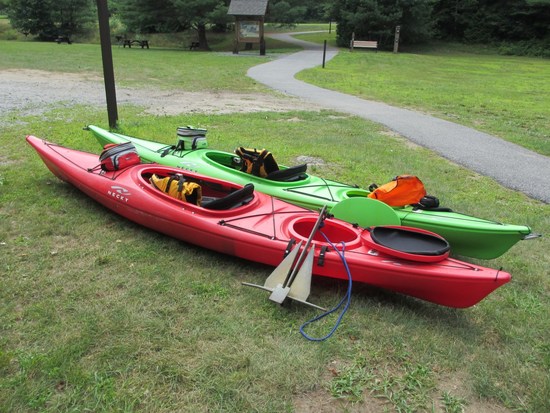
necky Our Necky's are a nice compromise of price and performance. We have spent a ton of time paddling in them. They are virtually indestructible and have been hauled across and dragged over beaver dams and what ever else gets in the way. Not a worry about holing them. I disagree about having to buy the very best and missing out on a ton of fun in the mean time. Heed the advise of longer is better and hull design is important but get what every you can afford and get out paddling. jimmyb Edit- be sure to get a good lunch hook, like the one show against the red boat LOL. I found that stuck well in the muddy bottom of the lake we were paddling that day. Rode was cut to the water surface. Someone cut and run.

Viewing 20 posts - 1 through 20 (of 20 total)
Loading...