Topic

Cuben Groundsheet – Pinholes

  • This topic is empty.
Viewing 23 posts - 1 through 23 (of 23 total)
PostedJul 19, 2015 at 3:16 pm

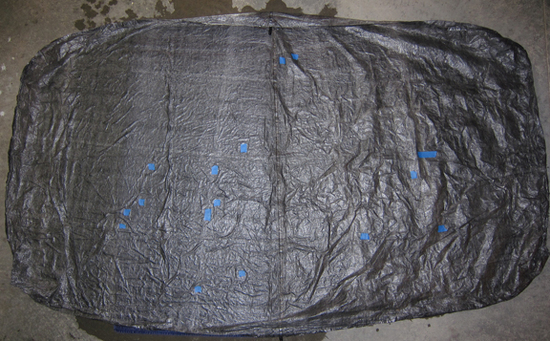
This is ground sheet made of 0.50 cuben

I soaked a large bath towel, laid the ground sheet on it, laid a dark bedsheet on top of that, laid down a 48"x12" sheet of plywood, then walked around, marked the wet spots, and repeated. Some were 3" in diameter, most were around 1" in diameter, after about 5 minutes of test time.

Pinholes

None of these are on the seam, (which I need to seal again). The end with the majority of the holes is the "head end".

I have about 20 nights on it.
Now I know how my air matt gets wet in a storm.

PostedJul 19, 2015 at 3:32 pm

The fabric is 0.50 ounce per yard laminate, with Spectra (I'm assuming) sandwiched inside.

M B BPL Member
PostedJul 19, 2015 at 4:14 pm

0.5 is really light for groundsheet.
Too light.

Are you sure about the wt?
Is this myog?

Seen the same even with 0.74

PostedJul 19, 2015 at 5:11 pm

MB-
I believe you are correct.

My Hexamid is 0.50, and now that I think about it, I'm sure I got the 0.74 for the ground sheet.

PostedJul 19, 2015 at 5:22 pm

Yup. I've never been a fan of cuben floors.

If you opt for light cuben (0.5oz, 0.7oz) then you'll get lots of pinholes and/or have to use a groundsheet. If you use a groundsheet you're just as heavy as silnylon but you spent more money on a more complex setup.

If you opt for heavier cuben (1.2oz, 1.5oz) then you're already just as heavy as silnylon, so you're just spending more money to get a few more holes. It is less slippery.

I don't like how slippery silnylon is, but it is the best option I've used for a floor. Run a few strips of silicon down the bottom of your pad and it's a pretty good setup. Even after 100+ nights silnylon can work pretty good.

Hiking Malto BPL Member
PostedJul 19, 2015 at 5:37 pm

I made the mistake of putting cuben in as a floor. After a couple of holes, I became very careful and used a tyvek ground sheet. Cuben IMHO has no place in the construction of items that are subject to abrasion.

PostedJul 19, 2015 at 6:24 pm

That's too bad, Greg.

I look at groundsheets as sacrificial in nature and therefore, use lightweight painters cloth (polycro). About $6 for each groundsheet I make and it generally lasts a season.

Matt Dirksen BPL Member
PostedJul 19, 2015 at 7:06 pm

+1 to Polycro, or any material that "designed" to be walked on, sat on, slid on, and eventually disposed of due to normal wear and tear.

I remeber when companies started selling custom groundsheets for their tents. At one level it seemed like a completely logical "accessory" to sell. It was very easy to persuade a customer to buy it, in order to best protect their shiny new investment.

But once one remembered what the groundsheet was "intended for", it became a very expensive piece of fabric for a lot of folk, and a cash cow for the companies making them.

Who would've thought they could make that kind of money with a dollar of material and 15 minutes on the Singer.

I do wish the Cottage companies would simply come out and tell their clients that Cuben fiber is really not recommended under their tent, unless one takes pleasure in burning their money. (Just offer a free sheet of Tyvek or something…)

[ Drew ] BPL Member
PostedJul 19, 2015 at 7:26 pm

"I don't like how slippery silnylon is, but it is the best option I've used for a floor. Run a few strips of silicon down the bottom of your pad and it's a pretty good setup. Even after 100+ nights silnylon can work pretty good."

Dan,

Would you recommend silnylon directly on granite slab or decomposed granite? I have a silnylon inner for my mid and have been using a polycryo sheet underneath it. Sometimes the surfaces I camp on seem like they'd destroy the silnylon from tossing and turning/sliding at night, but others say it'd be fine.

PostedJul 19, 2015 at 8:03 pm

I think .5 cuben just leaks. I have two stuff sacks of cuben .5
When I fill them with 4 or 6 inches of water to check that they are waterproof, they both leak. There are no obvious holes. water just kind of weeps through the fabric. I think it's just too thin and passes water. Mind you, these stuff sacks have not had a lot of use and there are no obvious holes or abrasions.

billy

M B BPL Member
PostedJul 19, 2015 at 8:31 pm

1.0 cuben is OK, much more durable
Easily patched with tape too.
Site selection should be a concern anyway.
Even pressure on silnylon floor will wet thru

cuben is great because its not slippery, but you have to take care of it, use it carefully.

In the hexamid with the net under it, its much better protected.

I would not have a tent with a plain cuben floor permanently attached, especially not a 0.74 like some sell.

Roger Caffin BPL Member
PostedJul 19, 2015 at 9:43 pm

> Silnylon directly on granite slab or decomposed granite?
It's what I use.

Cheers

PostedJul 19, 2015 at 10:21 pm

"Would you recommend silnylon directly on granite slab or decomposed granite?"

Silnylon varies a lot in quality. Some is coated pretty heavy and I can tell it's going to be waterproof for just about as long as the fabric holds together, while other silnylon is coated much lighter and it usually leaks after a year or two even if the fabric is okay. My experience is that TarpTent, MLD and Locus Gear use good silnylon (and probably many other makers), while some of the companies selling silnylon to the DIY'er are more suspect in quality. I have a MYOG inner tent for my mid that is of low quality silnylon.

Good quality silnylon – which is all you should be buying – has the threads so well saturated with silicon that it's truly impregnated and it won't leak unless the fabric is damaged or subject to quite high water pressures. So if you think you can camp on a surface and not destroy the fabric, then you shouldn't wreck the waterproofness.

My wife and I hiked the PCT last summer (~120 nights) which obviously includes the Sierra's and our TarpTent floor is still mostly waterproof. We never used a groundsheet and I only did minimal site prep, but we do choose spots that look soft and thus camping on granite was avoided. I don't think we ever did.

To actually answer your question, responsible camping on reasonably intact granite is probably fine to do a moderate amount, but tossing and turning on decomposing granite is probably pushing it and will likely reduce the life of your floor. I'd carry a groundsheet if you're expecting quite a bit of this.

In addition to the extra weight and fiddle factor, my complaint with groundsheets is that they can trap water between the tent floor and groundsheet (i.e. if the groundsheet is bigger than the tent, or running water flows between) which does really test the waterproofness of your floor since the water can't absorb into the ground. I don't carry a groundsheet and whenever possible I sleep on soft, porous surfaces.

PostedJul 19, 2015 at 11:19 pm

.5 is not ideal for groundsheets. Its too thin. 1.0 is much better, and black is the sexiest type too. Silnylong is 1.1 but its always 1.5+ finished weight, so going with 1.0 cuben is still going to save a lot of weight.

But honestly cuben isnt the best for abrasion uses. It excells at tarps and stuff sacks and backpacks if the bottom is atleast the cuben hybrid.

One good thing about cuben is the fact that it doesnt absorb water and or dirt. Shake it off, Sil holds water and gets annoying when it sags when it rains or even gets moist with dew during the night. Silnylon is very good for groundsheets and tent floors.

+1 to adding a small piece of polycro underneath your .51 cuben floor. I would make i small and put it primarily under your sleep pad where its needed mostly. I would make it 2x the size of your pad.

[ Drew ] BPL Member
PostedJul 20, 2015 at 9:53 am

Dan & Roger –

Thanks for the comments. My inner is in fact a Locus Gear Hapi mesh, but it's the lightest floor option they have. I'm not sure what the exact specs and material weight are. It feels durable especially in comparison with some other silnylon tents I've had, but holy crap is it the most slippery material I've ever used. I feels like it's teflon coated. Just switching from back to side sleeping on my Xtherm causes me to slide over a few inches on the floor. I'm definitely going to add some silnet to my pad and/or the floor soon. But, yeah, you can practically ice skate (in socks) if you had a large enough piece of it in your living room.

With your comments in mind, I might just cut my polycryo (not polyCRO) groundsheet to fit a bit larger than our sleeping pads.

d k BPL Member
PostedJul 20, 2015 at 10:02 am

Has anyone tried the silpoly from Ripstopbytheroll.com for a groundsheet? I'm wondering if it is any less slippery than regular silnylon.

Dale Wambaugh BPL Member
PostedJul 20, 2015 at 10:14 am

INHO, ground sheets are sacrificial and polycryo is a good option. At least it gives some chance of stretching over rocks and roots.

The whole idea of using cuben for a ground sheet AND a poncho makes me crazy. I could see a chance of using cuben for a sewn in floor in an attempt to save weight, but you'll take one step back in needing a polycryo sheet under. It seems that someone interested in the lightest shelter would have a sewn in floor anyway.

A silnylon floor could get beat up pretty bad and could be recoated a la Tarptent's seam sealing method.

PostedJul 21, 2015 at 5:59 pm

I can certainly understand if the ~.5oz material is unsatisfactory as a groundsheet. I find it comprehensible if the .~74oz is unsatisfactory as well. However, I do not see hardly any reports about Zpacks' Duplexes leaking; it uses the ~1oz material as a sewn in floor. This leads me to believe that it is completely unrealistic to use anything less than the ~1oz for groundsheet material **without special precautions.** If I understand those precautions well then I can provide adequate concessions but if I am not wise then I will have problems. Does the ultimate fault fall on the user or on the vendor? Ça ce discute.

Complex/modular systems come with a price but they do have their advantages. Most importantly, they require a high level of care to ensure their performance. That care may come at too high of a price for most. However, a few dedicated individuals should be able to leverage their skills and said material to a respectable net benefit.

We ought to be careful about how much blame is on the vendor and how much is our own responsibility. To a wise user the ~.74oz floor is a helpful weight savings when combined with careful site selection, for example. To an irresponsible and/or inexperienced user this genre of floor is irresponsibly chosen by the manufacturer. I'll leave you to make up your own mind about what the truth is.

NB: I'm making no judgment whatsoever about the OP.

PostedJul 21, 2015 at 10:44 pm

Drew
Locus Gear has the most slippery silnylon I've ever used. The stuff is greased lightning. The upside is that it should be quite waterproof, but as a floor I can see the challenge. I'm not using an LG inner in my Khufu so I haven't personally tried sleeping on it.

Robert
I suspect with floor pinholes the main determinant is the mylar used in the cuben, as opposed to the amount of spectra strands. I don't see the spectra really doing anything to prevent pinholes, but it would help them not enlarge. Both 0.5oz and 0.7oz cuben use the same mylar (.08) so I think these materials will perform similarly in floor applications.

The 1.0oz and heavier cubens use a thicker .18 mylar. This definitely reduces pinholes a lot, although I'm not convinced it won't still become a problem in the long term.

I don't think anyone should buy a cuben floor planning to put a groundsheet under it. That's just an expensive and complex setup that's at least as heavy as silnylon. If someone is willing to take the required precautions to use a cuben floor without a groundsheet and they're willing to potentially replace an expensive component of their shelter in the medium term, then it is an option to save a bit of weight, but this is a very niche application. For anyone but the refined SUL hiker, I'm pretty sure the money for a cuben floor could be better spent on some other piece of gear that saves just as much weight with less compromise.

That's not to say there isn't a place for cuben floors. I think there is, but it's a tiny niche. I think it's pretty tough to argue that it's a good choice for anyone who's base weight is over 5 lbs.

Matt Dirksen BPL Member
PostedJul 22, 2015 at 4:59 am

"I think it's pretty tough to argue that it's a good choice for anyone who's base weight is over 5 lbs."

Don't you mean "who weighs over 5 lbs."?

Just had to say it…

:)

P.S. Well spoken, Dan. It is interesting how the gear that is targeted for a "tiny niche" is so attractive to the part of us that probably isn't going to ever quite use it for its intended purpose, but we will always maintain a ray of Hope that someday we will.

Kind of like whipping out that darn Bibler tent on a car camping trip (which I shamefully admit I've done before… more than once. And of course it didn't buckle over when the T-storms hit.)

Rog Tallbloke BPL Member
PostedJul 22, 2015 at 5:11 am

Drew: " a solo tent floor uses about 2 square yards of fabric which is 3oz in silnylon, 2oz in 1.0 cuben or 1oz in 0.5oz cuben. The materials cost for upgrading to cuben is about $40 ($50 vs $10)"

Or 3.6oz for non-slippy pinhole-resistant Tyvek at a cost of $4.

John Eyles BPL Member
PostedJul 27, 2015 at 11:18 am

Just use polycryo. It's also about 1/2oz per square yard, and I've found it abrasion-resistant enough to use for several week-long trips in Grand Canyon. Then I replace it: about $10 from Gossamer Gear.

Sounds like Cuben would be real problematic for a tent floor. I guess you have to use a separate groundcloth, negating much of the weight savings of cuben, I'd imagine. But I rather imagine that if someone cares enough about weight to spring for cuben, then they probably also care enough to be using a tarp or pyramid (i.e. a floorless shelter).

Viewing 23 posts - 1 through 23 (of 23 total)
Loading...