Topic

Power Banks / batteries

  • This topic is empty.
Viewing 13 posts - 1 through 13 (of 13 total)
PostedJul 15, 2015 at 4:10 pm

Given the rapid change in this space fueled by mobile devices, and with more and more backcountry gadgets rechargeable by USB, I was wondering what people are using and would recommend, either with or without solar panels.

Ideally I'd like something as light as possible and somewhere north of 10000mah.

JCH BPL Member
PostedJul 15, 2015 at 4:18 pm

I like the jackery.com battery bricks. Lots of other options but these seem to last. Check out the Giant and Fit

Jerry Adams BPL Member
PostedJul 15, 2015 at 6:34 pm

Anker, 10,000 mAh, $22, amazon.com, 8 ounces, used it a couple times so far

PostedJul 15, 2015 at 6:50 pm

+1 on that Anker. They have a number of them for sale on Amazon in varying capacities depending on what your intended application is. Have a couple that I use extensively for city / day to day use. Nothing but good experience with them.

Matthew / BPL Moderator
PostedJul 15, 2015 at 7:25 pm

I've had good experiences with the Anker 3200 and 6400mah batteries. They seem to have the highest ratings on Amazon and the prices seem quite low. The case designs seem rugged and lack any goofy or unneeded features.

Just a thought: Typically I do not like buying products that I plan to replace in a year or two but it seems wise to not invest in anything pricey at this point because the products are maturing so quickly.

PostedJul 16, 2015 at 9:19 am

There can be quite a bit of variance between what the label says and what you actually get.

As I have yet to measure any of mine, I can't recommend anything.

PostedJul 16, 2015 at 10:07 am

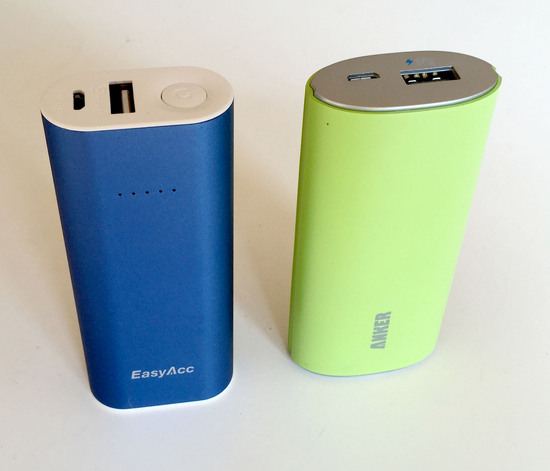
For sure distrust capacity ratings; Anker is a safe bet. However there are some other manufacturers out there with some attractive offerings that deserve to be tested. For instance, I compared an Anker 6400, 4.8 oz, $22, with an EasyAcc 6400, 5.1 oz, $16, and I actually prefer the EasyAcc. Their performance is identical: the Anker gave 2.33 iPhone 6 charges, the EasyAcc 2.36 charges. The EasyAcc is more compact, has a capacity display I find more useful, and has a faster input rate of 2A vs 1.2A for the Anker. 6400 is the max capacity I would ever need within a 12 day trip. For your request of 10000mAh, you might want to check out the EasyAcc 10000 second gen model, link below.
Anker 6400
http://www.amazon.com/gp/product/B00HA6ACW8?psc=1&redirect=true&ref_=oh_aui_detailpage_o00_s00
EasyAcc 6400
http://www.amazon.com/gp/product/B00XTU59HM?psc=1&redirect=true&ref_=oh_aui_detailpage_o02_s00
EasyAcc 1000
http://www.amazon.com/EasyAcc-10000mAh-External-Smartphone-Bluetooth/dp/B00M0E5KN6/ref=sr_1_1?s=wireless&ie=UTF8&qid=1437065597&sr=1-1&keywords=easyaccbats

Richard Nisley BPL Member
PostedJul 16, 2015 at 10:47 am

Richie,

For a north of 10,000 mAh measured output capacity, the Anker 2nd Gen Astro E5 tested better (output capacity mAh / oz) than 5 other batteries that I measured in this capacity category. This battery is advertised as 16,000 mAh capacity. I measured its input capacity at 13,905 mAh and its output capacity at 10,277 mAh (just north of 10,000 actual). Equally important, I measured its maximum charge rate as (2,050 mAh) and its discharge rate as (3,100 mAh).

Joshua Abel BPL Member
PostedJul 16, 2015 at 11:20 am

Cameron,

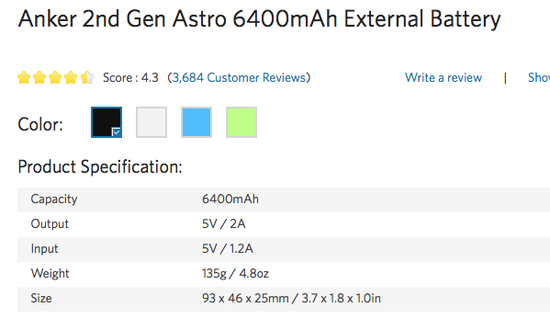
I dunno if your specs are wrong or old, but the Anker 6400 has a charging speed of 2A not 1.2A as indicated. I don't own one but I've been comparing units the last couple days which is the only reason I know this.

PostedJul 16, 2015 at 11:44 am

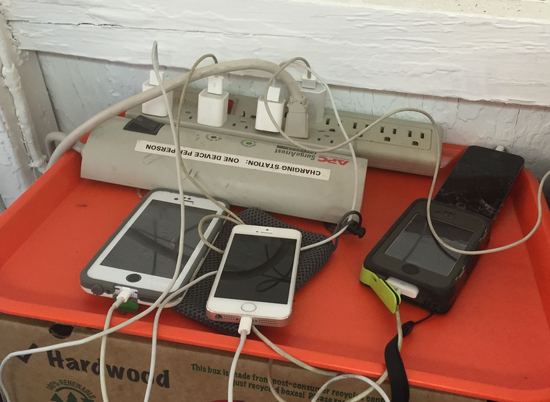
Hi Joshua. The current model Ankar 6400 has an INPUT charging speed of 1.2 A, as opposed to OUTPUT of 2A. This may be important if you want to swoop in and out quickly to tank up your bats. I was PCT section hiking a few weeks ago and took this picture; two hours later every receptacle was filled and people were hanging out in front of the Tuolumne store only because their devices were charging slowly or they were waiting in line to get a receptacle.chargingss

Joshua Abel BPL Member
PostedJul 16, 2015 at 11:52 am

yeah, looks like you're right I was reading it wrong. Sorry! :)

Jerry Adams BPL Member
PostedJul 16, 2015 at 12:33 pm

If you read the fine print, the mAh capacity given is the capacity of the Lithium battery which is about 3.6 volts. This gets stepped up to USB 5 volts, and the capacity gets reduced proportionally, and any inefficiency.

I measured my Brunton 4000 mAh capacity as 2500 mAh of USB 5 volts.

Maybe this isn't important because people aren't that aware of how much capacity they need, in mAh. Maybe number of times it will charge an iphone is a more intuitive measure.

I'll have to measure my Anker 2nd Gen Astro E3 Ultra Compact 10000mAh Portable Charger

Jim C BPL Member
PostedJul 16, 2015 at 12:53 pm

I'll be testing a Solpro Helios Smart, which is a 5000 mAh battery with three, small solar panels that fold up. It's smaller than a paperback book, and weighs 10 ounces. It's a bit expensive at $119. I got mine on sale for $99, which is still pricey.

It did well on a long weekend trip down here in Georgia, but I didn't really tax it. On my upcoming, six night Sawootj trips, it will be responsible for keeping two iPhones and a USB-rechargeable headlamp charged. This will be a more telling test.

Viewing 13 posts - 1 through 13 (of 13 total)
Loading...