In 2010 I spent the second night of my attempt to hike the Tahoe Rim Trail near Susie Lake in Desolation Wilderness. It was mid-October and the week before there had been a lot of thunderstorms, and early season snow at the higher elevations. I delayed my start from South Lake Tahoe by a day because the first night called for 45-50 mph winds at Starr Lake, along with lightning. This would be only my third time sleeping out in my BPL Cuben Nano tarp, so I exercised caution. When I started down the trail the next morning, I shortly ran into two women who were finishing their TRT hike. They had pitched up right on the trail in the dark the night before in the middle of that storm, not knowing they were only a mile or so from the TH, and spent the night watching lightning flash while the wind shook their tents.
I spent from first night in a light rain at Big Meadow, and get off the TRT and take a shortcut between Big Meadow and Echo Lakes the second day to make up time. It rained and snowed as I passed along Echo Lakes, but at least stopped precipitating as I got passed Lake Aloha and set up camp around 6:30pm in dying light.
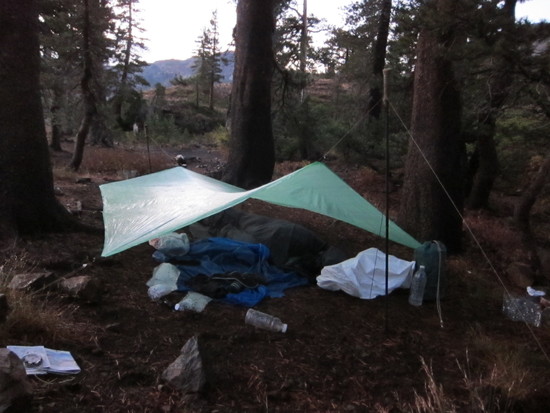
It started to rain again as I dumped boiling water into my Mountain Home bag, and as I waited for it to hydrate, I noticed that my tarp had been set up near the bottom and incline, and directly in the path of a narrow rivulet that was now filling with streaming water. I was sleeping on a polycro groundsheet, in a TiGoat bivy, in a down sleeping bag, and the temps were already in the 30s. So after a few moments of cursing myself, I unstaked the tarp and quickly but carefully dragged it , with my bivy/sleeping bag underneath, to a spot I had rejected earlier as possibly too small, but having the advantage of being on a small rise. In the process of unstaking, I had knocked the Photon Freedom off the brim of my cap. It was turned off, and black in color. I didn’t have time to search and possibly not find it. I had to use what natural light was left to get set up. The catenary cut did what catenary cuts are supposed to do, and made it relatively easy for an idiot to get an idiot-proof pitch, considering the situation, and the site was big enough, oriented such that the foot end of the tarp was windward. I couldn’t find my light, so I was consigned to eating in the dark, under storm clouds dimly backlit by the moon.
The hail and lightning started in earnest at 10pm. This was my first Cuben shelter, and the fabric felt so thin I was sure it would be shredded by the ice falling from the sky. Winds were 20-25mph measured on my Brunton ADC when I stuck my hand out the front. It was a scary but exhilirating experience riding out that storm in an open-sided tarp, watching the lightning flash, while the hail piled up around the perimeter of the Nano, waking up and banging it off the tarp to keep it from sagging. In trying to keep it low to the ground, I had pitched it too flat.
The storm ended up piling snow thigh deep up near Dick’s Pass, where I stood for a moment, looked at the snowy snowy landscape between me and Tahoe City, and further along the trail at Relay Peak, wondering if the snow would melt by the time I got there. I couldn’t risk being delayed any longer, being forced to choose between missing my flight; paying for an expensive ride back to South Lake; or abandoning the travel duffel left stashed in some rocks at the Kingsbury Grade TH, with my changes of clothes and the cardboard mailing tube for safely transporting my LT4s. I ended up backtracking, spending a night at Tamarack Lake, walking back to South Lake from there.

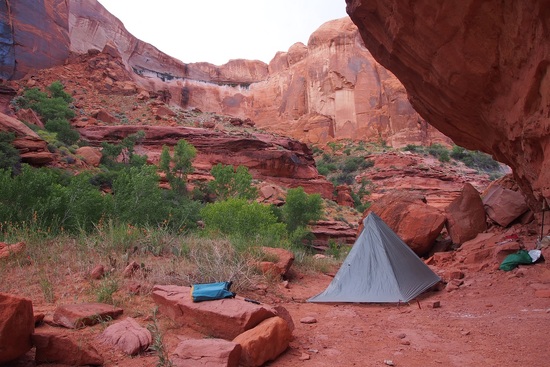
This past May I spent a night in Coyote Gulch, passed Jacob Hamlin arch, on outcrop across the creek and in line of sight of the pit toilet. Other groups had arrived earlier and claimed the more desirable spots under alcoves. The view was great but the exposure wasn’t. It was windy, 10-15mph measured on the Brunton, but not so bad I couldn’t get my spinnaker Solomid pitched. It wasn’t a great pitch though, a bit flat on the narrow, windward side. It seemed anyplace the sandy soil wasn’t too rocky to drive a stake(MSR groundhogs) it was too soft to hold them, and not deep enough to really dig a proper hole for a deadman anchor. I got three of four corners and the front pounded it and piled with big rocks to hold them down, careful to place the rocks so the line didn’t rub and abraid against them in the wind, tearing off a small corner of my ccf pad and wedging it between the line and the one rock where I couldn’t. The fourth corner and the back I had to bury the stakes in shallow holes and anchor with rocks on top of rocks, which I think led to the flat-ishness of the windward side. My LT4’s were sinking and sliding in the soft ground, so I had to put a pedestal built of a couple `flat rocks under the tip of each to brace them high enough. No amount of fidgeting could get the pitch completely tight, but I didn’t feel like taking it down and starting from scratch, and the occasionally light flapping of the spinnaker was tolerable. The wind gradually increased, until it was was blowing in the mid-20mph range by 9pm, gusting to 35 and up. The spinnaker flapped more noisily, but I got to sleep, only to wake up at 11:30, when the shaking jarred one of the poles off its rock pedestal, and it slid out, collapsing the tent, the windblown rattle of the fabric sounding like the world was crashing in. In my disoriented stated, I was frustrated when I couldn’t grab the pole and rocks and reset them, until I remembered I was sleeping in my Serenity net tent, and the mesh was blocking my attempts. I got it back up and rode out the night fitfully. In the morning I swore I was going to trade in the Solomid for a free-standing Tarptent so I didn’t end up in this situation again. Cooler heads prevailed and I’ve still got the mid.