Topic

Olefin Reemay as summertime insulation.

  • This topic is empty.
Viewing 13 posts - 1 through 13 (of 13 total)
Russell Lawson BPL Member
PostedJul 5, 2015 at 12:37 pm

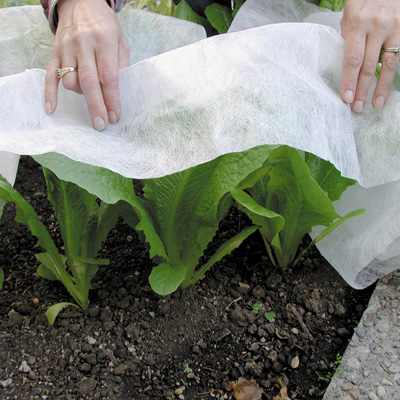
Hello, I have this fabric called Reemay that is used as frost and bug protection in farm application. It is made of a cheap poly called Olefin, weighs .6ounces a yard, has the lowest moisture retention and does amazingly well for hard frost protection and at keeping heat in the soil for early season plantings.

I have been in a pinch needing to change vaulves past midnight and have used reemay as a blanket in the summer months. It works amazingly well with clothing on but has a sunfried cheap plastic feel and is fragile.
elofin
So I am interested to see if anyone else has experimented with this fabric for insulative purposes.
I came up with an example for weight of 6.8ounce 2sq yard blanket if three layers of reemay were sandwiched between 1.1nylon and 5mm silk. At 4 layers of reemay it would be far more practical by weight to use 2.5 climashield but I can't convince myself to spend any more money.
I will have to experiment one of these nights and see how many layers keeps me warm enough.
feedback appreciated
PostedJul 5, 2015 at 5:39 pm

Yes, this material is often called "row cover." I've used it for insulation and as a lighter (and more fragile) alternative to conventional bug netting. I think it is available in polypropylene, polyester, and nylon. Reemay makes polypropylene and polyester products. Row cover is available as light as 0.29 oz/yd.

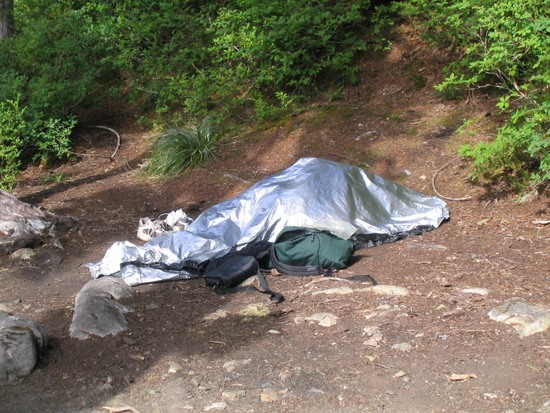
My first really successful MYOG project, about fifteen years ago, was a sleeping bag made with multiple layers of very light polypropylene row cover and several layers of aluminized polyethylene film. I went on a weekend trip in the Olympic mountains with two friends. They both had matching tents, down sleeping bags, and Thermarest pads. I had no shelter at all and no sleeping pad. I just had my MYOG multilayer sleeping bag, which packed down to the size of a grapefruit. I made a nest with leaves and duff and slept under the stars. Some snowflakes fell during the night. I was too warm and had to strip down to my underwear in my bag. The next morning, I woke up damp with sweat. Both of my friends complained of being cold all night. They fired up the stove as fast as they could and hugged their mugs of coffee. One of them had to break out his emergency blanket to warm up.

Data says that down is substantially warmer than any synthetic insulation, so I assume the warmth of my MYOG bag was mostly due to the radiant/vapor barrier film. That experiment doesn't really give us any information about the performance of the row cover alone, so it doesn't really answer your question, but I suspect that multiple layers of polypropylene row cover would compare favorably to any other synthetic insulation.

alumibeast

PostedJul 6, 2015 at 11:56 am

What if you corrugated this stuff?

That would give you a larger trapped air volume than the material alone.

The questions I see with that are:

– how best to do it
– sewn? that would be a lot of stitches
– glue? weight penalty?
– compression/wrinkling
– would the corrugation pop back up after being squished, or would it crease and stay mostly flat?
– dimensions – how tall/wide to make the corrugations? Smaller will add more weight in seams/glue and trap less air than larger, but suffer less convection loss and probably loft better.
– how well would it work anyway?

You could either attach to a single flat face, or sandwich the corrugation between 2 flat faces, and those faces could either by this stuff, or a shell material.

Jerry Adams BPL Member
PostedJul 6, 2015 at 12:18 pm

yeah, good idea, trapped air is what you want

I seem to remember style of women's clothing that are sewn to make rows of 3 dimensional features

Maybe something with elastic

PostedJul 6, 2015 at 6:56 pm

Maybe you wouldn't have to make full length rows of stitches. Maybe a stitch or two here, a stitch or two there would be enough to create corrugations. Or maybe all you have to do is twist it up damp, like you do with a broomstick skirt after you wash it.

Russell Lawson BPL Member
PostedJul 6, 2015 at 11:39 pm

good ideas. Based on the logic you all stated, maybe I take three layers, hold the middle one in place and baffle out the other two on either sides with half inch tall and half inch wide tunnels sewn in place, going length wise. Then put a layer on top and bottom of the baffles with dabs of glue here and there to ensure a little structural contact for the half circle baffles.

Sounds a lot better to me than flat layered blanket, hopefully the material can handle some tailoring and be worth it. spending $10 a yard on climashield seems more logical after rereading what I said, but I persist.

PostedJul 10, 2015 at 1:22 pm

Tyvek is compressed under hot rollers to consolidate it into a smooth, flat, paper-like sheet that has no loft. It is polyolefin paper. Its performance as thermal insulation will be similar to printer paper. The row cover described by the OP is polyolefin or polyester gauze. Some varieties have a grid of dots where the fibers have been consolidated, but most are more like thin, fuzzy felt.

Dan Yeruski BPL Member
PostedJul 11, 2015 at 10:47 am

Yes Colin,good stuff tyvek is.

I have used a gathering foot to create airs space and loft with tyvek. Worked well for my project.

 photo gathering foot 2_zpsigy8i2zw.jpg

d k BPL Member
PostedJul 11, 2015 at 10:56 am

Gee, where do you get that green and white striped Tyvek? ;-)

PostedJul 12, 2015 at 5:56 pm

Do you think that you could insulate something like a Houdini with this stuff and come out lighter compared to something like a Patagonia down sweater?

Viewing 13 posts - 1 through 13 (of 13 total)
Loading...