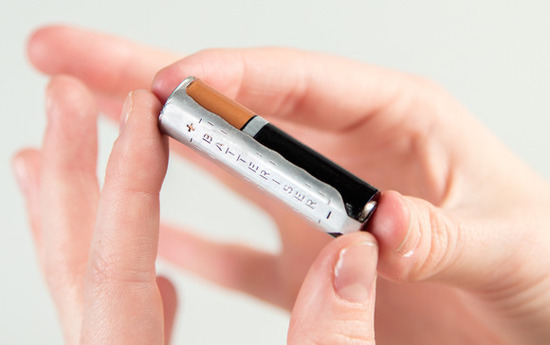
I am an electrical engineer. This might extend battery life for some poorly designed things, but the claims are exaggerated and it won't work for everything.
For high drain devices, the batteries are dead when they can't provide enough current any more. This device can increase the voltage but not the current. A battery with this device might show a 1.5V open circuit voltage with a dead battery, but if you hook up a large load, like a powerful LED light, it won't be able to maintain regulation and the voltage will drop and it won't work.
In addition, a circuit that small can't handle a lot of current, so if you put it in a device with a high load, maybe 1A or more, it will shut down or overheat or burn up. Small electronics simply can't handle a lot of current because it takes relatively large wires. A power supply that increases the voltage requires inductors, as far as I know, and it's impossible to miniaturize an inductor that can handle high current beyond a certain point. It's limited by the resistance of the wire and the magnetic properties of the core.
They come to the 800% claim by assuming that the battery is dead at 1.4V, and every 0.1V is another unit of capacity. It doesn't work that way. It's not linear. And rechargeable batteries are nominally 1.2V anyway, so if a device works with rechargeables it will work with alkaline batteries below 1.2V. Alkaline batteries are usually considered dead below 0.8-1.1V, and there's really not much energy left in them after that.
Check out these battery discharge curves.
http://www.powerstream.com/AA-tests.htm
You can see that after voltage drops below around 1V there is simply no more capacity. These discharge curves are done at constant current, which is kind of like the load this device will put on a battery. In fact because of inefficiency and the way power conversion works, this device will actually draw increasing current as the voltage drops, so it's even worse than these tests.
The 4th curve is a good example of a situation where one might think this would help- a relatively low load. But as you can see, once the battery voltage drops below about 0.8V there's no more energy, and it's dead. If you had this device hooked up to a dead battery and you wanted 100mA at 1.5V it would need to draw at least 200mA at 0.75V, and a bit more because of inefficiency (it could be 80-90% efficient if it's really good). If you put a 200mA load on dead battery (measuring 0.75V), the voltage will quickly drop to 0 because the battery is dead.
I have a couple Princeton Tec headlamps that are regulated. They maintain full brightness until the batteries can no longer supply that much power. At that point, they warn me (by flashing) that the batteries are low, and they continue to make as much light as possible until the batteries are really dead. Maybe with some changes to the regulation circuit they could maintain full brightness a bit longer, but after that they would suddenly shut off completely once the battery is fully dead. I'd prefer to have some time of gradually decreasing light so I have time to change the batteries before the light cuts out. I use them for caving, and there are some times when you can't change the batteries, so it would be bad to have a light that suddenly shuts off.
In short, this thing is snake oil. When I read the part about the break-in at the beginning I had to check to make sure it wasn't published on April 1, it just sounds so contrived. Apparently there was a real break-in, but they could have staged it and called the police to report it. I hope the police find the people responsible because they are probably working for the inventor of this device.
The circuit is probably a Joule Thief.
http://www.instructables.com/id/Make-a-Joule-Thief/
It works well for extremely low current loads, like a single LED way below full brightness.
There are things on the market that probably already use this technology. For example, Logitech makes wireless mice with over a year of battery life on a single AA and keyboards that will go 2-3 years on a single (or two, I can't remember) AA. I have yet to replace the battery in my wireless keyboard.