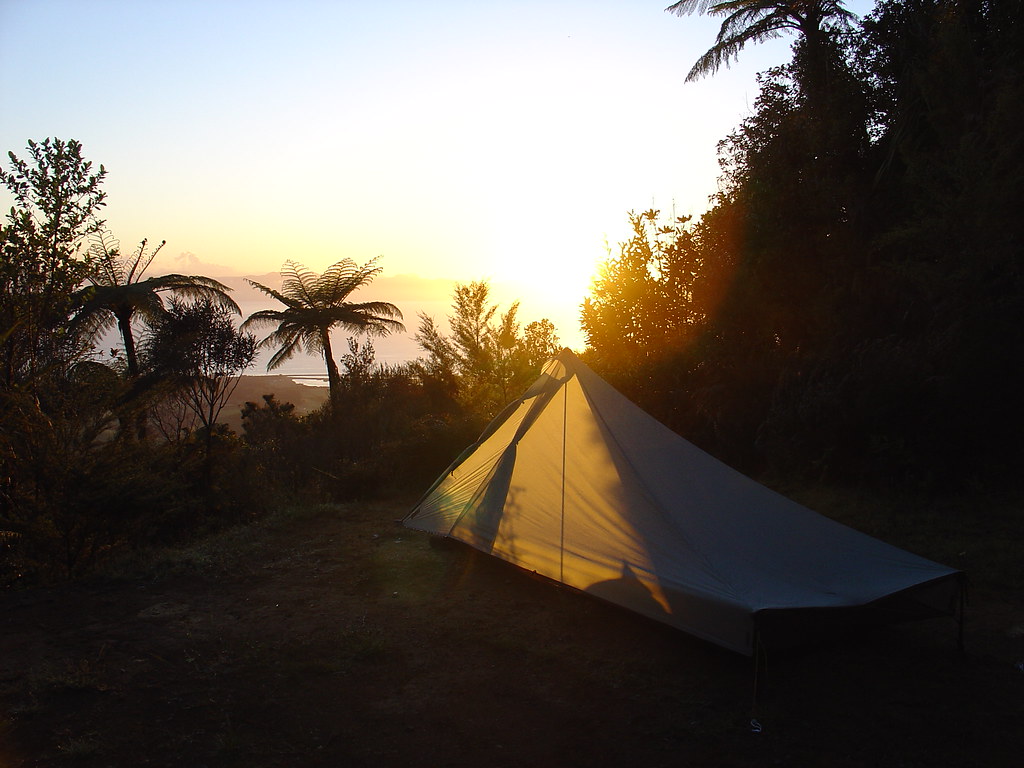
So I had a fun trip out in the weekend where I had my first night out in my first tent, a Tarptent Contrail.
I camped out in the Hunua Ranges (which are near Auckland in the North Island of New Zealand), on clearing on a ridge looking out to sea. No bugs and a perfectly clear night (spring here, so hot sunny day but still fairly cool evening) so I had everything opened up.
Given I'd done everything I thought I could to avoid it (camped high up, no mesh or door zipped up, clearance around the back & side to let mesh breathe), I was still suprised at the level of condensation: enough to start dripping onto the lower half of my sleeping bag. When I was awake it was easy enough to shake off the bag, but I did have to sleep :)
Admittedly the complete lack of breeze (and a hot day followed by a cold night?) weren't ideal, but while in the North Island anyway I'm resigned to it always being humid enough that this is always going to be a problem. (In my limited experience most of the South Island is much dryer – in fact most of the rest of the N. Island is a bit less tropical and sweaty than Auckland).
That's fine, I get to carry a 700g tent to compensate :) I'm curious though, how do other folks in humid spots tackle this?
– a bivy bag? The bivy bags sold here have a Quantum upper, which is no more waterproof than a standard sleeping bag liner anyway – is 2 layers of Quantum really going to help? Plus they cost almost as much as I paid for the tent! And if I'm using a bivy bag, surely I may as well just use a tarp?
– a more water-resistant sleeping bag (endurance, epic) upper? Hmm I hope not because I've already ordered my Arc Alpinist in Quantum :) (if it ever shows up!). Still not waterproof though & hurts breathability+weight.
– a full 2 layer tent (and not just in inner layer of mesh)? Heavy.. pricey..
– be content that a bit of water dripping onto the sleeping bag isn't going to lead to hypothermia on a mild night? (And in the winter.. ?).