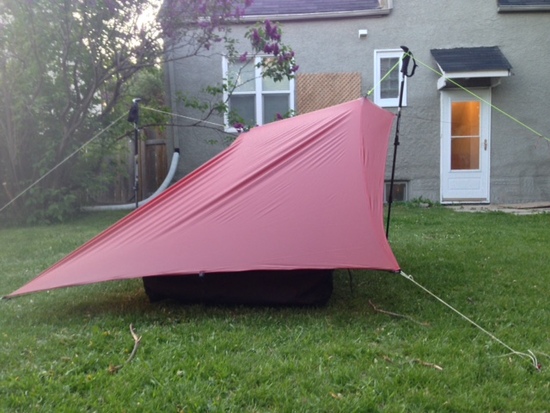
Topic

One-person tent using 0.5oz netting

  • This topic is empty.
Viewing 18 posts - 1 through 18 (of 18 total)
Thomas Conly BPL Member
PostedJun 1, 2015 at 11:02 am

Disclosure before I begin: Kyle over at Ripstop by the Roll offered to supply me the netting for this project if I agreed to do a build and a review of the new NS50. So, this post is both a review of the netting as well as a MYOG posting.

I completed a one-person tarp/tent over the weekend. My criteria for the design was:
– able to sit up in it
– easy to get in and out
– dry entry, double wall with lots of ventilation
– able to pack inner and outer separately
– able to cook with my pot outside and with me dry on the inside
– does not rely on having trekking poles (I don’t always carry them)
– as light as possible (of course)
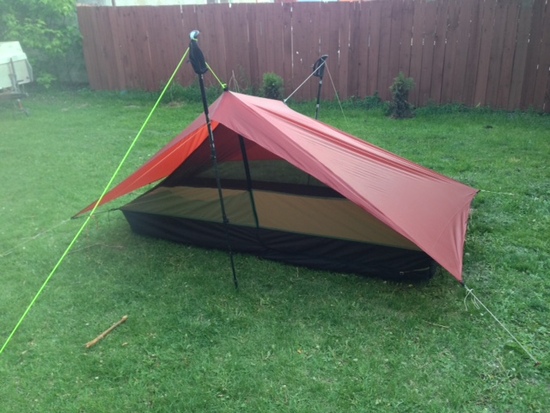
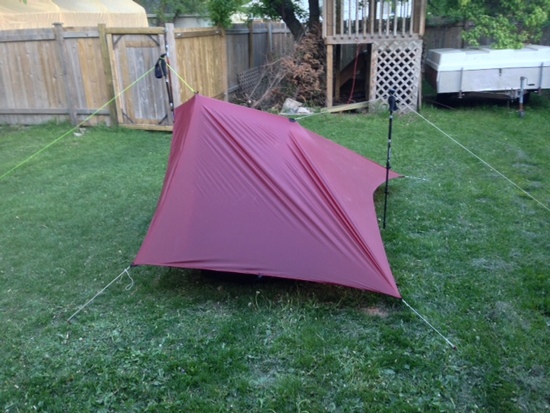
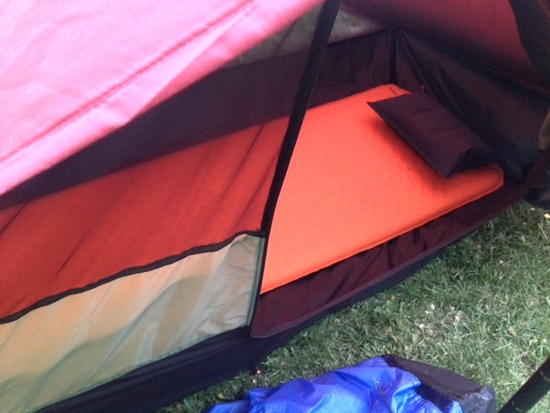
front

left

right

inside

Here’s the resulting specs:

Weight: Tarp – 7.1 oz Net tent – 7.7 oz Total – 14.8 oz
Dimensions: 28” wide by 80” long by “38” high.
Bathtub: 6” tall at the back and 9” tall at the front. The nylon also extends up the sloped walls by 3” on the sides.

I had three yards of Argon silnylon kicking around so I made a flat tarp and had plans of making some sort of net tent that could be pitched under it. I liked the idea of a half pyramid pitch because it provides good coverage on three sides and you can sit up under it. However, when I played around with the tarp, I found the open side a bit too exposed for my liking and I also found that the back side of the tarp was longer than it needed to be. So, I cut triangles off the two short ends and created a beak on the front of the tarp. This shortened the back wall, creating a more rectangular shaped floor and provided more coverage on the front. I took measurements from there and designed the net tent.

I noticed that when you pitch a tarp in a half pyramid, the peak of the tarp is angled out when compared to the two front corners. I decided to pitch the door of the net tent back as well. I had to design the net tent in Sketchup because the design was getting a little complicated and I didn’t feel like doing that much trig. The door is angled so that the floor is 6” further back than the peak. This made for a tighter pitch but also will hopefully make it difficult for rain to find its way into the tent. The rain would have to be quite slanted in order for it to hit the net tent.

I added a pull out on the tarp to tighten the pitch and increase the headroom inside. I also put a pull out on the net tent that can be adjusted from the inside. This helps a lot with the headroom in the net tent because it is a little small. There is a short guyline on each of the three sides close to the ground. This allows you to keep the tarp from lifting in a wind and exposing the net tent.
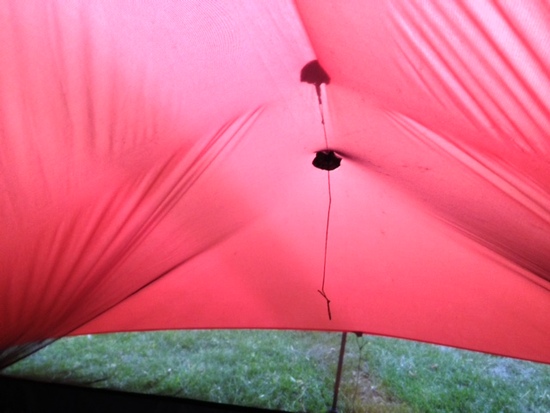
pull out

For the net tent, I used the NS50 netting and 0.9 oz siltaffeta, both from Ripstop by the Roll. One of the concerns I think people probably have with the NS50 is its durability. I found the durability of the netting to be comparable to the 0.67 oz netting that I’ve used in the past. The netting is definitely lightweight, but it doesn’t feel too delicate. Like any lightweight fabric, care should be taken when using it, but I wouldn’t hesitate to use it again. It’s a bit different from the other nettings I’ve used. It has more stretch and better drape than other nettings. This could be either a positive or a negative, depending on the application. The better drape allows it to pack up smaller. I also found that it was a little bit more likely to fray than other nettings. The other nettings that I’ve used don’t seem to fray at all and I’ve even left the raw edge exposed in several projects. The NS50, however, started to fray just a little in a couple of places when I handled it a lot. I don’t think it’s anything to be concerned about. It just means you probably want to use seams that fold the raw edge in. The green nylon on the front is a water repellant, breathable nylon that I already had.

I’ve heard reports that the siltaffeta is not fully waterproof, but I chose to use it as a floor regardless. I would rather have a tent floor that is mostly waterproof with a ground sheet rather than carry the extra weight of a bombproof floor. I run the risk of having water flow under the tent but on top of the groundsheet, but I’ll risk it. The siltaffeta is really nice and I hope to see Kyle come out with a second version sometime soon.

I’m really happy with how the project turned out. There is *just* enough room for me, which is exactly what I was going for. It pitches quickly and easily using trekking poles, sticks or trees, and It’s really easy to get in and out of. There isn’t much room for extra gear, but when I’m hiking with minimal gear, all my stuff fits by my feet anyway. There’s just enough room for my shoes under the overhang. And of course, under a pound for a double wall tent seems pretty awesome to me.

Bob Gross BPL Member
PostedJun 1, 2015 at 11:15 am

You said that you were going to make a shelter that did not rely on trekking poles, but the photos clearly show trekking poles, and they seem to support the whole thing.

–B.G.–

todd BPL Member
PostedJun 1, 2015 at 11:19 am

Splendid!

RBTR gets great reviews.

If you sold these, you'd get great reviews too!

Don A. BPL Member
PostedJun 1, 2015 at 11:32 am

Nice looking tent Thomas. The trekking pole use or lack there of seems clear to me.

"does not rely on having trekking poles (I don’t always carry them)"
"It pitches quickly and easily using trekking poles, sticks or trees"

Thomas Conly BPL Member
PostedJun 1, 2015 at 11:35 am

Bob,
I also said you could use sticks or trees, or paddles when I go canoeing. I wanted to avoid making a tent that requires you to put the poles on the inside like a Zpacks hexamid. Both poles are on the outside and simply have a guyline wrapped around them. In fact, the first time I pitched it, I used my dog's pooper scooper for the back pull out. I decided to use something a little classier when I took pictures though. :)

Bob Gross BPL Member
PostedJun 1, 2015 at 11:58 pm

"I also said you could use sticks or trees, or paddles when I go canoeing."

I missed the part about canoe paddles. Where is that?

–B.G.–

PostedJun 2, 2015 at 2:09 am

Pretty obvious to the non obtuse that the OP meant you could use alternative ways of setting the tent up.

PostedJun 2, 2015 at 9:32 am

Sorry, original poster who put up lots of cool information and photos about a cool project, including straightforward information about the poles, sticks, etc. that can be used to put it up. Unfortunately that's not good enough for some.

Please provide an alphabetical list of alternative objects with which one can set up the tent. And then cross-reference it by natural vs. manmade object. And then by color. Perhaps then, and only then, Mr. Nitpick will be satisfied.

Sorry OP, you got GROSSED OUT!

PostedJun 2, 2015 at 11:15 am

Great looking tent! Awesome work.

I just received an new duplex shelter from zpacks and had them use the 0.5 oz netting. I haven't used the tent yet, but the netting is feels a little delicate IMO. It's fine for my needs as I'm not thru-hiking with it, but I might opt for the heavier stuff next time. I also wonder about the breathability of the 0.5 oz netting. The netting is closer to tulle fabric than regular noseeum netting. It seems like it might inhibit airflow more, but I'm not sure yet.

Anyway, congrats on this project. Super light results. Great job!

Bob Gross BPL Member
PostedJun 2, 2015 at 11:46 am

"I also said you could use sticks or trees, or paddles when I go canoeing."

Thomas, this doesn't make any sense at all. How can I use this stuff when you go canoeing?

–B.G.–

J-L BPL Member
PostedJun 2, 2015 at 11:46 am

"The netting is closer to tulle fabric than regular noseeum netting. It seems like it might inhibit airflow more, but I'm not sure yet."

Compared to noseeum netting, tulle has a more open weave that allows for more airflow. My sample of NS50 had a significantly denser weave than tulle

Thomas – that looks like a nice shelter. I bet it packs up tiny. I think if you are going to use a groundsheet, going with something like Siltaffeta makes good sense

Allen C BPL Member
PostedJun 2, 2015 at 12:26 pm

"I also said you could use sticks or trees, or paddles when I go canoeing."

Thomas, this doesn't make any sense at all. How can I use this stuff when you go canoeing?

–B.G.–

Clearly, when he is off canoeing he has no use for the above mentioned items, so you are free to use them at your leisure.

Seems pretty obvious to me!

Thomas Conly BPL Member
PostedJun 2, 2015 at 1:16 pm

Bob, normally I'm the grammar Nazi. I thought this forum was relatively informal but I guess I'll have to step up my game.

Dave, I've been resisting the urge to make some immature comment about how to pitch a tent all day. Don't tempt me any further by asking for a list of natural and man-made objects that could be used.

Ryan, is the netting used by Zpacks the same as that supplied by RBTR? I didn't notice enough of a difference in the weave to think it would affect breathability, but maybe I just wasn't thinking about that aspect while using it.

PostedJun 2, 2015 at 1:34 pm

"I also said you could use sticks or trees, or paddles when I go canoeing."

"Thomas, this doesn't make any sense at all. How can I use this stuff when you go canoeing?"

When he goes canoeing, you can hit yourself repeatedly in the head with a medium-sized stick, and then fall out of the low tree in which you were perched.

Done.

Bob Gross BPL Member
PostedJun 2, 2015 at 1:38 pm

Dave, what you wrote first (before you changed it) was much funnier.

You could probably take all of this to your twelve step meeting.

–B.G.–

PostedJun 2, 2015 at 1:43 pm

Nothing is funnier than the thought of you hitting yourself in the head with a stick prior to falling out of a low tree.

Well, "Raising Arizona" maybe, but this is a close second.

Ian BPL Member
PostedJun 2, 2015 at 3:40 pm

That's a damn fine looking shelter Thomas. Well done.

Viewing 18 posts - 1 through 18 (of 18 total)
Loading...