Topic

barometers in phones

  • This topic is empty.
Viewing 5 posts - 1 through 5 (of 5 total)
PostedMay 15, 2015 at 12:14 am

The other day I noticed the iPhone 6 added a barometer, which apparently a number of Android phones have had for a little while now. The chip is apparently a Bosch BMP280, and is claimed to be reasonably accurate (±1 hPa absolute, and ±0.12 hPa relative).

I’ve always felt some unease with barometric altimeters as a change in the weather or temperature can throw off the numbers. (I.e. I’ll happily take a ±10m GPS vertical error over a ±100m altimeter error.) Having taken a few days to play around with it, I do feel a bit more comfortable with it. I also remain aware that it requires regular “care and feeding”; a day after the last calibration it’s now 40m off. Probably that is from the recent light weather system moving through, which dropped the air pressure about 5 hPa. How it fares in the mountains, with the chance of encountering actual weather in short time frames, remains to be seen.

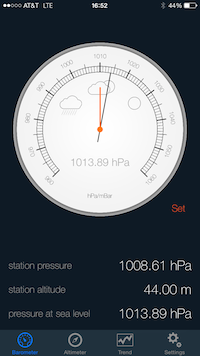
For apps, I’m using the two shown below; “Pro Altimeter” is a barebones display that can easily be calibrated either manually or via pulling data from nearby airports. “Barometer” has a traditional face, more options, and can capture trends over time. For moving in the mountains I would use the first, and the latter is likely more suitable for home or office use.
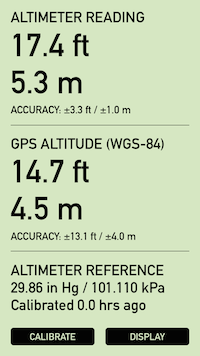
Screenshot of altimeter
Screenshot of barometer

For reference, a change of 100m in altitude should generally be indicated by a change of 12 hPa on the barometer (or, 30-43 feet per hPa for most hiking altitudes).

Rick M BPL Member
PostedMay 15, 2015 at 12:40 am

Thanks for reminding me of another reason I got the iPhone 6 as my first smart phone. Not many quality apps had enabled this feature when I got it back in October, so had forgotten about it. Now seems there are many to choose from.

Jim C BPL Member
PostedMay 15, 2015 at 7:08 am

Cool. I had forgotten that the iPhone 6 had a barometer. I’m working on a little app that uses the GPS and, if found, the WeatherHawk myBlue-T, which is a small Bluetooth thermometer that works with smartphones. The myBlue-T is an interesting gadget, but the official app is pretty limited, so I wanted to improve upon it.

I’m a software developer by trade, but not an iOS developer, but this is turning into a fun side project, though it’s progressing slowly as a) iOS development is not my area of expertise, b) I only have so much time to spend on it.

I also plan on adding support for the Thermodo, which is a dongle that plugs into the headphone port. But I don’t yet own a Thermodo, so that will come in a later version.

Ben C BPL Member
PostedMay 15, 2015 at 7:36 am

Thanks for posting. My 2-3 year old Samsung Galaxy S4 has it too. I just downloaded a free app and it seems to work fine. I don't know how much power it draws though.

PostedMay 15, 2015 at 8:28 am

Yeah i think on the phone it works great as a cloud effect. Apple/Google have barometer readings everywhere so they can tell the difference between weatehr and elevation. When I got the barometer phone, I really noticed a difference where overpasses and tunnels didn't seem to confuse the phone Maps app as much.

Out in the woods,Barometers excel in cliffs and canyons that can throw gps signals off. But idk if I'd waste my phone battery checking it as often as I do on my barometer watch. It was really fun going through the rockies shouting elevations back to my partner when we were exploring the park. The 100-300 foot variance of the barometer reading really didn't seem to matter when you're between 9-14k.

Viewing 5 posts - 1 through 5 (of 5 total)
Loading...