I recently purchased a Big Sky Chinook 2P tent and thought I'd post a brief review after using it for a few nights in Southern Utah.
From another thread (http://www.backpackinglight.com/cgi-bin/backpackinglight/forums/thread_display.html?forum_thread_id=102274&skip_to_post=867477#867477), here are the options I went with and the weights on my scale:
Outer shell: Supr-Sil UL fabric, weight = 17.9 oz
Inner: mesh inner, weight = 16.5 oz
2 Poles: UL aluminum 17-in poles, weight for the pair = 11.0 oz
3rd Pole: heavy-duty aluminum, weight = 7.4 oz
Pole splicer: weight = 0.3 oz
Edit to add some dimensions (measurement accuracy is about +/- 1 inch):
Width of fly at head end: 54''
Width of fly at foot end: 48''
Width of inner tent at head end: 52''
Width of inner tent at foot end: 48''
Length of fly (measured from center at head to center at foot): 94''
Length of inner (measured form center at head to center at foot): 92''
Peak height of fly: 44''
Peak height of inner: 42.5''
The tent requires a minimum of 6 stakes (2 for the head end, 2 for the foot end, and 1 for each vestibule/door); however, there are an additional 8 tie-outs which you can optionally deploy for heavy wind giving a total of 14 stake-out points.
Here are some pictures:
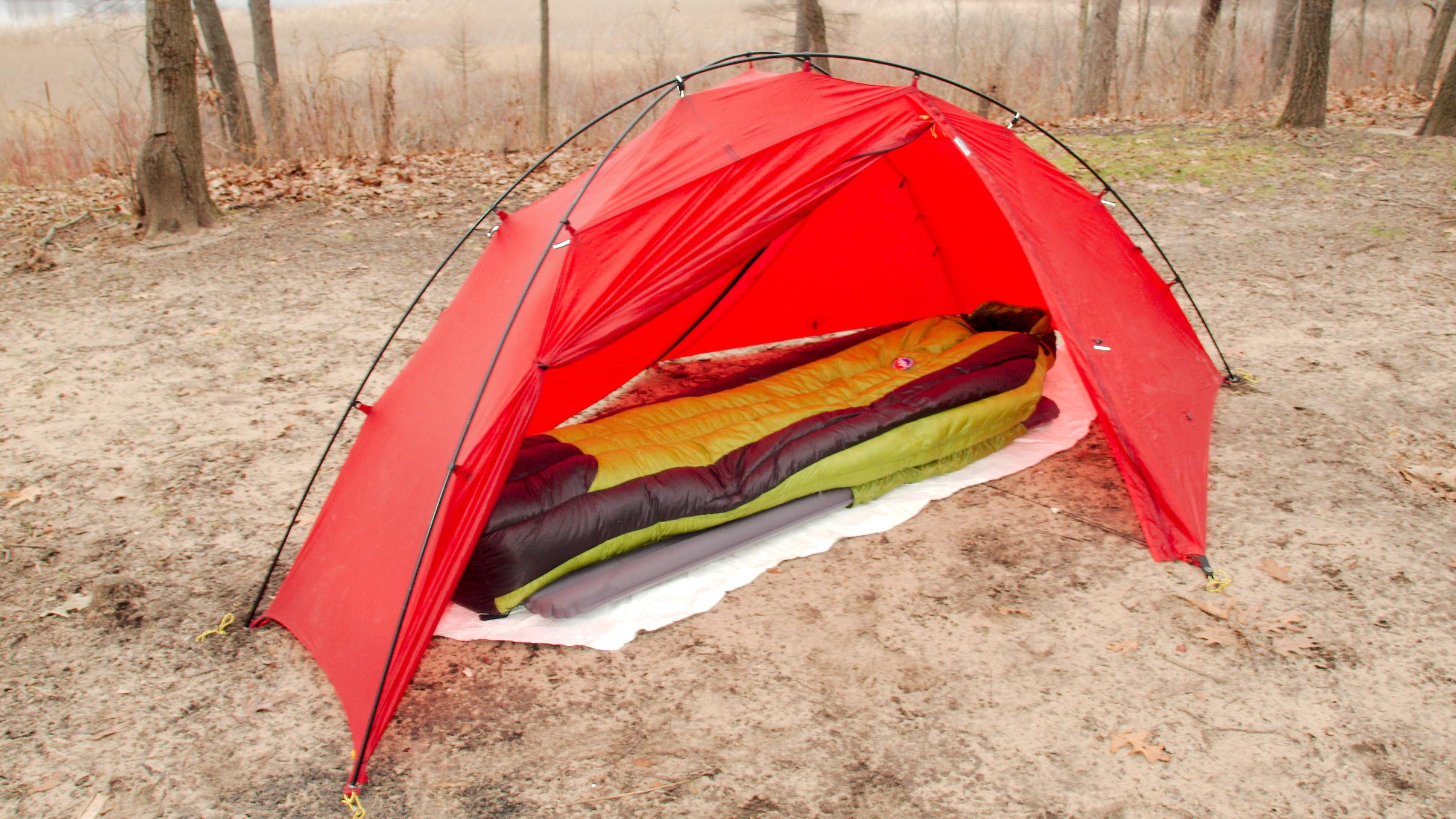
The fly comes very close to the ground:

It has a very deep bathtub floor:

Plenty of room for the dog and I (dog is 50 lbs). The mesh inner has some huge pockets:

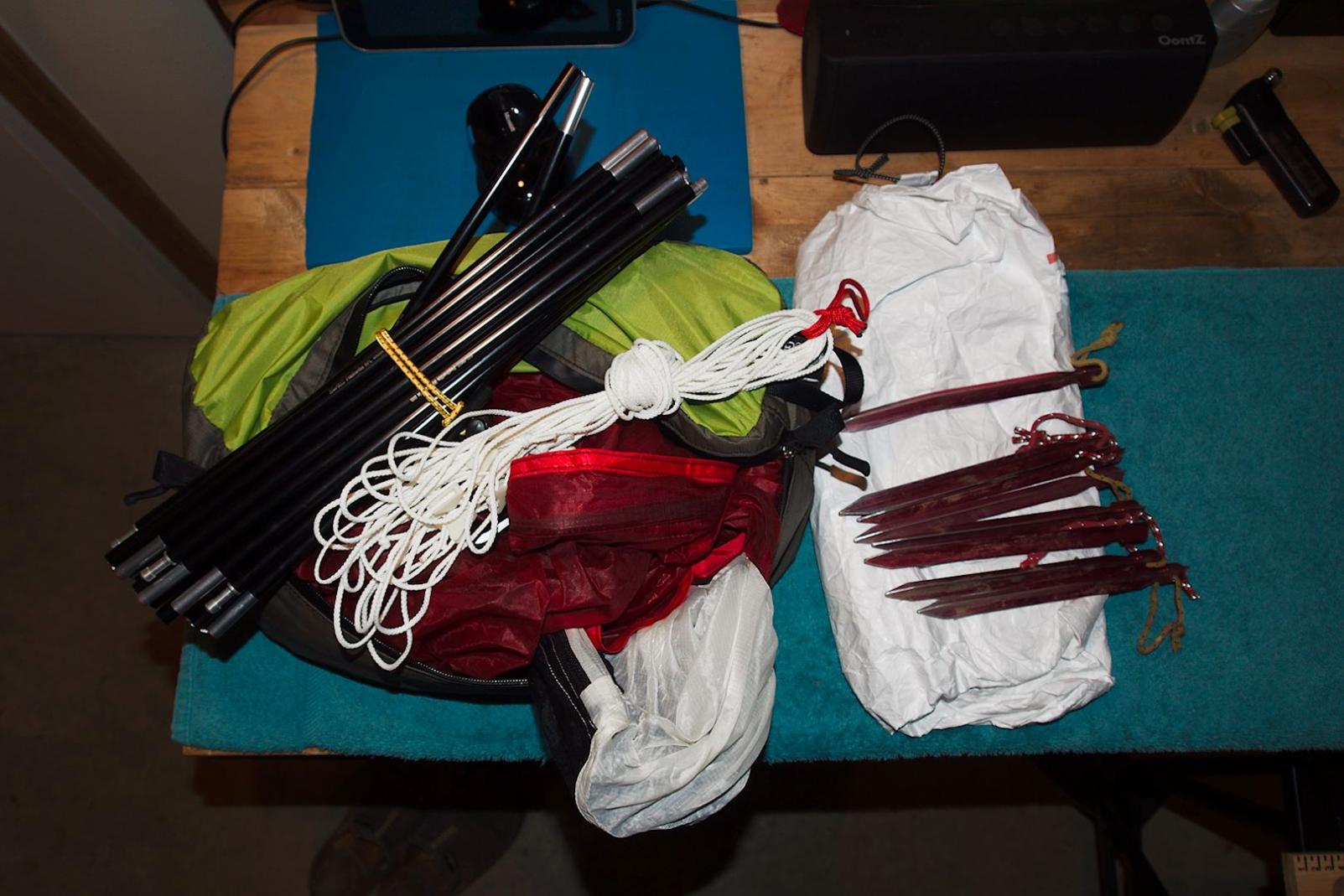
Fly and mesh inner are in the MYOG blue stuff sack (which can be compressed to about 2/3 or less of the volume shown):

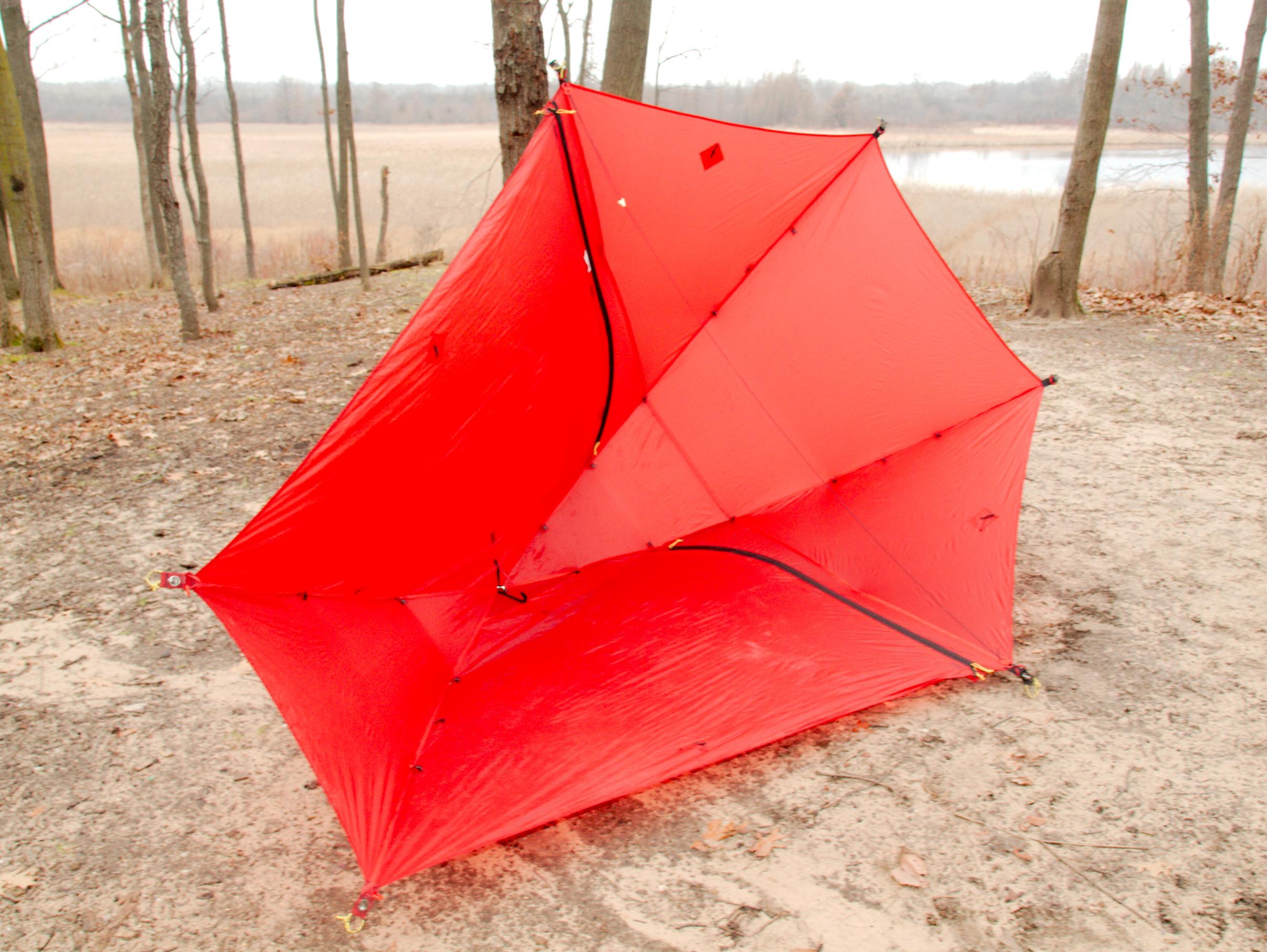
My first night of using the tent involved setting it up late at night, in the dark, with a storm fast approaching. We were car camping near the trailhead, so the ground was rather hard. Set up was pretty easy. I staked out the corners first, put the poles in the grommets, and then clipped the fly to the poles. As I was staking out the vestibules, it began to rain. I appreciated the dry setup and that the inner sets up with the fly. As a test for wind, I only used the minimum 6 stake-out points. After a gusty night with several hours of rain, I woke up nice and dry. I hardly noticed the wind and did not hear any flapping. I had no condensation on the inside, but lots of dust on the floor and fly. Here is the tent after a night of rain:

One thing to note is that the water shook off the tent fabric very well. Yes, it stretched and sagged a little like normal silnylon. But it seemed to pack up drier than other silnylon sheleters I have used.
I was glad to have a self-supporting tent on this trip. Our camp sites were either very sandy or on hard rock. Yes, I could have pitched a pyramid tarp at these locations, but it would have made things more annoying. Below is the tent pitched on sand. One interesting thing to note is that on the door sides of the tent, there is a toggle a few inches above ground-level (with a loop of elastic on the opposite side of the fabric). I did not know what these were for, and Big Sky told me they are for bottom vents for letting in air. Neat. I liked them. There are also vents at the top which you can velcro close:

I brought a variety of stakes to test: 6-inch Easton nails, 8-inch Easton nails, and Lawson Equipment's "burly" Ti stakes. Surprisingly, the Lawson "burly" Ti stakes held the best in the sand.
After another day of rain and wind (wind strong enough to rip out every stake of our group tarp – my tent hardly budged), I set the tent into drying mode the following afternoon with our first bit of sun. The exposed pole and clips make for handy drying locations:

At this camp location, I was unable to get a single stake in the ground (solid rock with 1-inch of sand on top). It's a mostly free-standing tent, but I of course anchored it down with some rocks to keep it from blowing away:

I purchased this tent because I wanted a shelter with decent interior volume and a fairly small footprint. I also wanted a dry set-up. And for it to be storm-worthy. I went with the Chinook 2P instead of the Big Sky Revolution 2P (very similar tent model) because I liked that the fly on the Chinook 2P comes closer to the ground and that I can use the 3rd pole for extra snow-loading. I plan on sewing up my own mostly-solid-fabric inner tent for the Chinook 2P, which will probably come out much lighter than the standard one and probably better for winter use. I should end up with a tent I can use for all-seasons and car camping too.
Overall, I am quite pleased with the tent. It seems to be very well made (the stitching seems excellent).
What I like:
Lots of room inside for the dog and I
Easy and dry set-up
Wind-worthy with all 14 stake-out points (well-placed to help the poles take lateral wind loads)
Decently light
Useable vestibules
Large interior pockets are great
High bathtub floor
Very pleasant to use (hard to describe, but I actually ENJOYED using this tent)
What I dislike:
#3 zippers on tent fly and inner began to stick a little with all the sand (I expect with some care they will be fine – they run smooth after washing them – but I would still prefer #5 zippers on the fly). To be fair, it was so sandy, the #5 zippers on my friend's tent completely failed on this trip
I cannot leave the doors open in the rain: by only unzipping them 2/3 of the way, I can enter and exit without getting rain on the inner, but there is no easy way to tie-off the doors at this position
Others thoughts:
Clips: the tent poles connect via clips. I was worried these clips would be strained and that I might have troubles with them, but they seem very sturdy to me – Big Sky has made them well. I would have no concern using this tent with its pole clips in bad weather. I am sure pole sleeves would be stronger, but for all practical purposes, I think the clips will be fine. Now WHY Big Sky went with clips vs sleeves, I am not sure. Maybe clips are lighter, or they tension the silnylon fabric better – I don't know. They are quite easy to use.
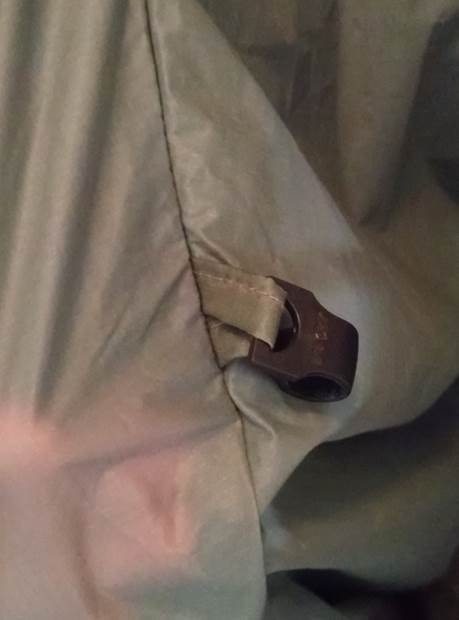
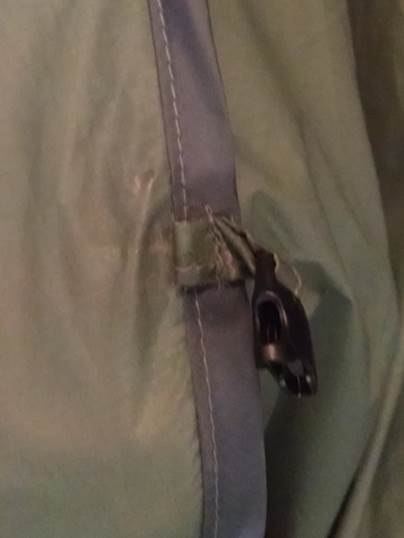
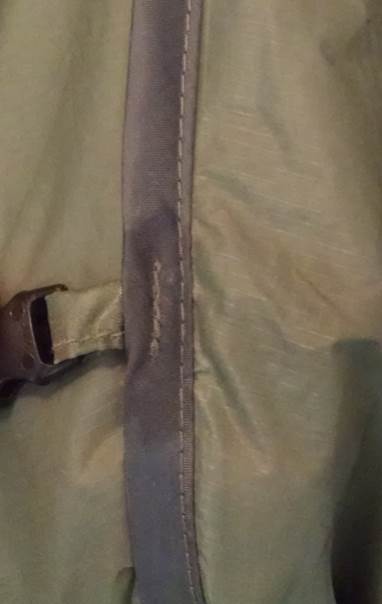
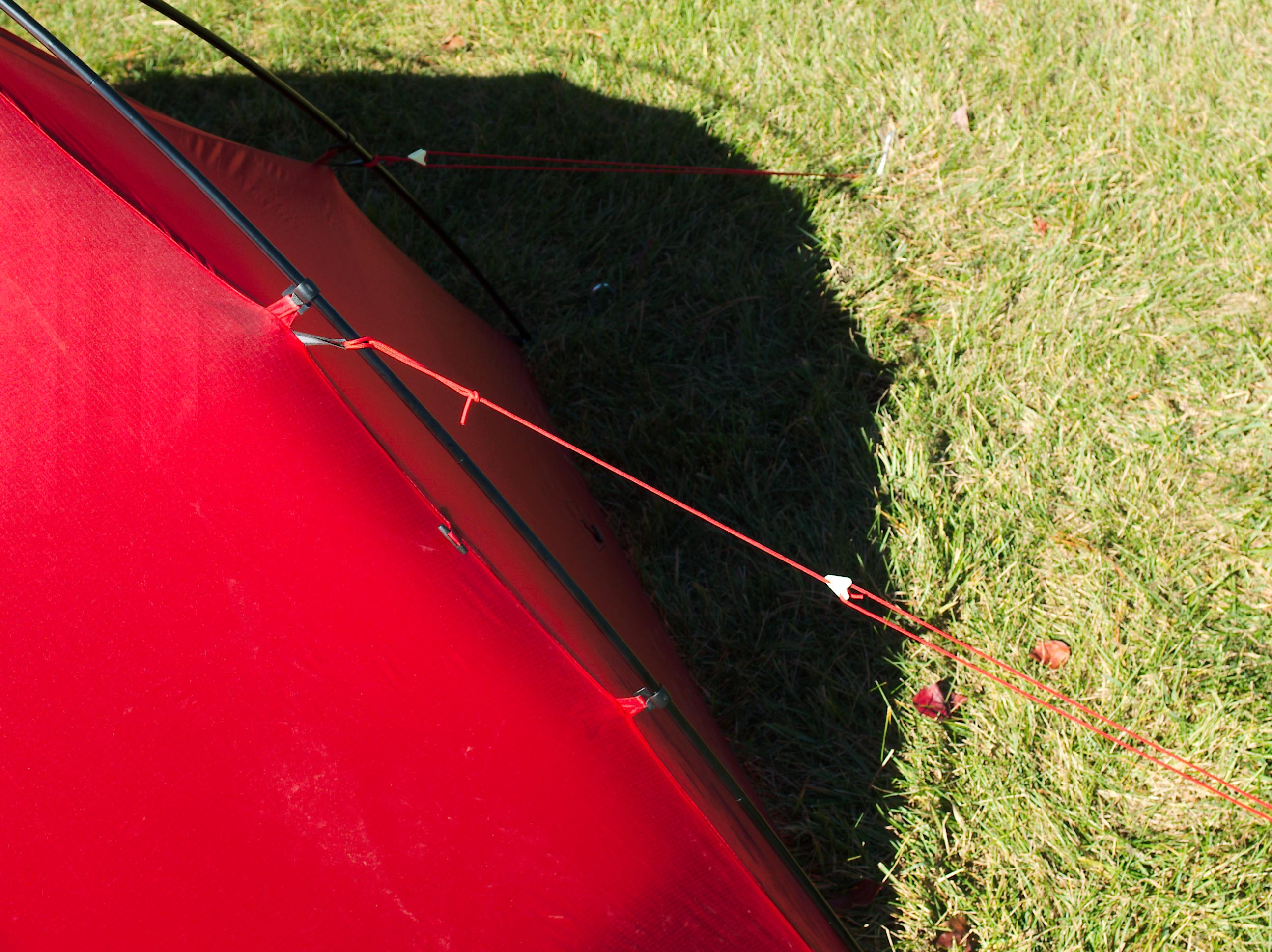
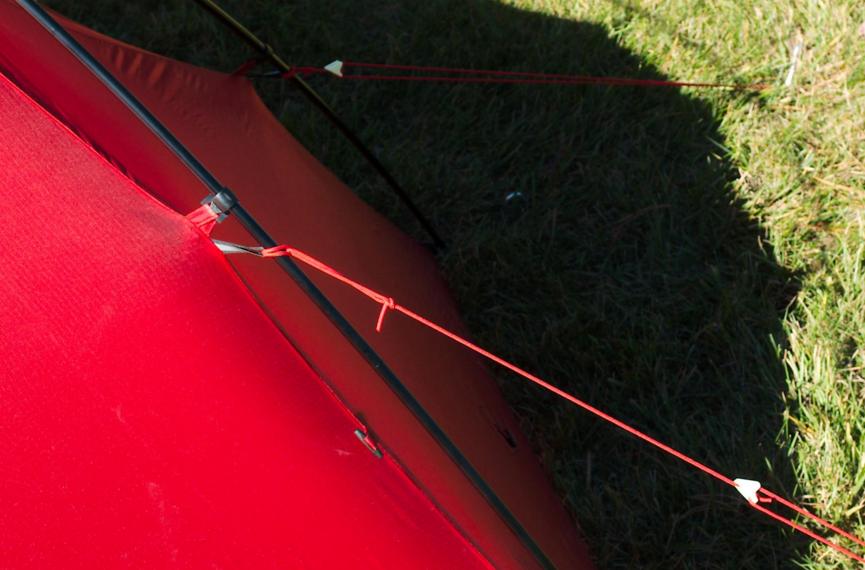
Added weight: the whole tent is pretty light, but it seems it could made be even lighter. It uses bulky plastic hooks to the connect the inner tent's corners to the fly's corners. And it uses 15 of these buckles to connect the inner tent to the fly (surely mitten hooks would be lighter):

I am not associated with Big Sky in any way. Yes, their website is bad (I don't really care). My customer experience with them was positive (emails were answered promptly).