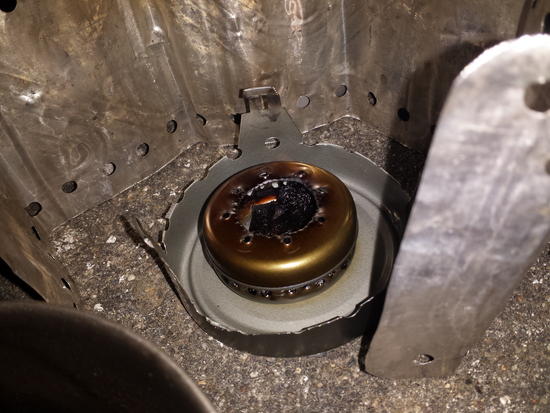
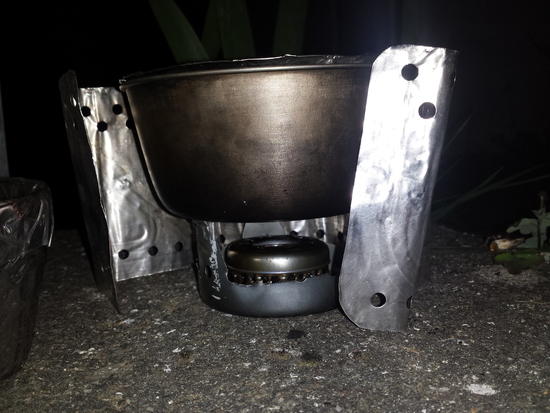
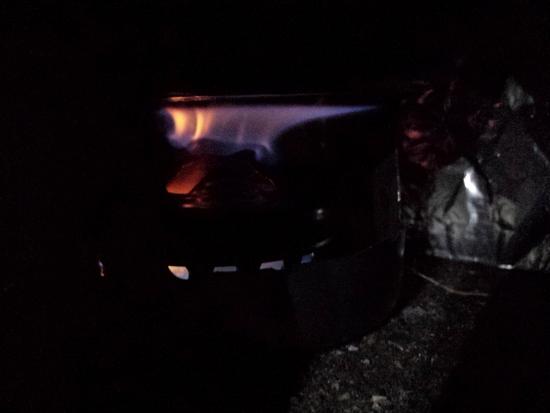
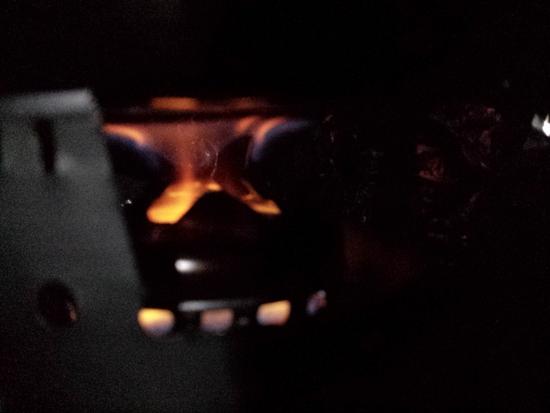
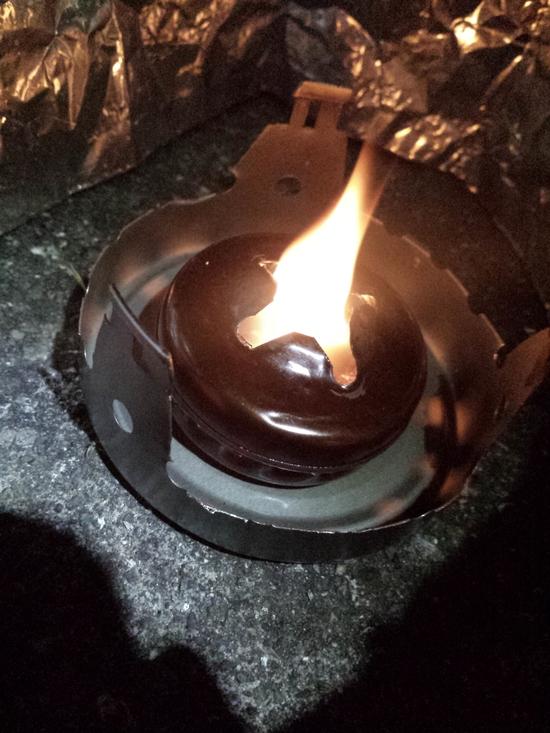
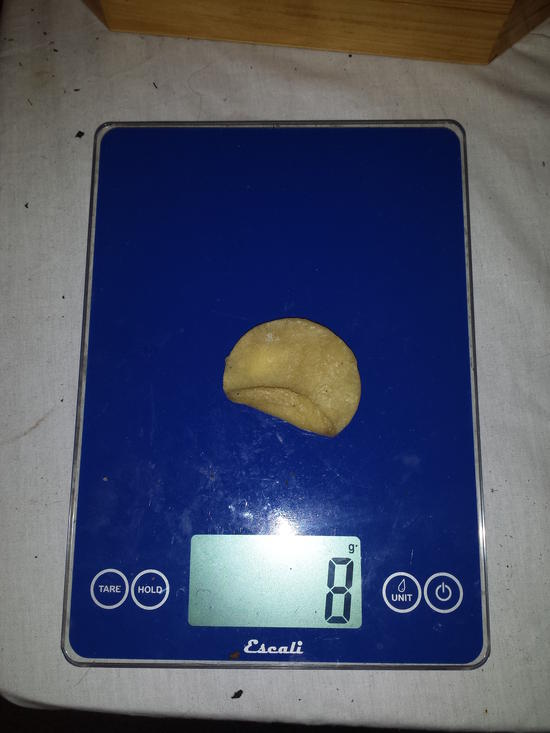
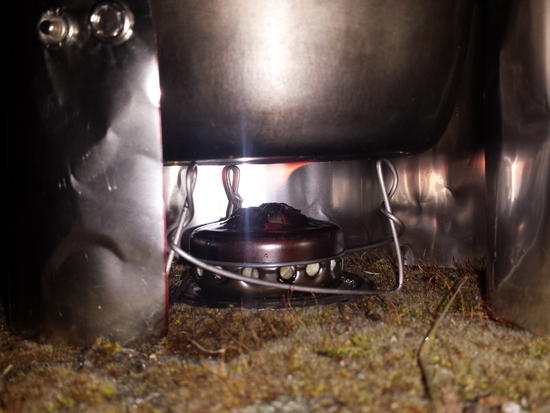
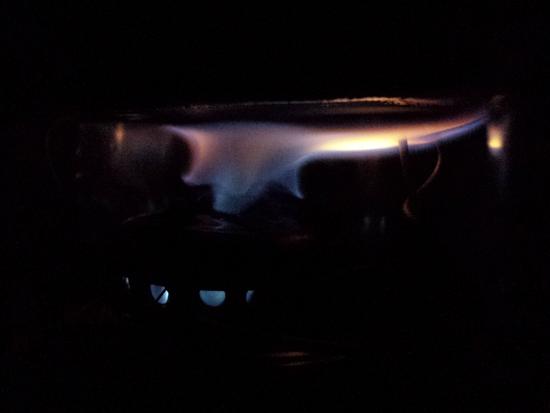
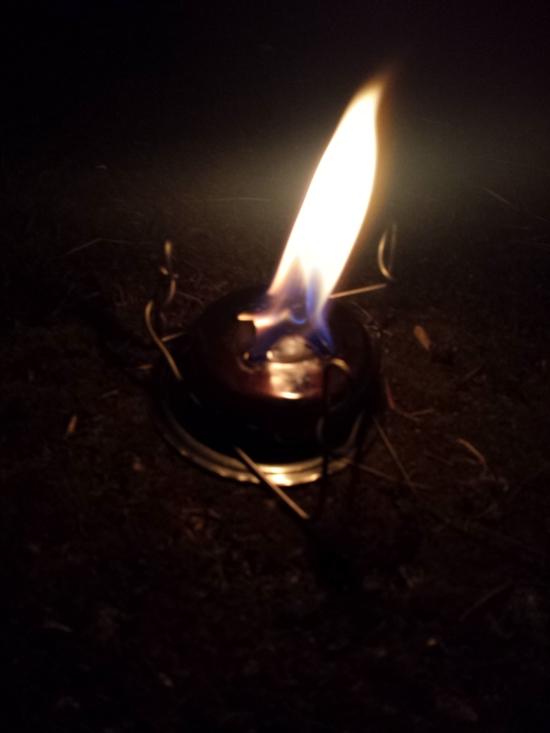
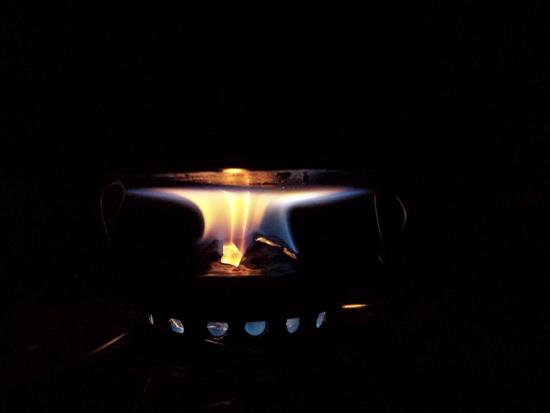
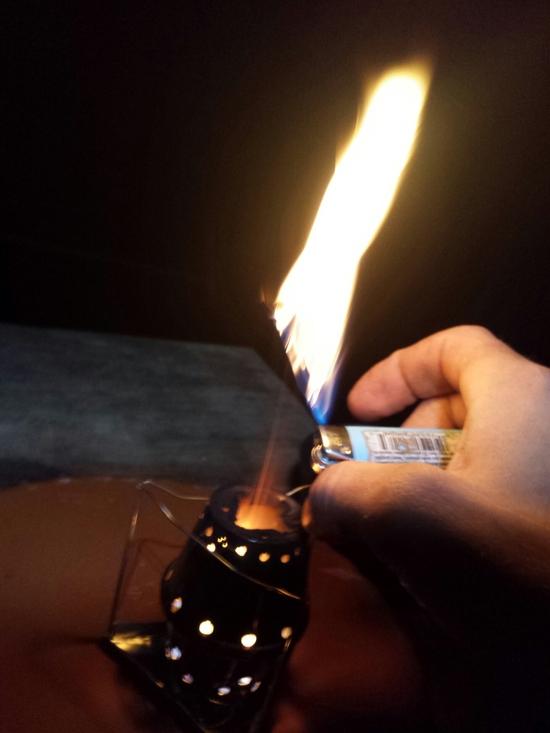
Hello all! The day I get an evening to myself is the day that one of my many hobbies gets some serious progression. This evening I decided to play with an alcohol stove, which didn't work but it did work as a wax stove! Here is a new 11gram wax burner that boils water in about 13 minutes off of 8grams of wax, that's right .25-.3 ounces.

As soon as it is lit I can place the pot on the stand, which seems to be best at 1 5/8" high. The wind doesn't blow it out until it is low on fuel but can be brought back with a quick puff at the intake holes.

I enjoy my old wax stove but it is to tall, making stands and windscreens to large. This new stove can also be made to work with small cups.
Topic
Mini Wax Stove Update
Become a member to post in the forums.
- This topic is empty.
Ok just incase anyone cares, I refitted the thing with 16 holes on the bottom and four holes on top that I cut to make a X. works a lot better had water boiling in 11 minutes off of the same 8grams of paraffin wax. bees wax should burn hotter and faster will test later.
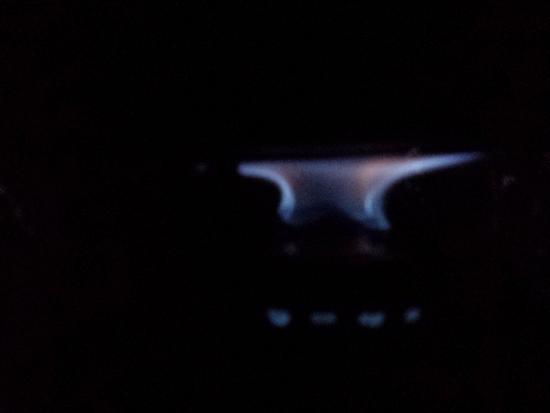
Larger thicker and more connected gas ball
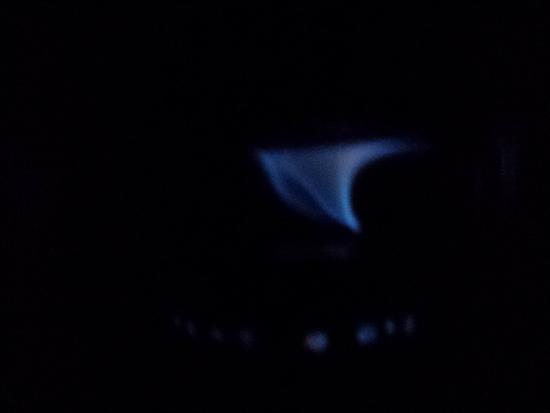
post boil dying flame, red indicates that cotton is being burnt


When it's only good for lighting up your space while you chow down. Simple wax stove! Paired with the Titanium Z stand and foil windscreen and lid, this could land under 2.5ounce, super efficient, cook kit.
Cool stove, Russell.
How much water did you boil? That sounds like a very efficient little burner!
Also, what did you make the potstand from?
Thank you,
I boiled the standard 16oz of tap water. The pot stand was a tuna can I was playing with as an exterior chamber until I figured out this lotion tin.
Final specs of my final stove kit:
Lotion Stove 12g
Titanium Z stand 5g
Can lid base reflector 6g
.002 Stainless steel windshield 20g
Black cinch bag 10g
Snow Peak bowl 52g
.002 Stainless steel lid 8g
Cozy top and bottom 25g
Bamboospoon 10g
Overall 148g or 5.2ounces
I woke up after a couple hours of sleep and did a 100% beeswax swab at 8grams
I put the 16ounces of water on the stove at 30 seconds. It went from normal candle to gasification blue flame at 4:30. And boiled water at 11minutes 20ish seconds, rolling boil at 15:30. even with me tampering with it, the 8ounces of fuel lasted 20 minutes, then went immediately out. Notice the difference between my earlier photos that were paraffin and this batch of photos which is 100%beeswax. Beeswax burns faster and hotter, which requires larger flow. So it isn't as true blue flame as the paraffin with the same stove.
Hope you enjoyed, this version is much easier to duplicate than my last one I did for the BPL Article, and with weight saving bonus features!


Yeah, paraffin is a high density heat source on a par with gasoline and diesel fuel. Not quite up to butane/propane mixes but it doesn't require a pressure tight container, either. (~19000BTU/lb)
Russell,
Did you form up the 8 gram wafer of bees wax from, say, a toilet bowl seal?
Do you light the beeswax with a match or does it require a wick of some kind.
Does bees wax, paraffin and candle wax all work to some degree or another.
http://www.backpackinglight.com/cgi-bin/backpackinglight/candle-stoves-lawson.html
This is an article that will explain more about my experiments on this stove, and how I made it this far.
I don't understand the toilet seat thing, but anyways the fuel is 99cent cotton makeup removal pads that weigh 1gram for two of them and come in a huge package at the dollar store. I have a tiny slow cooker that melt the wax to soak the cotton swabs in. That's it. Edit: the cotton swab is the wick, no need for anything fancy, in the first picture of my last post you can see that the wax near the intake holes has not yet melted, when it all warms up and melts there is no need for a "wick" the heat alone keeps a suspended flame out the top of the stove.
Paraffin defiantly works more consistently than beeswax but I prefer accidental intake of natural beeswax fumes. Both work well and are very safe fuels to travel around with or leave in a bag without worry of spills. Plus the prices of wax are very low, something like 7 cents per cotton pad for paraffin and 25cents per pad of beeswax.
Toilet bowl wax rings seal between toilet and floor flange. Made out of bees wax.
I've tried wax a bit and it leaves this waxy soot on my pan. And it gets on anything else it touches. Then, the only way I can get it off is to use paint thinner.
True that, it is sooty, that is why I incorporate an essential pot cozy. My previous design was far cleaner a burn but only because it took 3 to warm up, skipping the slow sooty burn process. This stove I threw it right on before it even gasified, but seems to be more of a hard coating or vaporized wax rather than your typical candle dust.
I also keep a dedicated candle steel wool scrubby at the home for maintenance on my wax cook pots.
I think if you had the right storage bag (or sheet) it could control the soot.
I like the simplicity and high heat capacity of wax.
Russell, Pretty neat idea and design. I wonder how your stove would work using olive oil on the pads–versus wax. If it works (?) one could have a dual-use fuel.
Waxs, olive oil, oil in general all have about the same heat content. As a general rule, the heavier the oil, the more heat content (usually only a few calories though.)
The ease of a wax "wafer" is difficult to beat for most conditions…all except for extreme heat, when the wafer starts melting. I am guessing a small piece of plastic wrap will keep individual wafers separated. Put them in a plastic bag for hauling.
Many people seem to have trouble carrying oils. Regardless how thick they are, I think of a very thin liquid. A PET or smaller Nalgene bottle (2,4,6,8oz size) will hold it pretty well but check the tops…
I did some experimentation with de-soldering braid as a reusable wick. It worked, OK. though I think stainless might have worked better.
First, thanks for all this, Russell.
I don't think olive and other vegetable oils do have the same cal/weight as petroleum oils & waxes. I believe that is due to a large component on non-combustible glycerin within them. IME they burn very sooty. You could strip that with biodiesel processing, but probably not on the trail. ;)
I'm impressed with how much more quickly you get blue flame than your earlier stove, Russell. My experiments have all been with much smaller wicks, which extended above the fuel body (paraffin and petroleum jelley) and I never got blue. I'd like to try your design but with a fiberglass disk (piece of kiln batting), one you could stoke with paraffin pellets.
Now for a longshot. I wonder if you or someone reading could explain the physics of what turns the flame blue. I have trouble with the term "gasification," which I'll get to. My guess is blue indicates complete combustion, meaning adequate mixing and oxygen. So maybe this results when the fire is hot and fast enough, drawing a faster rush of air into the mix. But then I wonder why this higher heat doesn't just vaporize more fuel, confounding the optimal mix by making it too rich again.
Not that it matters here, maybe, but "gasification" instead of "vaporization" to me is a loaded term from other stove discussions, particularly wood "gasifiers," which drew a lot of informed argument. As I understand the physics, solids never burn with a flame; only the vapors driven from them, mixing with air, by heat, create flame. I pick this nit only to isolate the notion that a flame-stage of this stove–or any stove–when the flame gets blue and better, is the result of any different basic physics than the vaporization that allows the first flame to begin with.
When using a gas welding torch, one adjusts the oxy/fuel mix until a blue or neutral flame is achieved. This means there is no excess oxygen. I do not know why the flame is blue, but I do know that the orange component is indicative of excess oxygen. With the torch this means that you are adding too much oxygen. With the gas stove I am not sure if it means excessive air is being drawn in or there is not enough heat to combust all of the fuel so some of the air is released as orange i.e. unburnt oxygen. I am guessing it is the latter because as the stove heats up, the orange disappears and a clean neutral flame is present.
What is the diameter of the basic burner? It appears to be about three inches.
–B.G.–
I wonder if you or someone reading could explain the physics of what turns the flame blue.
The physics/chemistry of hydrocarbon combustion is really quite complex. In simple terms, each molecule of fuel gets broken into small bits, and these bits are further broken into individual atoms. The hydrogen atoms combine with oxygen atoms to form water. If there is sufficient oxygen, the carbon atoms will combine with oxygen to form carbon monoxide. If there is still sufficient oxygen, it will conbine with the carbon monoxide to form carbon dioxide.
The blue colour is caused by the "bits" – pairs of atoms such as C-H and C-C, vibrating due to the temperature. The distinct blue colours are called Swan bands after the Scottish physicist who discovered them. Look closely at a gas flame and you will see two shades of blue.
The yellow colour is caused by hot individual carbon atoms – soot.
So, in a alcohol/gas/white gas/wax stove, an yellow flame is always indicative of incomplete combustion due to insufficient oxygen, so soot and carbon monoxide are being produced.
> I do know that the orange component is indicative of excess oxygen.
Have you tried cutting off the oxygen to see what happens? The flame gets 'softer' and orange. The orange colour is carbon atoms glowing and making soot. When you open up the oxygen or air flow, the flame gets bluer and looks 'stronger'.
Others have explained what the two blue colours mean. I will add that the length of the flame is also an indicator of how much oxygen you are injecting. Once the flame is blue, a long flame means the flame is still pulling in oxygen from the outside. As you increase the flow of oxygen the flame gets shorter because it does not need extra oxygen from 'outside'
Anyhow, you have got it back to front: an orange colour is indicative of a deficiency of oxygen. Most any stove user or gas-torch user knows this.
This is the problem with wax stoves of course: getting enough oxygen into the gas being emitted from the wax. But some of these designs manage to do that, which is rather interesting.
Cheers
I inadequately expressed my query on flame color. (but I did need the helpful confirmations that a flame colored blue is hotter than the "luminescent" flames, and burning more completely). Knowing I'm right in thinking this stove has achieved a "good burn" when it goes blue, I'm more curious how this remarkable thing (for paraffin wick) happens for THIS stove. Again, I can only guess as the burn gains heat, the air inrush gets ideal. But, why no runaway, no over-vaporization of the paraffin? Compared to a Bunsen burner, say, the porting is pretty crude. Even a kerosene lantern, though luminous, has a flame/soot control.
> how this remarkable thing (for paraffin wick) happens for THIS stove. Again, I can
> only guess as the burn gains heat, the air inrush gets ideal.
The huge number of holes arounds the base, to let air in, is obviously a major factor in getting enough oxygen into the fuel/air mix. Shut those holes off and you would have a 'candle' flame. Open them up and get good mixing inside the chamber and you get a far better fuel/air mix for combustion. A vital key is LOTS of oxygen.
Couple that with a quite hot vaporisation plus a hot feedback from the tips of the flames to the roots of the flames, to help the initial breakdown of the long-chain hydrocarbons, and you have a fortunate combination.
> the porting is pretty crude.
Well, dunno about that. A hole is a hole, and the gas flows through it.
True, there is no control over the area of the the holes, but this is early days for the development of wax stoves!
Cheers
Well, maybe. Just because there is little carbon being burned completely does not necessarily mean it is completely burned. As Stuart was saying, paraffin is a long chain. In most cases, you need to view the flame UNOBSTRUCTED to get a fairly accurate indication. For example, I believe Dan Y. was producing an unpressurized gas stove and because it had a blue flame under a pot, he assumed it was burning clean. Yet his consumption was miserable, ~.30oz for two cups of water, if I remember correctly. On low, with a good wind screen, I can do 1/3oz per LITER with a white gas stove (Best was .23, worst was .49 over about 20 runs.)
It turns out that there was quenching by the pot happening. All the soot normally associated with inefficient burns was being cooled by the pot before it could turn the typical orangish color.
I believe the same is happening here.
Hydrocarbons, natural waxes, etc, are longer than what can easily be burned. Basically they need to be in an oxygen rich environment. I like to think of this (rather inaccurately) as O2 reacting from each end. Once the O2 is burned, then it needs to be replaced. In a non-jet environment, there is simply not enough O2 to burn a long 5,6,7 or more carbon chain.
The final proof of efficient burning is lack of soot and lack of CO. Both mean you are leaving unburned fuel, hence cannot be efficient. (Though a small amount of either/both is tolerable.)
Wonderful discussion! I have learned so much, and certainly am only this far practiced in stove design due to the archives of factual wealth stored on this forum. I am so pleased to be able to give back with this small fascination of mine.
To clue you in to what I learned from the first article version to these two prototypes is that you need about three to one ratio of intake to exhaust holes to get an adequate flow. The first tin design had unhindered flow and not enough intake ports. The flame would float half an inch above the stove and wind would blow it out, but then be reignited by the flames that hangout next to the intake ports. To complicate this with other design ideas, I found that in previous versions with to much intake, it would ignore flowing to the top and just blow flames out the bottom.
Now for my findings in regards to the information above, to get a blue flame this stove, because it isn't a rest on top/side jet style, requires the pot to be about 1 3/4" above the ground. That dynamic keeps the flow in some sort of sweet spot. My previous assumption was that the bowl obstruction slowed the flow down enough where there is open air to use the heat to burn any gas before it could move on. My crude experiment with a lighter in the exhaust fumes to find excess gas out of this stove did not produce a larger flame from free unburnt fuel. Also I find that the dampening x in the exhaust port helps to keep the flame slowed and grounded to the source of the fuel.
wasted fuel that lost it's 
If I were to get another day to myself to make more, I would defiantly make one out of a larger tin with more intake from smaller holes and maybe longer arms on the X, or even wider. Hope this lightweight, efficient cooking option is more viable for you folks than the last one which seems like a tank now.
Hi James
Good point.
I was trying to address the question of whether an orange flame in general means too little oxygen or too much.
More oxygen!
Cheers
Basically, the color of flames has to do with the wavelengths they reach. The more energetic the wave length, the closer to hard radiation it gets. (Not strictly true but close enough for non-nuclear type combustion.) Long chained hydrocarbon will burn bluer, almost to light purple, given a enough oxygen. There are several spectra associated with it. Carbon and it's associated electrons, hydrogen, oxygen, intermediate molecules (co, h, o ions) and so on. Each element will vibrate in de Broglie wave lengths (photons), hence only emit distinctive light signatures. Don't forget that what we see as visible light is only a small bit of the electromagnetic spectrum. Easy enough to understand but don't try too hard… A star spectrograph is one tool that uses this to read what astronomical bodies are made of. Each element has a unique ionized signature.
Anyway, visible examination of a flames color is fairly good at judging its heat. Bluer, going to purple and rather dim is about the hottest you can get a hydrocarbon flame in our atmosphere.
Vaporization is fairly necessary for combustion. It means almost all fuels will get hot enough to ionize before they will burn. This means heat is also necessary to a self sustaining combustion. It usually means there are at least two reactants in the mix.
"Combustion" is not instantaneous. It is a process of intermediate, usually highly unstable, products relaxing to a more stable configuration and releasing energy. Think of a balloon with air as the energy. Let the air out and you release energy. You have to work to blow it up again (add energy.) So at each point there are several steps and several molecules involved. It takes some time for this to combust. If ANY reactant, including ionization energy, is in short supply, it will simply drop out…you get CO, Cxhx(COOH), etc. Some are toxic, some are plasticy, some are alcohols, etc. All are byproducts.
Great picture with the lighter in the exhaust stream, Russel. Thx again.
Reading between the lines & finding no counter to my supposition, I'm going to theorize I'm right on why the oxygen goes from not enough (for 4 min 20 sec.) to sufficient.
"It went from normal candle to gasification blue flame at 4:30."
The only thing that changed with the stove over 4:30 was increase in heat. So while that heat was increasing vaporization of the liquid paraffin, increased force of exhaust must have increased in-draw of the air(oxygen) more. As to why this increase in stove temp doesn't continue–gaining, even–and then lead to thermal runaway and explosion, my theory is now, "because it just doesn't."
Three to one, in to out. Thanks for the starting point, Russsel.
Generally, carbon requires a LOT of heat to get it to burn. That's why it converts to to intermediate products first( co or something.) Look at diamonds, they take so much heat they are considered a mineral. Graphite is a precursor that is also difficult to burn (it was used in WWII as steering vanes in the rocket exhaust for the V2 rocket.) Lampblack also is difficult to burn. It just makes things sooty unless you really apply lots of heat. Carbon in the forest has a very long half life. Replacement is MUCH easier.
Become a member to post in the forums.