


Snow Peak introduced two new remote canister stoves:
BiPod Stove:
http://snowpeak.com/collections/all/products/bipod-stove?variant=1283807760
GeoShield Stove:
http://snowpeak.com/collections/all/products/geoshield-stove?variant=1283875800
Topic
Become a member to post in the forums.
.
Snow Peak introduced two new remote canister stoves:
BiPod Stove:
http://snowpeak.com/collections/all/products/bipod-stove?variant=1283807760
GeoShield Stove:
http://snowpeak.com/collections/all/products/geoshield-stove?variant=1283875800
I have to say I can't see any point to the BiPod stove. Remote canister means I have a lower center of gravity, I can put a full wind screen around the burner, and hopefully allows me to invert the canister.
This does none of those things. The burner still sits above the height of the canister so your center of Gravity is only slightly lower than a canister top stove. I guess a wind screen could be made with a notch for the fuel tube, but it's pretty intrusive. and there's certainly no hope for inverting that canister.
In addition, it increases the size of level ground needed. The ground under the canister and the ground under the stove head must be level or it's going to cause a headache. This problem doesn't exist with any other stove type.
Seems like worst-of-both-worlds engineering to me.
^^^ +1
And I have no idea what the target audience for a $500 canister stove is…but I predict single digit sales figures at best :)
http://snowpeak.com/collections/stoves/products/gigapower-li-stove-gs-1000?variant=671131993

I think all of us should pitch in and buy one for Hikin' Jim.
The footprint of the bipod stove is much larger than a stove that's supported only by the canister, so it will be much more stable. Center of gravity only matters to the extent that the CG is over the footprint (draw straight lines between points of contact with the ground to determine footprint). Although they call it a bipod, it's actually a tripod, so it won't wobble on slightly uneven ground, though it might not sit exactly level. And it looks like the legs have course adjustment, so it might work on a slope or step of a certain angle or height, and you can place rocks or stuff under the legs or canister as needed to level it.
Bipod stove:
quote: 'A wide support arm and sturdy legs allow you to safely cook on larger pans'
Well, yes. Groups?
Geoshield stove:
Integrated windshield, remote canister
Well, OK, but a bit 'fancy that'.
Gigapower Li stove ($500)
Assuming they have not made a mistake with the price … the mind boggles. I guess you could put a large cast iron pot on that one. Very Japanese car camping. Potential market there of course.
Cheers
Gigapower Li stove ($500)
Now that's an odd duck. Guess they never heard of straight propane. ;^)
34,000 BTU… I wonder how long a 110g canister lasts on that one.
Niche market, for sure.
Interesting these two stoves. They both seem well executed — but ill conceived. It’s nice to see Snow Peak trying something new, but… I’m going to predict that these aren’t going to go anywhere in the US market. Heavy, expensive, and of questionable wind proofness.
Someone sent me a GeoShield to test. It’s well made. The fiddle factor is there, but it’s not excruciating. I can set it up in about 40 seconds. Much faster than white gasoline or kerosene stoves. And you do get a very wide, stable surface from something that packs down small.
The really oddball thing about it is the “windscreen”. Normally, you want a windscreen to extend up high enough where 75% of the pot is covered. Their windscreen only reaches to approximately the bottom of the pot. Not only that, the windscreen is quite porous. The wind goes through it pretty easily. Really, to do it right with this stove, you’d have to bring a separate windscreen, adding yet more weight. Yes, it will do well with a big pot or pan, but there are a lot of other options that can handle a fairly big pot like say an MSR Dragonfly or something like that. I see some design miscalculations here and a very limited audience.
I shot a video of a quick wind test. Watch what happens when I put a real windscreen around the stove. Crappy video, but hopefully it gets the point across.
https://www.youtube.com/watch?v=1MkIv9Vvl3c
HJ
I should add the following to the above post: The Geo Shield has a pot for which it is optimized, the “Mountain 1500.” See photo from the Snow Peak website, below. In my video, above, I used an Evernew 2.6 L pot which has a smaller diameter than the GeoShield’s windscreen. I didn’t get much in the way of wind protection from the GeoShield’s windscreen the way I had things configured. The Mountain 1500 whose diameter meshes just so with the GeoShield’s windscreen will have better wind resistance, perhaps far better. I won’t know unless I get one. We’ll see.
HJ
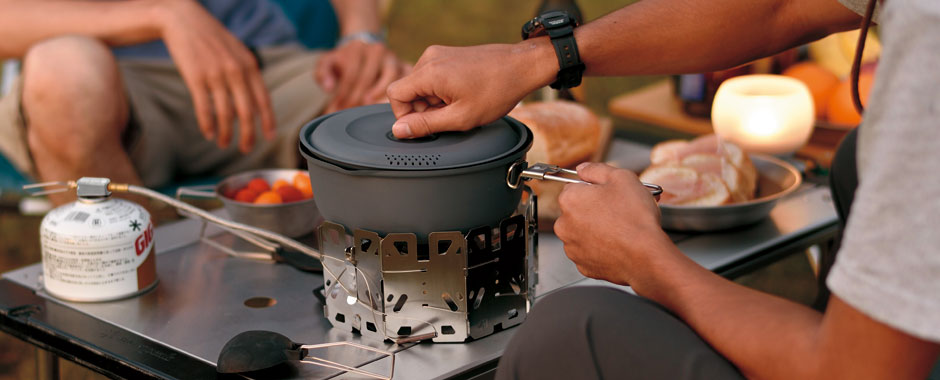
I think the right word for some of the more recent designs is ‘glamping’ – or car camping. Jim’s photo (from the SP web site) says it all.
Cheers
Roger,
Well, yes and no re “glamping”. A lot of the photos I see coming out of Japan and Korea have this feel (of extraordinary amounts of gear). I get the impression that this is how it’s done for Japan and Korea. I could be wrong there. So, maybe the GeoShield is an attempt to tap into the glamping crowd. It may also be a product intended to appeal to Snow Peak’s home market. If Snow Peak is assuming that the American or other markets will respond in the same way as their domestic market, I think that they may be in for a rude awakening.
The GeoShield is a really stable cooking platform for serious cooking or really large pots that packs up really small. Perhaps that’s what Snow Peak is banking on to sell the product. And while a $100 remote canister stove that weighs 14 or so oz may not hold much appeal to the BPL crowd, there are a lot of different schools of thought on backpacking. It’ll be interesting to see if it sells. I suspect it won’t, but MSR apparently has been doing well enough with the Windpro which sells for the same price. The Simmerlite from which the Windpro came is no more.
HJ
I get the impression that this is how it’s done for Japan and Korea.
I sort of got the impression that glamping in Japan is a bit like tailgating in America – yes?
Cheers
I could see this working for larger groups such as Scouts or for mountaineering base camps or safari trips, inside a cook tent.
Good to see the video demonstrating the ineffectiveness of the windscreen.
It’s actually nicely done and very compact for a stove that will support such large pots and pans.
I don’t see it being of much interest to the UL crowd although it’s in the same general weight class as some of the multi fuel stoves when the weight of the pump is included.
Regarding the windscreen, there are two set up modes. In “big pot” mode, the pot supports are essentially at the same level as the top of the windscreen and the bottom of the pot is above the upper edge of the wind screen. You will have the least amount of wind resistance in big pot mode.
In “small pot” mode, the pot supports nestle down a couple of cm and the bottom of the pot is below the upper edge of the windscreen.
My video was shot in big pot mode. In all fairness, I really should shoot another video in small pot mode. I don’t expect my results to change much, but I really should run the tests. For good wind protection, one generally wants the windscreen to extend up 75% of the sides of the pot. Even in small pot mode, you’re not going to get that kind of coverage. In addition, the diameter of the windscreen is fixed and cannot be decreased to give better protection to smaller pots. Not only that, but the windscreen has a lot of perforations, further reducing its effectiveness.
There is a pot specifically designed for the stove, the “Mountain 1500,” a wide 1.5 L pot. The diameter of the pot is optimized to just fit inside the windscreen in small pot mode. This would be the maximum effective configuration for wind resistance. To really do a thorough job on the review, I should test with the pot for which the stove was designed.
However, since most people will not restrict themselves to a single 1500 ml pot, I think wind tests using other pots are fair game. I don’t think it’s a particularly wind proof set up in either mode. A supplemental wind screen is most likely necessary. It would be most ironic to have to provide an additional windscreen to a set up based on a windscreen, but that’s my take on this set up.
HJ
Er… Thanks for posting these curiously interesting stoves but I’ll stick with my MSR Universal setup. Very versatile for a huge temperature and fuel range and also very stable.
BTW, why does the “Geoshield” stove not have an inverted canister stand? Jus’ saying’.
Dunno why the GeoShield doesn’t have a canister stand, but it doesn’t. I tried the stand that fits the Kovea Spider and the Kovea Hydra, but no go. The GeoShield’s valve block is too wide.
A little yogurt tub with a slot cut out of one side works pretty well, or you can just lean it up against a rock or a shoe or something.
HJ
Become a member to post in the forums.
 Ultralight folding polesCarbon fiber, adjustable, 15" collapsed length.
 © Beartooth Media Group Inc.
 Loading...