Topic

FireMaple FMS-118 dying flame

  • This topic is empty.
Viewing 18 posts - 1 through 18 (of 18 total)
PostedApr 14, 2015 at 3:13 pm

Hi everybody

Recently I acquired a Pinguin Mantis stove, which is just a rebranded FireMaple FMS-118

http://www.pinguincz.cz/en/product/mantis/p-4343

I had to have the seller exchange the first product shipped to me, after one month I discovered it leaked at the hose near the valve (bad crimping ?). Now I am on the second one, so you could say I have some experience with these beasts.

No matter if the canister is upright or inverted, the problem is that the flame slowly diminishes and dyes, unless I open it more from the valve of just "play" with the hose or canister or the valve … a slight touch "revives" the flame for maybe a few seconds then the flame starts again to go lower and lower. Now – for the first stove I received I thought this issue appeared because of leaking hose … but the second one doesn't leak … or should I look better for a smaller leak harder to notice ? I am using the stove at temperatures around 0 degrees Celsius … and on medium to simmering flame (don't like big flames around my 12 cm diameter pot).

I don't know what to do … I really like this little stove. Any one here had this problems with FMS-118 ?

Roger Caffin BPL Member
PostedApr 14, 2015 at 4:38 pm

Hi Mircea

First, check the jet in the stove. It may be blocked. Take it out and clean it with thin BRASS or COPPER wire; NOT with a steel pin! Also remove and clean the needle valve. We have an article on stove maintenance at
http://www.backpackinglight.com/cgi-bin/backpackinglight/essential_stove_maintenance.html

It is quite normal to have to adjust a stove a bit when cooking. Everyone one does that.

> I am using the stove at temperatures around 0 degrees Celsius
In this case I suspect that the canister is freezing and losing pressure. Under those conditions you will have to run the stove with the canister inverted – completely upside down. Read some of our other stove articles here at BPL for more information. (I wrote a lot of them.)

Cheers

Stuart R BPL Member
PostedApr 15, 2015 at 12:13 am

"No matter if the canister is upright or inverted, the problem is that the flame slowly diminishes and dyes"

Try a new canister – is that any better? If not, then as Roger says, you probably have a blockage somewhere.

If a new canister is better, then realise that to get the benefit from inverting a canister, it has to be used inverted from full (or at least most of the time). If the flame has already died, inverting the canister at that point will not make a lot of difference.

Roger Caffin BPL Member
PostedApr 15, 2015 at 2:36 am

Noting what Stuart wrote, I now suspect a dirty needle. Possibly all waxed up. Some canisters contain dirty waxy gas mixes – especially the Chinese ones.
Clean per Stove Maintenance article.

Cheers

PostedApr 15, 2015 at 5:14 am

Thank you all for useful answers. I dissasembled the needle valve – there was no trace of dirt there, maybe some grease from the screw threads, just to be sure I wiped the needle with a cloth. For the jet, I inserted a piece of brass wire taken from a brush, it moved freely – no signs of obstruction.

After that, my tests at room temperature (25 C) seemed better from what I remember – less fiddly (I only tested the stove at this temp once – after receiving it). I'll wait for the weekend to see how it works it at 0 C again.

Stuart – I'm using the canister inverted from the beginning, and yes – the canister was new. Usually it stays "half inverted" – on the side of the canister like in the pic below, but if I have a stable surface I try to invert it more (don't have stand for a perfect vertical position). It integrates nicely with my titanium foil windscreen.

Pinguin Mantis / FireMaple FMS-118 in use

P.S. – Can someone please explain why not to use canister upright first and then inverted – I am very curious why is that. I assume that propane goes first when using upright, but in liquid feed even with only butane left, it should work without problems at 0 deg C.

James Marco BPL Member
PostedApr 15, 2015 at 6:49 am

Like many new stoves, there is likely a small amount of machining/stamping lubricant left on parts. Sometimes there are bits of metal from machining. It happens. I don't think this is a really thorough cleaning. Many degreasers can also leave a residue, so these are not recommended. Likely the best to use is alcohol. Warm the stove up to around 100F/40C and inject some 99% alcohol with a small syringe into the jet and valve systems. This will likely cause some problems the first couple times you use it, since it isn't really like the gas for burning. Then hook it up (outside) and blast it free. Do this a couple, maybe three times. Any metal fragments will usually be loosened and also be blasted out of the valve. If you can remove the jet, do it and insert a small plastic stray and blow into it hard to flush any remaining alcohol/wax/oil/metal fragments out of it. Then reassemble, blasting it clear a couple times with butane as you put the pieces together. This will clean out the hoses, valve, jet and lines by dissolving and mixing the alky with the oils, then blasting it out.

I think there might be two basic design flaws with the stove preventing good inverted operation. The first is the lack of a regulation valve on the stove. This means that there will be a longish delay (2-5 seconds) when adjusting it.

The second is the length and distance of the preheating loop. Unlike a Windpro, there isn't much in the flame and both the connections (incoming gas, outgoing gas) reach down under the stove to a largish block. This block is the problem. The block will act as a heat sink trapping in "coldness" and dissipating heat (well, one way of looking at it.) When starting it you could well be heating the gas, then re-condensing it in the block just before the jet. This will lead to flame surges/sputtering when cold and difficult heating because the evaporation will now be concentrated near/at the jet but will also be used by any liquid fuel to heat and expand the gas before going up to be heated! The long tubing runs also contribute to both heat loss & cooling. The block is at the bottom, well away from any heat from the flame. Simply removing the incoming gas connection and attaching it to the gas line would improve operation. Likely it will work fine in any temps >40F but not too well below 32F/0C. As built it will never be a good cold weather stove. See Rogers articles on the basic design principles of cold weather gas stoves (5 parts.) http://www.backpackinglight.com/cgi-bin/backpackinglight/caffin-evolution-of-winter-stove#.VS5r2fAmi00

This is besides the quality control problems. I am guessing that Fire Maple will soon drop this stove.

BTW: I believe this also explains why liquid fuel is often better than gas fuel. It has little to do with propane/butane mixes.

Stuart R BPL Member
PostedApr 15, 2015 at 7:58 am

"P.S. – Can someone please explain why not to use canister upright first and then inverted – I am very curious why is that. I assume that propane goes first when using upright, but in liquid feed even with only butane left, it should work without problems at 0 deg C"

Yes, when used upright the propane gets used (not exclusively but) pretty quickly.

n-Butane has a boiling point of 0 deg C. That means (by definition) at 0 deg C, the vapour pressure of butane is equal to sea level atmospheric pressure. So a canister of butane at 0 C will have no "guage" pressure and so no pressure to force the gas out and through the jet. Turning the canister upside down makes no difference to the pressure inside.
The reason for using the canister inverted from new is to prevent the propane from getting used up quickly. When used inverted, the % propane stays the same as the contents are used up.

PostedApr 20, 2015 at 12:47 pm

After a thorough cleaning & greasing at home (completely disassembled the valve – double o-rings on hose side were not greased) I put it through a weekend tent camping. This time the temperatures were lower … I estimate something like -5C in the tent's vestibule (inside tent -2.5C). The flame was still very erratic. I had to "bump" it by rising the canister or adjusting the valve every 10 seconds or so,otherwise the flame would diminish to the point where even with a windscreen the slightest blow will turn it off. I know for sure I had pressure left in the canister, because it would start even with canister up. The fact that two stoves had exactly the same behavior looks to me like a design defect. I'm puzzled by all people who are satisfied with their FMS-118.
This is too unusable for me, I'll go back to Omnifuel for three season use. Still the legs of the stove are completely detachable and seem nice for a MYOG alcohol stove project, maybe I'll use them in the future:)

PostedApr 21, 2015 at 2:34 pm

Finally, I think I found the cause of the problem and the solution.
After firing it at room temp with canister up, I noticed that if I just press the valve knob without rotating it, the flame would diminish, not unlikely the cold temperature inverted canister in the field. I took a look at the valve shaft … surely it was having too much play inside the housing, the nut securing the valve had too larger diameter than the shaft. In the field, the coldness caused by the gas evaporation which occurred at the valve probably shifted the valve shaft continuously, throttling the flame.

I fixed it simply by inserting a piece of aluminium foil from a baking pan, between the nut and the shaft rolling it tightly – width approx 4mm, length – at least one turn is needed, better two for a tighter fit. The purpose is for the shaft to have as little play is possible.

Here is the picture, with a piece of foil already inserted seen as a round bushing and for demonstration a piece of foil just cut.Pinguin Mantis Fix

Roger Caffin BPL Member
PostedApr 21, 2015 at 4:06 pm

Hi Mircea

I have to say I don't really understand why that should create or solve your problems. That's why I went for a dual-valve system on my Winter Stove. However, I am sure many of us would like to hear from you about how your stove goes for the next few trips.

Take note of Stuart's comments about the need to use the canister inverted from the start. A straight butane fuel is of no use to you below 0 C.

Cheers

PostedApr 21, 2015 at 10:26 pm

Hi Roger

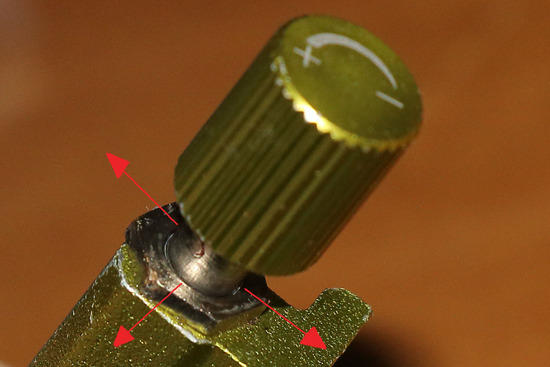
I agree my explanations are not very clear. Besides, what I called a nut is in fact a hollow screw, through which the valve shaft goes. The problem is that the clearance between the shaft and the screw is too big. The shaft can move when you press ON THE SIDE of the knob, and it affects the flame even in gas flow mode (canister up). I could extinguish the flame on simmering and medium setting, JUST PRESSING THE KNOB laterally. In the following pic the arrows show how the shaft can move :

Pinguin Mantis valve detail

Why is that affecting the flow ? A technical drawing with the valve would be useful here, but don't have time. The needle instead of sitting straight through the hole to hose part, will sit at an angle, maybe will touch the margin of that hole. Why is that occurring even at room temp with canister up ? Because gas will evaporate/expand into the larger space of the fuel line, and that will cool the valve first (we all know this cooling – sometimes condensation appears on the valve and fuel line near it). The cooling will move the shaft to one side – because of difference in contracting between the parts.

What I made was just to put a bushing made from foil inside the hollow screw fixing the valve shaft, so it will rotate more concentrically and the needle will be always in the center of the hole.

Roger Caffin BPL Member
PostedApr 21, 2015 at 11:40 pm

Hi Mircea

Oh, I understood that part.
What I have trouble with is understanding why that should cause the flow to creep all the time.

What gas brand are you using?
I ask becasue we know that some brands are clean, while other brands ('dirty' ones) have dust and waxes in them. Some of the dirty brands (usually made in China, even with a western brand on them) can clog a needle valve up in a few seconds.

Cheers

PostedApr 21, 2015 at 11:45 pm

Hi Roger

I use the same brand of canister, that is Pinguin. 4 season mix, made in Korea. I had been able to use a canister of this type with an upright stove (FMS-116T) to the last drops, in temperature only a few degrees over 0 C.

James Marco BPL Member
PostedApr 22, 2015 at 4:53 am

Mircea, I think that the pressure will stabilize on the valve after a few seconds. Expansion and contraction due to heat will also stabilize since it requires a temperature differential. For the most part after running a minute or so, you should be able to adjust the flow rate fairly cleanly with only a degree or so in temp change. I don't believe that is the problem, but loose parts are always worrisome.

Somehow the fuel flow is being changed, I agree. Get a couple different fuel cans to check the dirt build up and try the can on a different stove if you have one. It could well be in the can. Once the wax/dirt is in the system, it needs to be cleaned again. The tests may mean cleaning two stoves.

It really sounds like a problem that plagued the old Simmerlite. Running at full bore was fine. Turn it down, and it kept going slower, slower till it would go out. Really inefficient and MSR dropped the stove. There was not much adjustment on it. Though, they still kept the basics as the WindPro.

Like I say there are problems with the design, apparently. I found this this morning:
http://blog.hillmap.com/2013/01/fire-maple-fms-118-sputters-in-cold-vs.html

PostedApr 22, 2015 at 6:06 am

James,

I agree that the pressure and temperature should stabilize at the valve. What is unfortunate is that the equilibrium position, mechanically speaking is throttling down the fuel flow. The clearance is large enough that it allows movement of the shaft until it touches the hollow screw and/or probably inside the needle touches the walls of the hole – imagine a tapered cylinder (needle) inside a straight cylinder, but the axes of the two are not centered – the small film of fuel flowing will be impeded if the cylinders are touching in two points.

That is my explanation, and I repeat the result of my little experiment with the upright canister (nobody seemed to pay attention to this): I could almost turn off the flow by pushing on the side of the knob, not turning it, not pushing inside – in any direction pointed by the red arrow in my pic above. That demonstrates that the play allowed by clearance between parts is too much for precise smooth operation. The bushing I made from foil solves this problem.

I opened that valve many times, no amount of waxes or paraffin was found on it.

Unfortunately with all these experiments, I had left only 1/3 rd to 1/4th in a lot of my canisters. But I'll carry one in this weekend just to try it outdoors.

James Marco BPL Member
PostedApr 22, 2015 at 8:04 am

James,

I agree that the pressure and temperature should stabilize at the valve. What is unfortunate is that the equilibrium position, mechanically speaking is throttling down the fuel flow. The clearance is large enough that it allows movement of the shaft until it touches the hollow screw and/or probably inside the needle touches the walls of the hole – imagine a tapered cylinder (needle) inside a straight cylinder, but the axes of the two are not centered – the small film of fuel flowing will be impeded if the cylinders are touching in two points.

I understand. When the stove is set and at operating temp, it should remain set…regardless of any slop in the valve. There is not enough change due to expansion or gas/liquid flows to do otherwise. The problem you are attempting to fix would manifest as a vibration or noise at the valve. Vibration or noise can be construed as movement…

Similar problems also reported here:
http://bushwalk.com/forum/viewtopic.php?f=15&t=10569

According to these guys, the belief is the preheat tube diameter is too large allowing raw or unburned portions of gas into mix. The "fix" is to insert a small diameter wire (no size given.) Note that this will also cause additional heat to be absorbed/transferred to the gas and theoretically can work. (If you reduce the volume of gas being heated but apply the same heat then, in essence, you make the gas hotter/increase pressure.) I never tried it, just going by others problem reports.

Anyway, it seems there is some design problem. Maybe your fix will do it.

PostedApr 27, 2015 at 11:23 am

This weekend the temps were higher, so I could test the fix only at 5-6 degrees C, not lower. Canister had 70 grams of gas left. It seems OK, although still not so constant as I would like. Probably a stand for canister to raise it a little more higher and vertical would have helped.

I also did the trick with copper wire inside tube (I think I managed to insert 1 cm of it) but stuttering problem still not solved. Other mod : eliminated the sintered metallic filter inside jet (stupid idea of the manufacturer) and inserted a little coiled silica rope instead.

I would like to insert a silica rope wick inside the vaporizer tube, but it's so narrow and it has too many sharp bends, it's almost impossible. Tried to insert first a guiding fishing thread, no success.

This stove seems to be made for a modder/DIY/MYOG-er than a "buy and it just works" stove, I would not recommend it to anyone.

Roger Caffin BPL Member
PostedApr 27, 2015 at 3:09 pm

It's all very strange. I have the original FMS version and it works just fine, with no signs of your problems. I am left to wonder whether Pinguin had them make some small changes to the design?

Can't say the preheat tube looked all that big on mine either.

At this stage I would be thinking 'FMS version OK, Pinguin version NOK'.

Cheers

Viewing 18 posts - 1 through 18 (of 18 total)
Loading...