


Would like to use same high R value inflatable pad all year around. Does anyone find themselves overheating with high R value pads in summer?
Topic
Become a member to post in the forums.
Would like to use same high R value inflatable pad all year around. Does anyone find themselves overheating with high R value pads in summer?

I have used downmats plenty of times in summer and they are fine.
no.
I haven't used high R value mats backpacking in the summer, but if I may share some car camping wisdom as a tent you can stand in with a queen sized air mattress is the only way I can get my husband to camp…
I don't know what the r value of the queen sized air mattress is, but I'm guessing it's decent. And no, no overheating.

That depends on the pad… I have slept on an older SynMat 7 (R Value 4.9) in the dead of summer… it was even hot laying in a hammock, but I couldn't tell that the pad was making things any worse… However, in the same conditions, on a NeoAir, it is worse… I can actually feel the heat being reflected back to me in these pads, so I had to stop using them in the warm months. I now use a small ProLite 3 in the warm months… But that really makes the NeoAir a great pad when it does get cold…
Chad is right, a downmat or synmat would be ok but something with a reflective barrier might roast you.
> Does anyone find themselves overheating with high R value pads in summer?
No.
Your mattress at home has a very high R-value.
Cheers
i do, i'm a warm sleeper, person in general. everyone is different that's why there is so much good equipment that gets traded. you can read all the good reviews you want if it doesn't fit or suit your needs it's not going to fit your needs. that's the whole part of experience that you have to figure out for yourself, then gear selection becomes easier as you get to know yourself you can almost know what items are going to feel like to you as you get to know yourself. it's not uncomfortable warm for me to sleep on a higher r- value pad. i just noticed the 1/8 ccf on a klymit torso pad is more comfortable for me then something with higher r value. i also toss and turn alot but don't wake up from the falling off the edge feeling. i've been tempted to try the new gossamer gear pad witch i believe is made by klymit for gossamer gear, but so far no big troubles with what i have. everyone is going to be different. and shelter ventilation is going to play a big factor also
i guess thats why i find myself sleeping on the floor more often with air mat then in bed

I'd wager that if someone experiences "overheating", it's not going to be from a pad's R value, but from whatever is on top of them, due large in part to radiant heat gain, humidity, and a lack of convection.
The "pad" simply prevents one's body temp from reaching equilibrium with the ground temp below them. Even in warmer months, the ground temp is still something to consider insulating from, for both insulation and moisture protection.
Even if it's a small amount of R value, it should help.
Thanks everyone. I have used a borrowed Exped 7 but not in summer. Also used a prolite pad for years, but not as luxurious as a thicker inflatable. I love the comfort of the Exped inflatables and wanted to save $ by not having to buy more than one pad.
This question was motivated by an employee at a major sleep pad company told me he thought he got too hot at the Grand Canyon because of his winter pad (even when removing all insulation and peeling off his sleeping bag. I'm wondering if what he was experiencing was heat radiating from ground/rocks.
@John totally agreed about people being different and trying different things out. However, I'd like to understand if there is scientific reason for a tendency to be too warm on these pads in summer.
Also, one super valuable part of BPL for me is narrowing down choices and saving time and $ with knowledge and experience from others, and I try to help in the same way.
I think its a matter of what the ground temp is. If a body is laying on a surface that's colder than the body the heat from the body will flow to the cooler surface which would cool the body,the more insulation you put between you and that surface the slower the body will cool. I'm not saying the insulation is making you warmer I'm saying the insulation keeps the body from giving off heat which cools the body. The warmer the ground temp the less it matters but the ground is most likely colder than our body temp. I really just posted this cause I wanted to see how many times I could use the word body not cause I know crap about anything. Also I think those queen size car camping mattresses have about the same R factor as a BA clearveiw or a double pane window with no gas and that's about 1. I would think that packed dirt or rock that stays in the shade would stay pretty cool in the mountains which is where I prefer to do my summertime backpacking.
This is not a statement its a question. Your house is kept at 78°you have a conventional mattress an air bed and a unheated water bed all at the same temp. What's going to be the warmest and what's gonna be the coldest to sleep on? Will it be the same?
^^^
WAG –
I would guess the conventional mattress would feel warmer, and the water bed cooler.
The water bed, assuming there is only a thin sheet between you and it, will conduct your body heat away at a faster rate than a fiber/foam mattress.
Thank God for the urban dictonary I had to look up WAG. My guess is that Greg's right but I bet the conventional mattress would pull heat away for a while better than the airbed but that would change. Then you could rollover to another cold spot like flipping your pillow. I think your mattress does make you warmer because it does have a high r factor.
If they all have the same surface temp., then they would all feel just as "warm" as eachother…But only for a brief moment in time.
To know what happens next, one would need to both know how long each mattress can "hold" their 78 degree state, and how long they can keep you from reaching equilibrium. How long can a water bed keep 78d with a person lying on top of them is a good question, and I'm sure there are folks out there with the answer.
Rember, the only thing that is truly "warm" in your analogy is you. Everything around you will want a piece of that.

So high r value pads make you neutral with the ground.
What if it's hot and you want the ground to take heat away from you?
Unless the ground itself is hot, in that case higher value would keep you cooler.
Or something like that.
"This question was motivated by an employee at a major sleep pad company told me he thought he got too hot at the Grand Canyon because of his winter pad (even when removing all insulation and peeling off his sleeping bag. I'm wondering if what he was experiencing was heat radiating from ground/rocks."
I believe the employee needs more training to understand the physics behind thermal conduction & thernal mass, before one is to conclude their pad is ever "too warm".
Having spent many nights in the lower plateau region of the Grand Canyon, the rocks have high thermal mass, absorb 100+ degree sunlight all day, and as a result, are radiating an enormous amount of heat through a good portion of the night.
A "winter pad" (higher R value) would actually be better at keeping you from taking on that radiant energy than from a thinner pad.
Hey this is just what I think I'm not saying I'm right. My first statement was that I think it depends on the ground temp.
I use a "winter" pad all year just fine. Any warm weather discomfort has more to do with the non breathable surface than the R value.
NO
Almost all discussions of pads concentrate on the air temperature, but the pad question is really about what is between you and the ground. It is really about the nature of the thermal mass below you, how much heat does it have when you start the night, how likely is it to change over the night? On a hot night you might not mind some heat being sucked away by the ground, but in any event the pad is not ever actually "heating" you.
^^^
"… but in any event the pad is not ever actually "heating" you."
When the ground temperature is above 98.6F the pad may eventually rise to ground temperature and transmit that heat to you. So technically the pad isn't heating you, it is the heat from the ground moving through the pad that is heating you.
> When the ground temperature is above 98.6F the pad may eventually rise to ground temperature
But we aren't walking or camping on Mars or Venus.
Cheers
It seems there might be some confusion between something which is highly insulative vs. something high in thermal mass.
The idea that any "R value" sleeping pad is either "giving" or "taking" heat from us is not not true in this case, because it is an insulator with very little thermal mass. Furthermore, the ccf pads typically have a much higher R per inch rating, and have even less thermal mass than perhaps an Exped Comfort Megamat 10. I suspect if I were to desire the ground to actually help me "cool off" at night, I could sleep directly on it. A good pad between me & the ground will not help me "cool off" but it also won't help me "warm up" either – because it only reduces conductive heat flow. Either way, this really doesn't measurably contribute to what we commonly experience as overheating.
There was mention of how the surface of a pad might affect overheating. Personally, I find an old Luxury Edition Thermarest pad to be one of my favorite, primarily because it has a very thin-fleece like surface on it. I believe this surface helps mitigate my body moisture, which can clearly affect by body's ability to release heat, and not perspire so quickly. But this "fuzzy surface" basically has nothing to do with the pad's overall R value.
As I believe was said before by several folks: overheating is best caused by a combination of high ambiant temp/humidity, low convection, low permeable surfaces on top of us, and lastly: too much insulation on top of us. My unscientific suspicion is the lack of good vapor transport is the biggest culprit toward overheating.
If this weren't the case, we'd all be comfortable sleeping in trash bags during the summer.
"But we aren't walking or camping on Mars or Venus."
Grand Canyon, September 2014, on the river. 110F air temp. 100F ground temp where I set up camp (Brunton recording thermometer). I didn't sleep much that night.
Become a member to post in the forums.
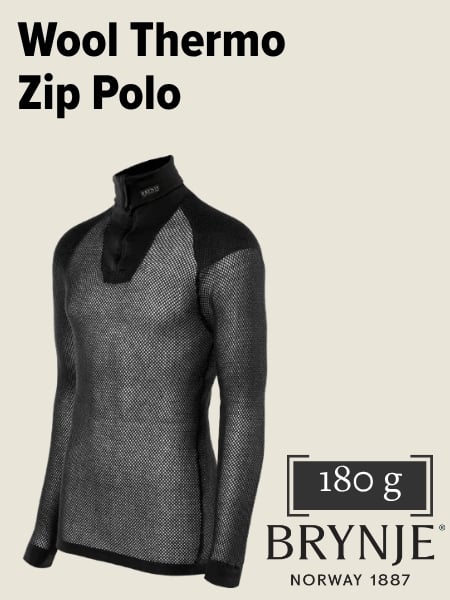 Wool Thermo Zip PoloMerino wool-blend mesh base layer with a 3/4 zip neck for venting and reinforced shoulders for pack-carrying comfort. Weighs 6.3oz | 180g
 © Beartooth Media Group Inc.
 Loading...