Topic

UL at -20F?

  • This topic is empty.
Viewing 23 posts - 1 through 23 (of 23 total)
Gary Pikovsky BPL Member
PostedMar 3, 2015 at 6:07 pm

What do you all think? Just got back from New Hampshire's Mt. Washington two day hike. Temps hit -15F, I was pretty toasty in the bag. Alcohol stove/Sidewinder lit well and boiled 4 pots at -10F using Everclear at 11min boil time!

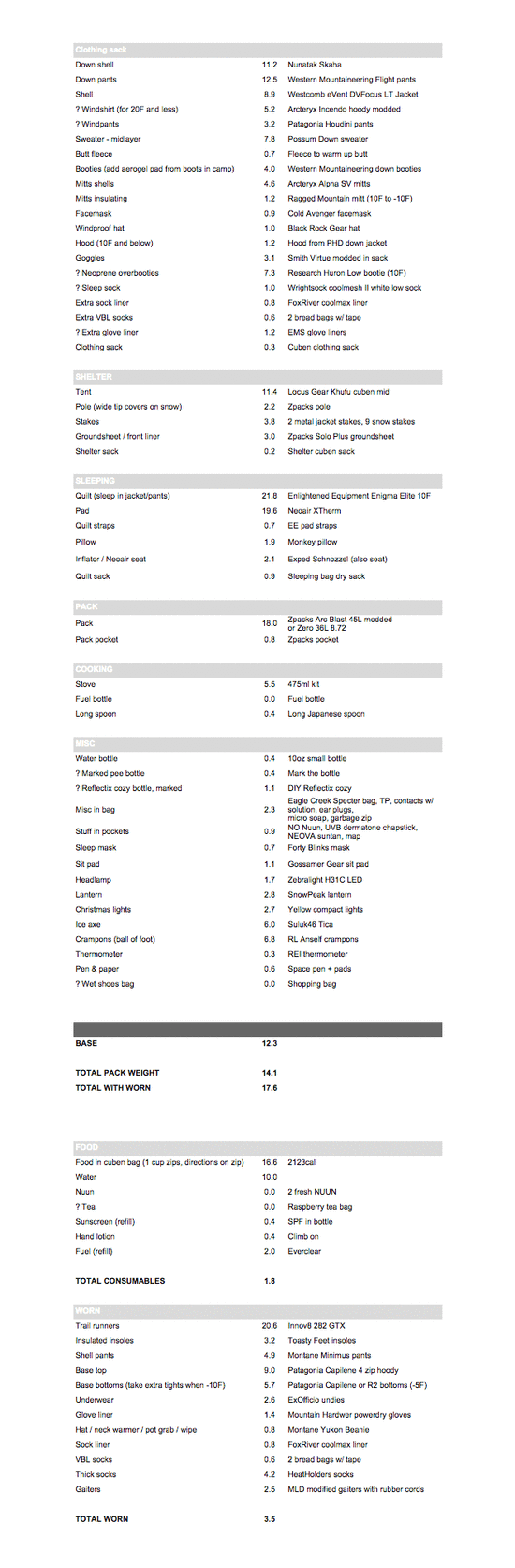
Pack base weight at 12lbs.

Tried not to compromise comfort and safety – list includes Christmas lights for a sweet campsite. Trails were packed, no need for snowshoes. Question marks are next to stuff I'm wondering to leave at home next time. Frisbee used as snow shovel, worked very well.

Would be grateful and curious to your experiences and tips in frigid temps, below tree line camping and UL summit trips.

-10F to -20F gear list

Edward Barton BPL Member
PostedMar 3, 2015 at 7:36 pm

How do you find that mask? I've seen it before but I imagined the breathing apparatus would be too wet and invasive to use for very long.

Mike M BPL Member
PostedMar 3, 2015 at 8:11 pm

sounds like it worked pretty darn well :) neat you're pushing your quilt that far

impressive that the alcohol is working that well in those temps; I have zip experience w/ alcohol, but always thought of it as a summer fuel

concerning the ? marks, if there is no chance of rain/wet snow (ie cold like you had)- I think you could choose either the hardshell or the windshirt, whichever you feel works best

if your shell pants are adequate for cutting wind, the wind pants might be redundant

walking may be different, but snowshoeing in those temps I definitely need neoprene overshoes-my feet would freeze w/ just wool socks and gtx trail runners, it might be that your feet are "locked in" snowshoeing??????

is running water plentiful? reason I'm asking is I don't think I could get by w/ a 10 oz bottle, I never count on running water in the winter- nice to have it, but I plan on melting snow and carrying a 32 oz Nalgene would be the minimum

how did the PHD hood removal go? I just bit the bullet and got one from Katabatic, I was thinking about making a detachable hood on one of my parkas, but didn't really know how to go about it

great idea on the Christmas lights! :)

Gary Pikovsky BPL Member
PostedMar 3, 2015 at 8:21 pm

@Edward Cold Avenger is a must for me now. I changed it though. The mask fogs up a bit when hiking up above treeline. In whiteout conditions, even a little bit of fogging could be annoying and could get you off the path, in my case into Tuckerman Ravine.

What I did is sewed in a flexible wire nosepiece with a rubber stopper on each end. (NiteIze makes one) I sewed that into a fleece and added a foam nosepiece Cold Avenger sells separately. That now completely prevents fogging.

When really cold, I also sleep in it. The warm micro climate it creates, really warms your lungs and core, in effect reducing your need for a super warm sleeping bag. Would definitely recommend it.

Now I'm working in the same two mods into a little facemask OR makes. It's three times as light and, more importantly, has more face coverage.

Simon Kenton BPL Member
PostedMar 3, 2015 at 8:28 pm

Thanks for posting. I don't have any experience at that temp but it's inspiring to say the least. Bookmarked :)

PostedMar 3, 2015 at 8:45 pm

Nice stuff.

My clothing strategy for really cold temps is a bit different. I always use really thin, light baselayers because I'm only relying on them for wicking, not insulation. So stuff like Cap4 is nice but I don't use it. The only baselayer change I make is a switch to long sleeves when it's cold.

I usually pair that up with just one shell layer, rather than having both wind and WP/B layers. Either type can work, because it's easier to avoid sweating in WPB when it's really cold, or alternatively when it's that cold a wind layer is often enough in light snow. I decide based on the forecast and go WP/B when in doubt.

In terms of insulation, I try to bring just one down layer that's warm enough for the conditions. Usually I can move in the day with just baselayer + shell, and then the down comes on at stops. If it was really super cold I'd think about adding a mid layer.

FWIW, my Montane Minimus pants leak like crazy. Rain comes through instantly.

Bob Moulder BPL Member
PostedMar 4, 2015 at 3:24 am

I can learn from your well-honed list, although I don’t think mine well ever get quite this refined!

Which Cold Avenger mask are you using? The ones Here are all listed as weighing .75 lb or so.

Overshot BPL Member
PostedMar 4, 2015 at 3:25 am

Nice report Gary. Was the Shaka warm enough with the temps, and a bunch of wind? I always thought of this as more of a mid weight jacket, not full on winter.

Was your achy setup robust enough to melt snow if needed to provide your water?

Nice report, and place!!

John DeMorris BPL Member
PostedMar 4, 2015 at 6:41 am

Awesome list Gary. Like the others I'm curious how you handled water with an alcohol setup.

Also, I didn't see any trekking poles listed. Were they not necessary or you don't care to use them?

Stephen M BPL Member
PostedMar 4, 2015 at 6:55 am

I would of thought the Skaha would be good to about 5f.

You mention a Frisbee as s shovel, you should look at the snowclaw.

Rob P BPL Member
PostedMar 4, 2015 at 7:10 am

Dan,

Which thin base layers do you use for cold weather? The reason I ask is that I think that Cap 4 wicks better and dries faster and feels more comfortable than Cap 2 for example (however that is my own subjective experience…)

I think it wicks on par with some of my Aclima mesh stuff. I love Cap 4 for it's wicking ability…I use it all the time in winter (in Michigan).

Thanks to the OP for the list…good stuff and good thread.

Peter Boysen BPL Member
PostedMar 4, 2015 at 7:11 am

Is that Butt Fleece trademarked? :)

Overall this list is great. That Cold Avenger looks pretty serious too; I've never seen those. I'm curious what the average perceived increase in a quilt or bags rating is when you can heat up air before breathing that way.

PostedMar 4, 2015 at 7:42 am

"Dan, Which thin base layers do you use for cold weather?"

Cold weather requires a lot of insulation, so I try to carry as weight efficient insulation as I can, which means mostly down rather than thick baselayers. I find pretty much any baselayer wicks well enough, so I decide if I want long sleeves or short, and then grab something light. I like my GoLite Wildwood Run tops, which are about 3oz (short sleeve) or 4oz (long sleeve). Like this:
http://www.amazon.co.uk/GoLite-Wildwood-Sleeve-Running-T-Shirt/dp/B005X6YJ3U

I tend to shy away from merino because thin merino shirts sag and stretch pretty bad under a pack on a multiday trip. I don't mind the feel or smell of synthetic so I'm happy with that.

My system of a thin baselayer + serious parka leaves a pretty big warmth difference between layering options. If I wanted an option between barely any insulation (baselayer + shell) and seriously warm (baselayer + down) I'd look to add a thinner down, synth or fleece layer, rather than a heavier baselayer. Something like a Patagonia nanopuff or 100wt fleece would be nice.

jake. BPL Member
PostedMar 4, 2015 at 8:48 am

Hi Gary, the list looks great! I have some questions..

When was this trip and did you stay at Hermit Lake? Did you only bring one 10oz water bottle? Did you use your xtherm directly on snow and were you toasty?

Thanks!
-jake

Edit: I see now you used a zpacks ground sheet.

Gary Pikovsky BPL Member
PostedMar 4, 2015 at 11:29 am

Some answers on the OP:


@Mike
M
Running water is available in Hermit Lake and Huntington Ravine at all times. If it wasn't I'd bring twice or three times as much fuel to melt snow – right now I have 2oz, which is enough for 4-5 boils around -10F. So then probably 5-6oz total for melting snow.

With shells and running jackets for cutting wind – I totally agree, just picking a one good shell is greet instead of shell and windshirt. What I found, in practice however, is that windpants and windshells are just so much more comfortable than shells when going uphill. The Arcteryx Incendo windshirt is a bit heavier than your 2oz Montbells or Zpacks windshells, but, because of the MASSIVE mesh openings under arms I never sweat in it. Sweat makes you cold immediately when stopping in super low temps. I also sometimes put shells on in reverse when hiking up – with the front open and facing back so your backpack is just against the base layer. Keeps everything dry and actually gives you more energy.

PHD hood removal is super simple. The hoods are attached by clips, so I just took mine of and added zpacks cuben loops and bungie on each side for fastening when the wind picks up. With a Cap 4 hood, a hat, a Black Rock Gear hat and a PHD hood, it's always easy to adjust for any temp down to -25F. All together the hat system weighs in around 3-4oz and eliminates a need for a sleeping bag hood. Much more comfortable to sleep in a hat than sticking your body in a hood.

Gary Pikovsky BPL Member
PostedMar 4, 2015 at 11:41 am

Answers on the OP:


@Dan
Durston

Interesting idea on minimizing base layers and maxing the insulation. On the Golite layers you sent I noticed there was no chest zipper. Do you find you sweat a lot in it? I may try the same approach. I found sweat nearly triples the weight of a shirt and tires you out more. For midlayers, do your Nanopuff or 100wt fleece breathe well? The possum down sweater seems just as warm as a 100wt fleece, but more flexible, breathable and doesn't stink. I don't think it dries nearly as fast as fleece, though. Tried Nano-air as well, but that's way too warm for midlayer when hiking.

On Minimus pants – so far, not leaking. Not sure if there may have been a bad batch. I also tried the Marmot's new Essence pants, which are much more breathable (close to Neoshell). But those and zpacks pants don't have articulated knees. I'd love it if Joe at Zpacks would add articulation to his pants – would be super solid.

Gary Pikovsky BPL Member
PostedMar 4, 2015 at 11:59 am

Some more replies, thanks for the great comments, guys:


@Bob
Moulder
Cold Avenger is the softshell version. It's definitely more than 0.75oz, more like 3oz with the mods I did. Originally around 2.7oz. I found the softshell to be very breathable and it blocks way more wind. Would not go with fleece one in cold, windy climates when in the negatives – you'll freeze much faster.


@Zach

The Skaha is super warm and super light. I had Tom put in 2oz of extra down in it and use the lightest fabric possible on shell. Sometimes it's even too warm. It doubles as a pillow filler nicely – very comfy, almost like home.

In general, the thought on the shell material is to keep it as light as possible in places that don't touch other surfaces – middle of legs, torso, arms. All the other parts I try to pick reinforced materials for duarability and good warth absorbtion – thus the heavier Arc Alphpa Mitts with full leather front/back, reinforced down pants front and back, heavier gaiters on bottom.


@John
De Morris
The trekking pole were not needed – I use the ice axe when going up or down. The Khufu mid works well with just one pole if you dig down below the shelter. Made the ice axe a bit longer than normal so I can reach ground comfortably when going downhill. The ice axe also double as a great tripod in snow.

@StephenF
The Skaha by itself is good to 5F, yes. When a midlayer, windshirt and shell are added, with all the hats it's good down to -12, even -15F.

I tried the SnowClaw, actually – it's really nice. The frisbee does the same lifting, but at three times less the weight. Frisbee also doubles as a glissading sled.

@JHL
Thetrip was two weeks ago – I stayed by Harvard cabin campsites, close to Huntington Ravine. Only brought 10oz of water – there's cracked streams at Hermit and Harvard where you can resupply and camp.


@Peter
Boysen
Gonna need to trademark the butt fleece. :) It's probably one of the most useful weird pieces of gear I have. For the weigh, it makes a huuuge difference in warmth. Problem with any down pants is they compress when walking or sitting. Always makes the butt cold, no matter how thick. The fleece piece, I put into a shopping bag (keeps it dry) and put on under the pants, with the bag sticking out a tad so it doesn't slide. This way, you can sit on snow and move without losing heat. Makes a good towel too.

Gary Pikovsky BPL Member
PostedMar 4, 2015 at 12:02 pm

With Christmas lights I gotta give dues to John Abela as inspiration – they really make a good campsite and look kick ass in photos!

Peter Boysen BPL Member
PostedMar 4, 2015 at 12:05 pm

That's pretty clever on the fleece. That's one of the ways I end up using the Minion that we'll be selling through EE if we ever get a slow enough week to finish up the website material for it. We use Climashield for the insulation, and then a layer of 10D fabric on one side and silnylon on the other, which is nice for sitting on snow. If you can hold it in place it sort of works as a sled on pretty packed snow too, although it won't work well as a towel like the fleece.

PostedMar 4, 2015 at 12:10 pm

My Black Rock is NOT windproof, plus it tends to get knocked off and misplaced with all that cold weather gear, so I've eliminated it. Hoods on hoodys never get lost. I start with a very thin merino hoody, an R1 hoody, the hood on the Atom Lt or Atom SV depending on how cold it is, topped by the hood of a light, or medium, or giant 3XL (good luck finding one) down parka big enough to fit over a polar bear (i.e., me.) NO HAT!

PostedMar 4, 2015 at 2:32 pm

Gary, could you comment on your footwear/socks and how warm your feet were? What was the hiking temp range?

Gary Pikovsky BPL Member
PostedMar 4, 2015 at 3:13 pm

Sure – I had on:

– thin coolmax liner
– then VBL liner – plastic bread bag with duct tape on ankle to prevent sliding
– HeatHolders sock – super warm and relatively durable. Much warmer and lighter than Smartwool heaviest Mountaineer sock
– Then boots – GTX lined low trail runner and velcro added on back for gaiters
– MLD gaiters, modified with back velcro, duct tape around potential crampon accidents and heavy rubber cord under boots

On top of that, if you're above treeline, I had OR neoprene overboties/gaiters. Or I was thinking of using the 5 hour whole foot warmers. Might try that one out next time.

This was quite warm. A bunch of guys in the camp had full Everest-type double plastics/Spantiks and they were just as warm as me. Their feet also got cold when they did nothing for over half hour. So did mine. I would say their system is just a bit warmer, but not by much. But it weighed almost 4-5 times what I had on and was not flexible.

I also brought extras for sock liners, VBL socks, and socks. The sock outside the VBL was completely dry for two days, even after cramponing for hours uphill. Will definitely use this system again next time.

PostedMar 5, 2015 at 7:30 am

Thanks, it's interesting to hear that the HeatHolders worked well. I'll have to try a pair. With footwear very similar to your system, except with a thick wool sock and no ToastyFeet insoles, my feet are barely warm enough while hiking or snowshoeing at 10 F. I currently switch over to a waterproof mukluk using Tingley overboots and Steger mukluk liners at 10-15F, but, while plenty warm even sitting around in camp, those are bulkier and slightly heavier than I really should have to use at those temps.

Viewing 23 posts - 1 through 23 (of 23 total)
Loading...