Ivo,
You said in part, “When you mention secondary research, that means it is only of an interpretative character to explain or draw probable (sic!) conclusions from primary reports. I dislike those, and many do not trust them – unless the author(s) has high credibility, and demosntrate(s) a verifiable train of thought. Was that the case with the one you mention?”
By secondary research I meant peer reviewed scientific journal articles not authored by me and specifically citations 1-8 which I have studied and have in my possession. You can typically acquire any journal article abstract free and the actual article, to read but not publish, for $35 – $45 each. The following all reach similar conclusions to what I previously presented in this thread. I have not read any that supports your contrary position but, please post the citation if you can find one:
1-McCullough, E. A., Jones, B. W., and Huck, J., A Comprehensive Data Base for Estimating Clothing Insulation, ASHRAE Trans. 91, 29-47 (1985).
2- Havenith, G., Heus, R., and Lotens, W. A., Resultant Clothing Insulation: A Function of Body Movement, Posture, Wind, Clothing Fit and Ensemble Thickness, Ergonomics 33 (1), 67-84 (1990).
3- Y.S. Chen, J. Fan, X. Qian and W. Zhang, Effect of Garment Fit on Thermal Insulation and Evaporative Resistance, Textile Research Journal 2004; 74; 742
4 – Chris M. J. Sawcyn and David A. Torvi, Improving Heat Transfer Models of Air Gaps in Bench Top Tests of Thermal Protective Fabrics, Textile Research Journal 2009; 79; 632
5 – Guowen Song, Clothing Air Gap Layers and Thermal Protective Performance in Single Layer Garments, Journal of Industrial Textiles 2007; 36; 193
6 – B. Lee, Theoretical Prediction and Measurement of the Fabric Surface Apparent Temperature in a Simulated Man/Fabric/Environment System, Combatant Protection and Nutrition Branch Aeronautical and Maritime Research Laboratory
7 – Zhu Fanglong and Zhang Weiyuan, Measuring the Thermal Conductive Property of Protective Fabrics to Radiant Heat Exposure, Journal of Industrial Textiles 2007; 37; 175
8 – N. Mao and S.J. Russell, The Thermal Insulation Properties of Spacer Fabrics with a Mechanically Integrated Wool Fiber, Textile Research Journal 2007; 77; 914
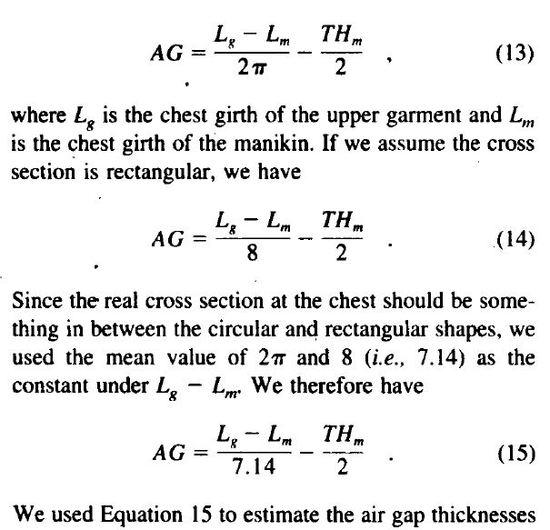
The information I previously paraphrased from memory recollection literally states, “Under no wind, the thermal insulation reaches a maximum when the air gap is about 1 cm (.394 inches) thick, corresponding to a difference of 7.5 cm (2.95 inches) in girth between the garment and the body. Under windy conditions, the thermal insulation reaches a maximum when the air gap is about 0.6 cm (.236 inches) thick, corresponding to a difference of 5 cm (1.969 inches) in girth between the garment and the body.”
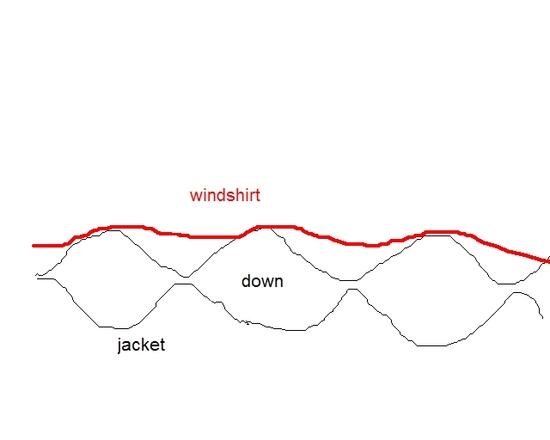
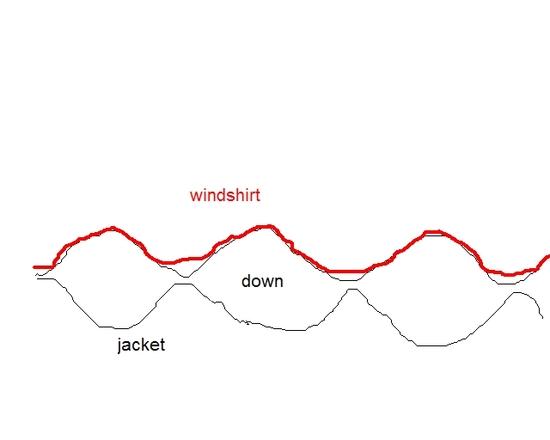
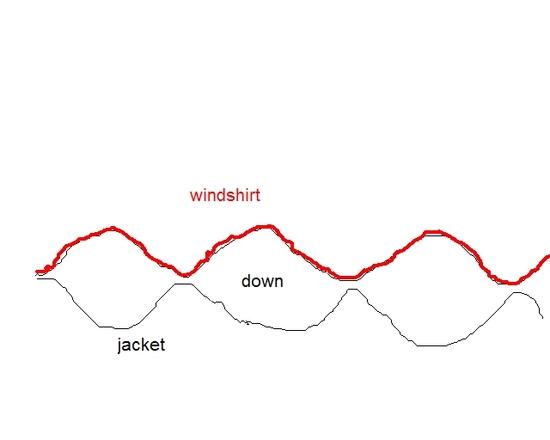
You said in part, “Then, you say that the average spacing between windshirt and the bottom of the "valleys" "never went below 0.25". What does this mean exactly?”
It means – from one of the secondary research articles listed above – Under windy conditions the thermal insulation reaches a maximum when the air gap is about .6 cm (.236 inches incorrectly recalled from memory as ~.250 inches) thick, corresponding to a difference of 5 cm (1.969) inches in girth between the garment and the body.
You said in part, “You tested a Mountain Hardwear Ghost Whisperer Hoody, which has horizontal baffles, while "my ensemble" involves the Stoic Hadron cardigan, with square baffles, which would certainly define a different topology of the contact between windshirt and down jacket. Thus, the support for the windshirt, exerted by the "peaks" of the down garment, would result in different amount of sag at different wind speeds”.
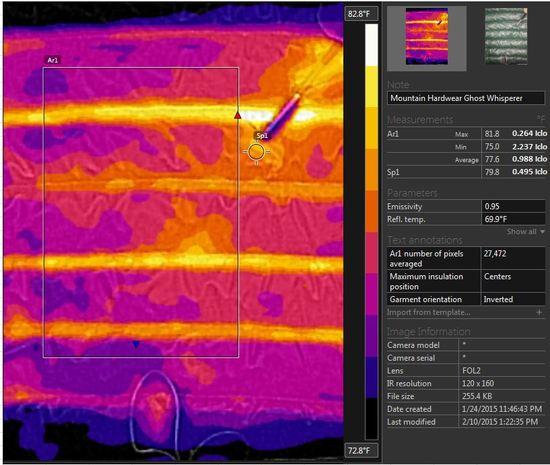
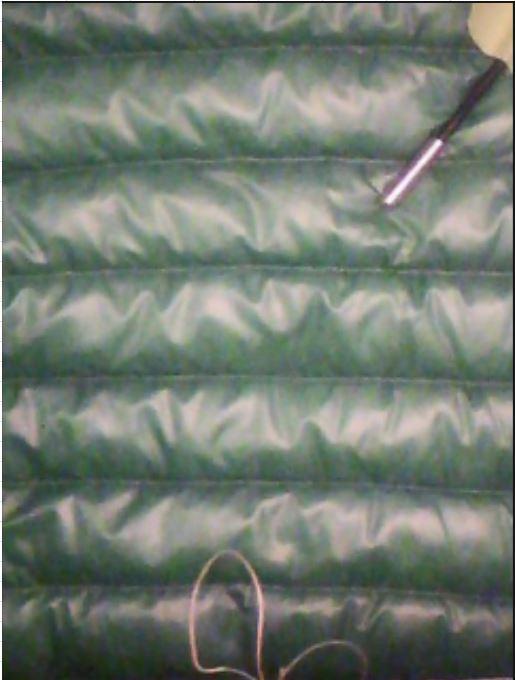
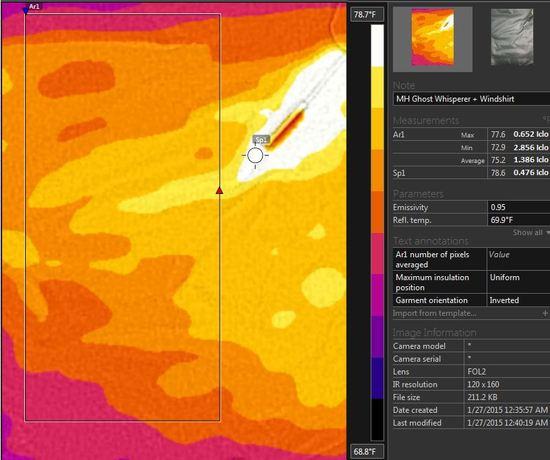
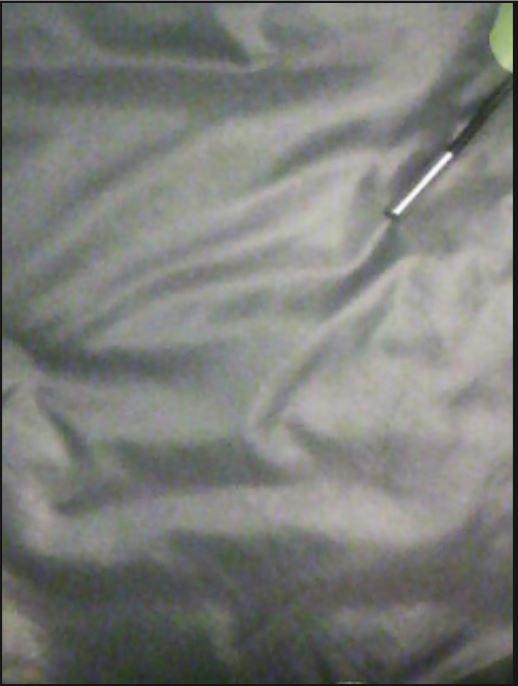
I used the Ghost Whisperer Hoody example because it was my closest equivalent product test result to your Hadron. The MB EX Light jacket has a square baffle topology and my comparable test showed a 29% difference in insulation value. The MB EX Light Anorak has a square baffle topology and my comparable test showed a 28% difference in insulation value.
You said in part, "The other statement of yours that you "used 0" to illustrate a minimum of 29% insulation improvement" in my ensemble leaves me quite puzzled." I meant both 0 inches spacing and/or girth increase between the wind shirt and the insulation. This was in contrast to the .239 inches of gap space or 1.969 inches girth increase, as mentioned above, for windy conditions.
The wind may push against an air gap augmented ensemble from one direction strong enough for a localized depression or collapse but, not continually from all directions at the same time. All of the air gap augmented ensemble's other sides continue to provide incremental insulation.