


Introduction
Fatigue is an often underexamined factor in backcountry performance and risk management. In practical terms, fatigue is not just a subjective sensation of tiredness. It is a transient reduction in the capacity to sustain force production, control movement, maintain pace, or preserve cognitive and technical performance after exposure to physical stress. In backpacking and wilderness travel, fatigue is especially important because it degrades both performance and safety margins.
As fatigue accumulates, movement economy declines. Stride mechanics deteriorate, balance becomes less precise, postural control worsens, and terrain management becomes less reliable. In parallel, decision-making quality may decline, particularly in contexts requiring route judgment, hazard assessment, pacing discipline, or timing decisions about food, water, shelter, and exposure. Thus, fatigue should be viewed not only as a performance limiter but also as a contributor to injury and other backcountry risks, including falls, navigation errors, poor technical decisions, and failures in self-regulation.
Fatigue as an exposure-dose model
A useful framework for understanding fatigue in the backcountry is an exposure-dose model. In this model, fatigue accumulates as a function of both the magnitude of a stressor and the duration of exposure to it. This is conceptually similar to dose accumulation in other physiological systems: the total burden is determined not only by intensity or by time, but by their interaction. A short bout of steep climbing at high effort may impose a fatigue dose similar to a longer bout of moderate climbing at a lower effort. Likewise, a prolonged descent may generate a substantial fatigue dose even when cardiovascular strain is modest.
This perspective is valuable because mileage alone is a poor predictor of fatigue. The physiological cost of a day in the backcountry depends more specifically on the type, intensity, and duration of loading. Key determinants include gradient, pace, pack weight, terrain irregularity, altitude, temperature, footing stability, substrate, nutritional status, hydration, and the degree of recovery carried over from prior days. As a result, two hiking days of equal distance may produce very different fatigue profiles.
For practical analysis, three broad forms of fatigue are especially relevant in backcountry travel: grade-dependent uphill fatigue, grade-dependent downhill fatigue, and pace- and grade-dependent metabolic fatigue.
Grade-dependent uphill fatigue
Uphill fatigue is driven primarily by concentric muscular work. During ascent, the lower-extremity musculature must repeatedly shorten under load to elevate body mass and pack mass against gravity. The principal contributors include the knee extensors, hip extensors, plantar flexors, and associated stabilizers. As the gradient increases, the force demand per step rises, and the local muscular fatigue dose accumulates more rapidly.
This form of fatigue is typically characterized by declining climbing power, progressive shortening of stride length, increased need for pauses, and greater reliance on compensatory pacing strategies, such as rest-stepping. Although cardiovascular strain often accompanies ascent, uphill fatigue is not purely metabolic. It includes a substantial local muscular component that is directly related to vertical loading demands.
Recovery from uphill concentric fatigue is often comparatively rapid, provided that the effort has not involved severe glycogen depletion or significant structural muscle damage. Acute recovery of contractile function may begin within minutes to hours as high-energy phosphate systems are replenished, cardiorespiratory stress decreases, and local perfusion improves. A more complete recovery usually requires restoring glycogen stores, adequate hydration, and sleep. In routine backpacking contexts, much of this fatigue may dissipate overnight, although heavy packloads, prolonged climbs, altitude exposure, and poor fueling can extend the recovery timeline.
Grade-dependent downhill fatigue
Downhill fatigue differs substantially in mechanism. Descending is dominated by eccentric muscular work, particularly in the quadriceps and other lower-extremity muscles responsible for braking and controlling impact. In eccentric contractions, muscles lengthen while under tension, allowing force control at relatively low metabolic cost but imposing greater mechanical strain on muscle fibers and connective tissues.
In addition to eccentric muscle loading, descents impose repetitive stress on joints and passive structures, especially the knees, ankles, feet, tendons, fascia, and articular surfaces. These stresses increase with steeper gradients, larger step-downs, unstable terrain, and heavier pack loads. Thus, downhill fatigue is both muscular and orthopedic in character.
This distinction explains why long descents often feel deceptively manageable from a cardiovascular perspective, yet produce substantial tissue stress and delayed soreness. The metabolic demand of downhill hiking may be moderate, yet the cumulative eccentric and joint-loading dose can be considerable.
Recovery from downhill fatigue is generally slower than recovery from uphill fatigue. The principal reason is that eccentric loading causes greater microstructural disruption (damage) in muscle tissue and greater irritation in joints and connective tissues. Symptoms may not peak immediately; soreness and functional impairment often intensify over the next 12 to 48 hours. Recovery timelines vary widely, but the decay of downhill fatigue is commonly measured in days rather than hours. This is especially true after steep descents, prolonged off-trail travel, high pack weights, or in individuals with limited eccentric conditioning or preexisting joint sensitivity.
Pace- and grade-dependent metabolic fatigue
A third major category is metabolic fatigue, which reflects the systemic demands placed on the aerobic and cardiovascular systems. This type of fatigue is driven by the interaction of pace and terrain. As pace rises, energy turnover increases. As the gradient rises, the energetic cost of locomotion also increases, even at modest speeds. Altitude, heat, dehydration, and inadequate carbohydrate availability further magnify the metabolic burden.
Metabolic fatigue is typically characterized by increased ventilation, elevated heart rate, increased perceived exertion, reduced pace sustainability, reduced heat tolerance, and, eventually, a generalized decline in physical output. It is closely linked to substrate depletion, especially glycogen stores, as well as to fluid and electrolyte imbalances.
Unlike local muscular fatigue, metabolic fatigue is systemic. It affects the whole organism rather than a single tissue group. It also interacts strongly with other fatigue types. As metabolic strain increases, movement economy declines, and neuromuscular coordination becomes less precise. This can increase the effective mechanical loading of both uphill and downhill travel. Thus, metabolic fatigue often amplifies musculoskeletal fatigue.
The front-end decay of metabolic fatigue can be relatively rapid. Heart rate, ventilation, and thermal load often improve substantially within minutes to an hour after cessation of effort. However, full recovery depends on restoration of fluid balance, core temperature stability, and energy stores. If glycogen depletion is substantial, recovery may require many hours and, in some cases, more than a single overnight period. This is one reason why cumulative multi-day fatigue can develop even when no single day appears extreme in isolation.
Relationship among fatigue types
Although these fatigue types can be separated conceptually, they are tightly coupled during actual backcountry travel. Steep ascents often combine concentric muscular fatigue with substantial metabolic stress. Descents often combine eccentric and joint-fatigue demands with cognitive and stabilizing demands, which are exacerbated by prior metabolic strain. Over the course of a long day or multi-day trip, these forms of fatigue interact cumulatively rather than independently.
This interaction helps explain why performance degradation in the field is often nonlinear. A hiker may appear stable for many hours and then deteriorate rapidly once several fatigue pathways converge beyond a functional threshold. At that point, risk rises disproportionately. Foot placement errors become more common, poles are used less effectively, reaction time slows, and decisions about timing, route choice, or stopping become less reliable.
Why recovery timeframes differ
The recovery time course of fatigue depends on the physiological processes required for restoration. Metabolic fatigue often resolves first because ventilation, circulation, and acute energetic stress can normalize relatively quickly once activity ceases and fueling begins. Concentric uphill fatigue often resolves next because the limiting factors are frequently substrate-related and neuromuscular rather than strongly injury-related. Downhill eccentric and joint fatigue typically resolves last because it depends more on tissue repair, inflammatory regulation, and recovery of connective structures.
This distinction has direct field implications. A person may feel aerobically recovered the morning after a hard day while still possessing impaired downhill control, residual muscle soreness, reduced shock attenuation, or joint irritability. Subjective readiness, therefore, may not correspond to full mechanical recovery.
Case study: two routes, two pictures of fatigue
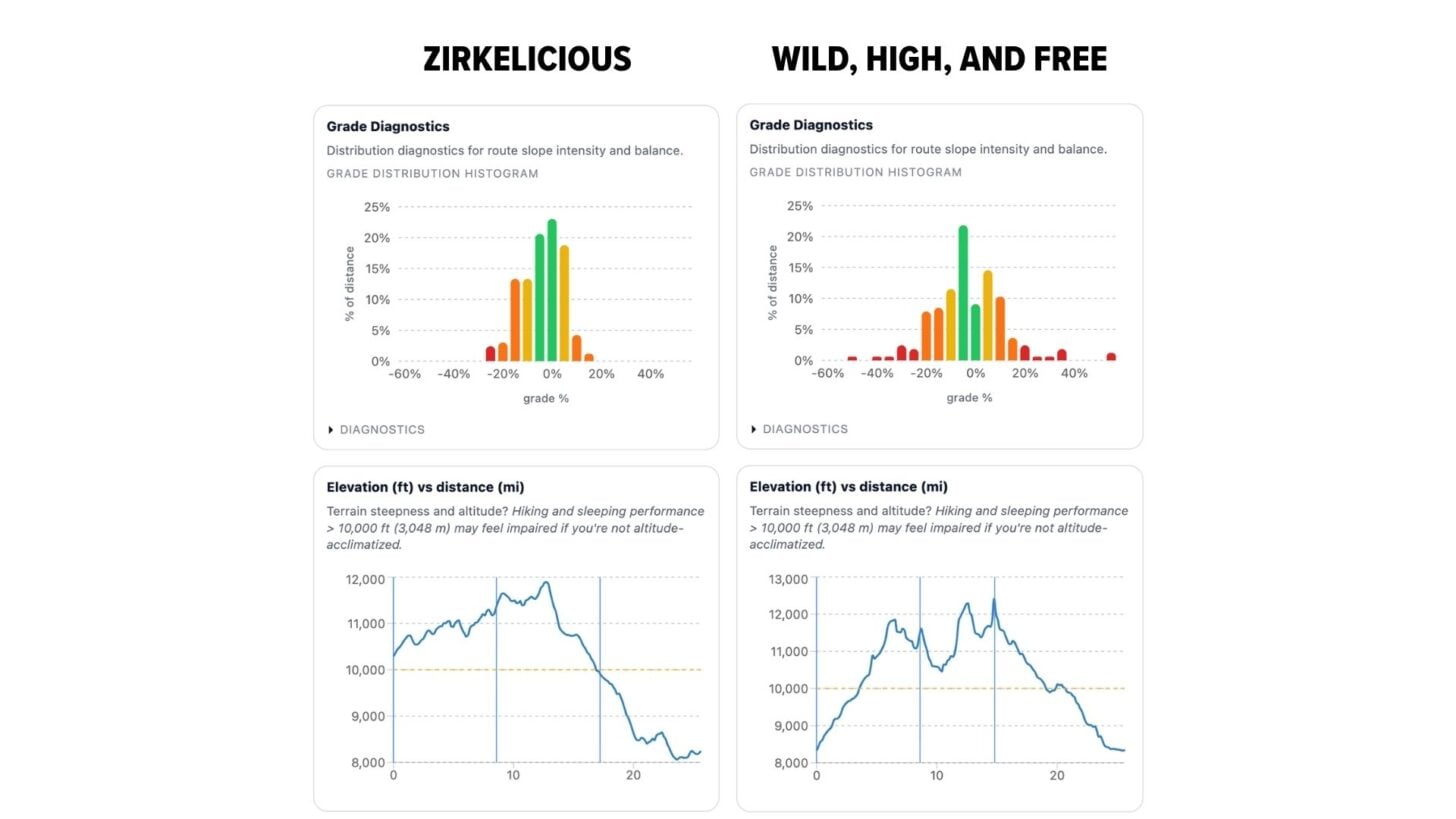
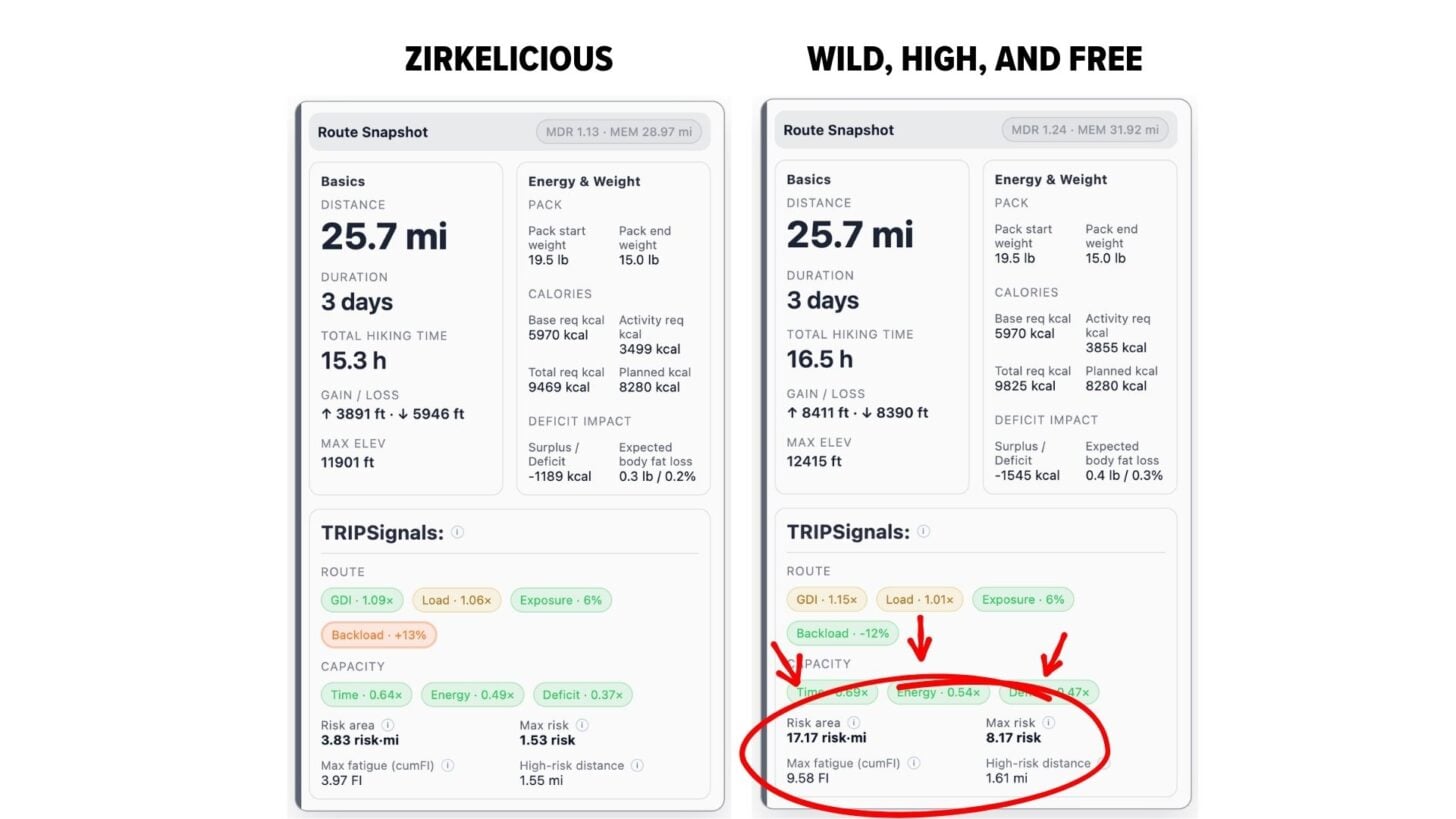
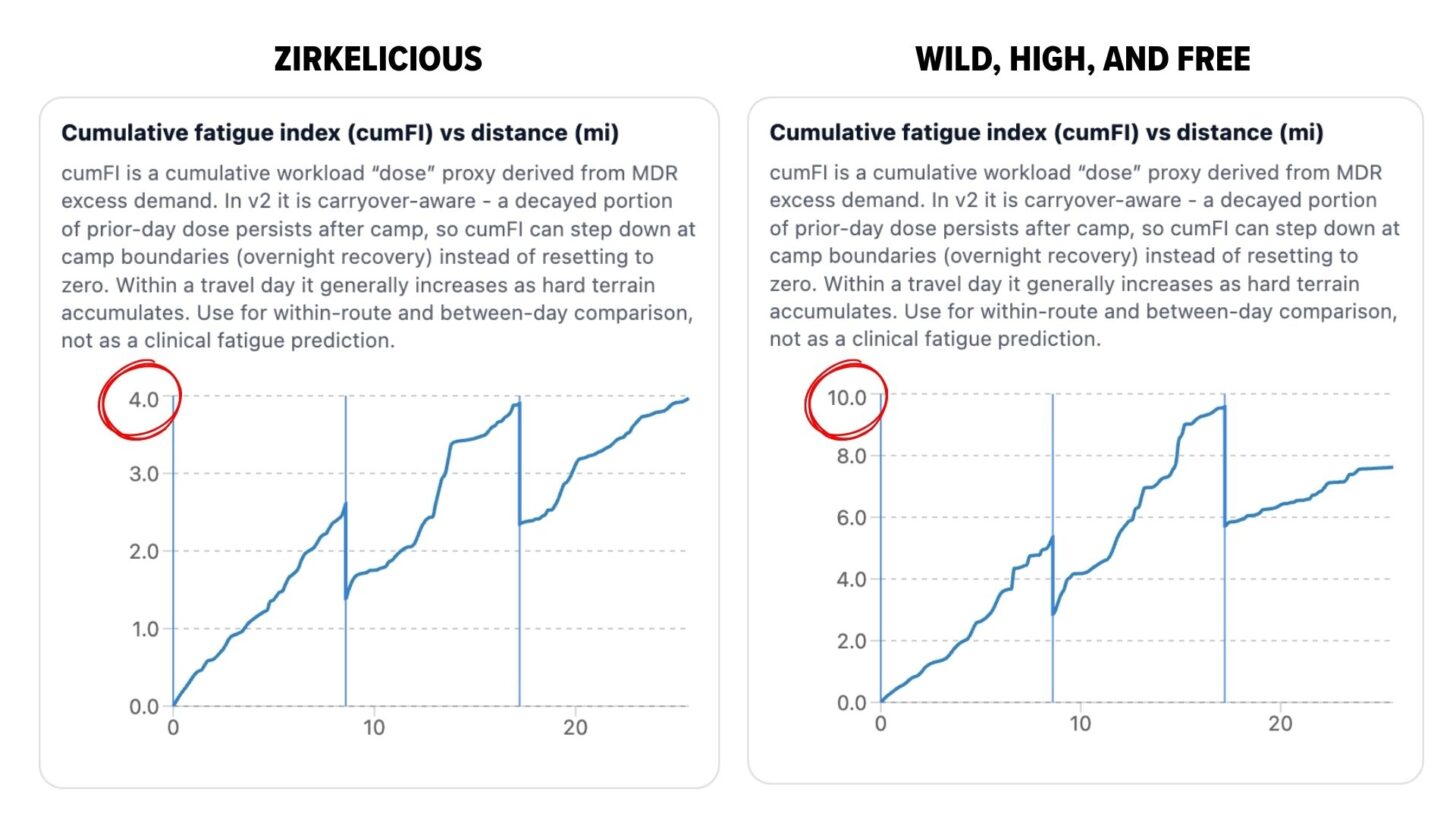
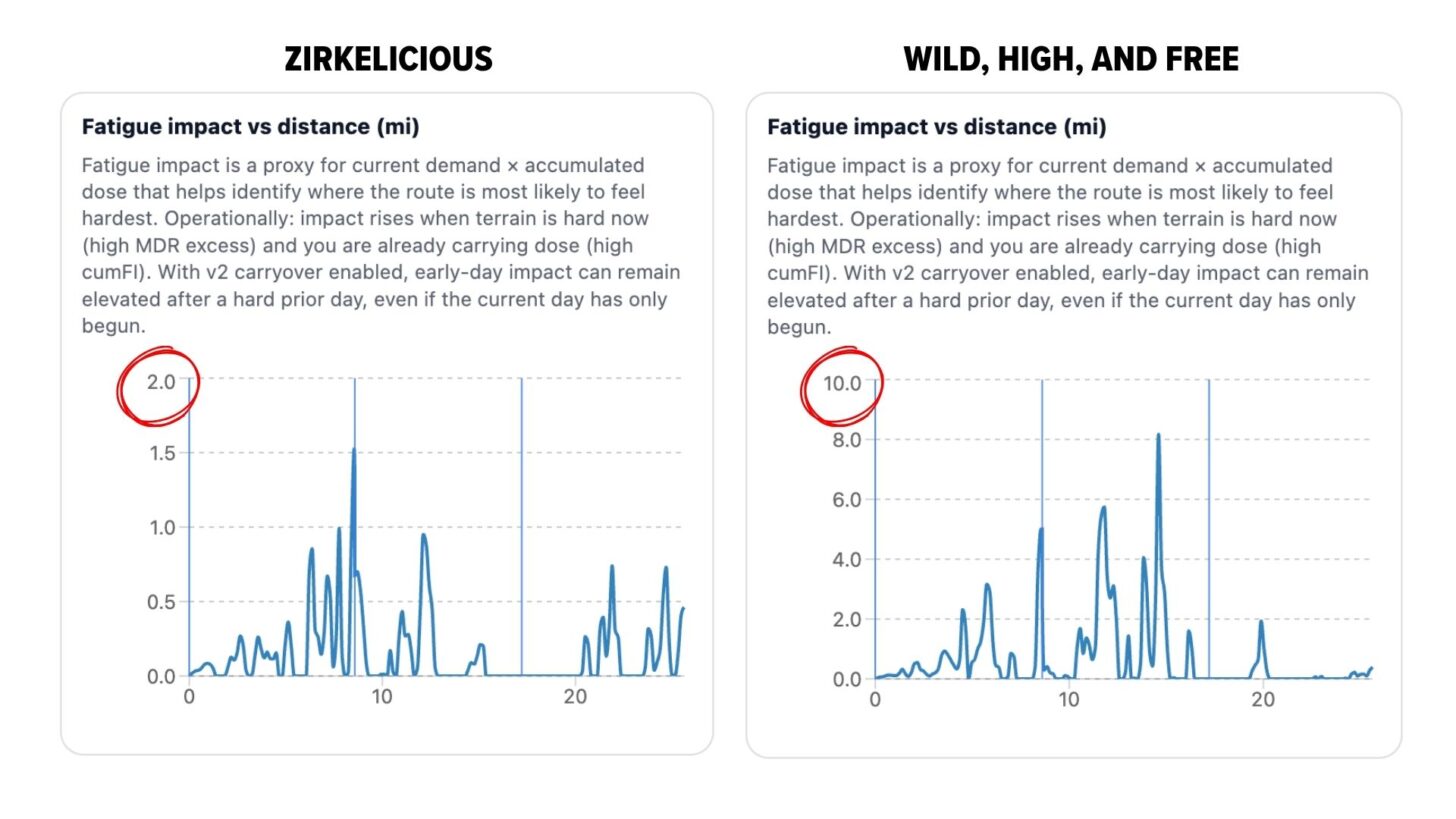
To illustrate the impact of route geometry on fatigue, we can compare two routes and model them in TRIPS. TRIPS models uphill, downhill, metabolic (pace), and altitude-related fatigue accumulation and decay. Fatigue is modeled in TRIPS using dose-exposure models coupled to stateful integration in response to the hiker’s progression along the route, recovery and sleep at campsites, and changes in time spent at altitude.
Consider two different routes, both 25.7 miles in length: Zirkelicious (a traverse of Colorado’s Zirkel Wilderness) and Wild, High, and Free (a high route through Rocky Mountain National Park):
Conclusion
Fatigue in the backcountry should be understood as a cumulative physiological burden arising from repeated exposure to mechanical and metabolic stress. An exposure-dose framework provides a useful way to interpret how fatigue accumulates: not simply through distance traveled, but through the interaction of gradient, pace, load, terrain, and duration. Within this framework, three major categories are especially important: uphill concentric muscular fatigue, downhill eccentric and joint fatigue, and systemic metabolic fatigue.
These categories are related but not interchangeable. They accumulate through different mechanisms, impair performance in different ways, and decay over different timeframes. Understanding those distinctions improves both trip planning and risk management. It encourages a shift away from simplistic mileage-based thinking and toward a more accurate assessment of how terrain and effort shape recovery demands, performance capacity, and injury risk in wilderness travel.


Discussion
Become a member to post in the forums.
Companion forum thread to: Key drivers of activity-related fatigue in the backcountry
Fatigue in the backcountry is not just a subjective sensation of tiredness. It is a cumulative physiological burden that can impair movement quality, physical performance, decision-making, and safety. This article introduces an exposure-dose framework for understanding fatigue accumulation and examines three primary categories: uphill concentric muscular fatigue, downhill eccentric and joint fatigue, and metabolic fatigue. It also considers the interactions among these fatigue types and explains why their recovery and decay occur over different physiological timescales. Two routes with different grade geometries are compared using the TRIPS software platform.
Become a member to post in the forums.