


Leaving a hiking itinerary with a friend or family member is one of those fundamental “things you should do” if you’re heading into the backcountry.
It doesn’t have to be a complicated document – a summary of your planned schedule, your trailheads, your route and campsite locations, vehicle info – those things are kind of the bare minimum.
But there is a way to level up your itinerary so it becomes an immensely valuable tool for search and rescue, in case they have to get involved.
Last week, we released our Hiking Itinerary Template to our email newsletter audience:
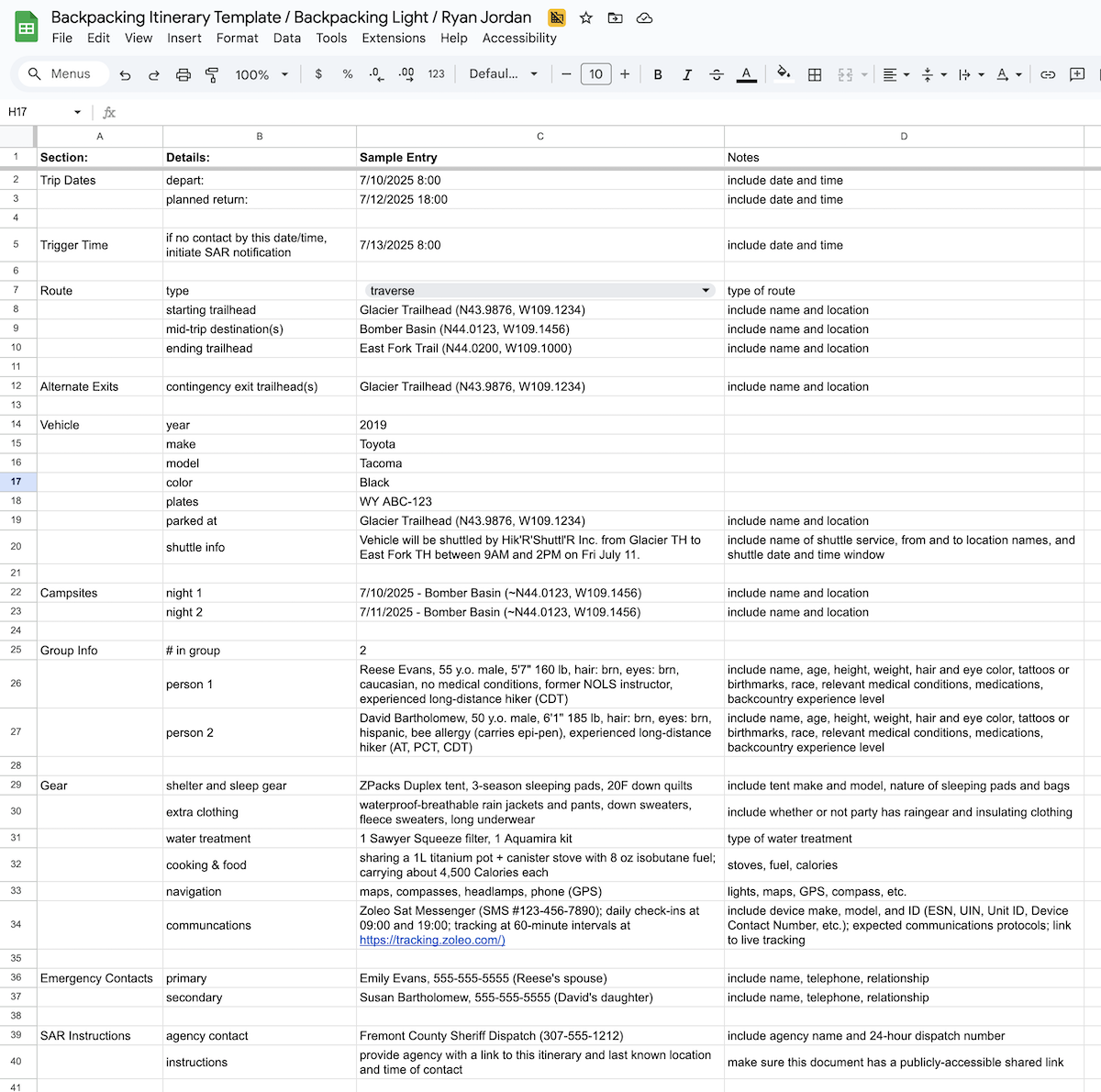
Learn more and get your copy here.
Not an email subscriber yet? Join the list today, lots of free and deeply useful and technical info goes out to our email list twice a week.


Discussion
Become a member to post in the forums.
Companion forum thread to: Don’t overthink your hiking itinerary
Get your free copy of a hiking itinerary spreadsheet template.
One of the issues I have experienced time and again with my emergency contacts back home if I am communicating with them via sat messenger is missing a routine check-in, because I’m still on the trail late into the evening or in a canyon where I can’t get a message out, etc.
So one thing I’m curious about: do you have an MO with your emergency contact in this case? What is it?
Mine is that if I miss a check-in – there’s no drama, just a limitation in time or topography, and to otherwise follow the itinerary instructions (24 hours late to the trailhead).
However, I’m considering revising this for check-ins, which may be especially helpful for long treks of several days or more.
Thoughts?
I’ll preface this by saying I generally don’t do very risky outdoor activities compared to a lot of people. No areas with bear attacks around here, no white water, no skiing… and being in Scandinavia, even the remote places aren’t all that far from civilization.
Traveling with an inreach, I consider check-ins purely social calls and instruct my contacts to do the same. When I have the ability to call for help, I don’t want the stress of a dead-mans-switch for SAR.
In my personal experience, I think there’s a tendency to blow the risk of hiking out of proportion.
Urban areas have literal millions of apex predators, steel boxes whizzing around at speeds as deadly as any rock slide and infection risks that make giardia pale in comparison. All in an environment more complex and unpredictable than anything I’ve ever considered hiking. I have heard it said very succinctly — I’m less worried about bears than about humans.
But somehow the expectations I encounter are reversed from the risks as I see them. And I’m honestly not immune to it myself.
I enjoy roaming, picking my route more or less spontaneously. I should embrace that more.
If you know that your emergency contact gets nervous when you miss a check-in, then you will check in as soon as you can, right? Perhaps you could agree on a time window before they call SAR? Something like, “Don’t call the rangers unless I am more than x hours late for check-in”?
(You could start at 12 hours and negotiate down from there, so it doesn’t sound reckless when you agree on three.) ;)
You could also set up a canned message: “I’m OK, just running late for my usual evening message”. Depending on your message plan it might cost you something to send it, but that might be worthwhile to some nervous contacts. Initiate the message at the usual time, and your messenger will send it when it can.
Honestly, this should all be automated by AI. As long as your watch detects a pulse and hasn’t registered a car crash, it could automatically check in for you: “This is Alexa/Siri checking in on Ryan’s behalf at the usual time. He’s still alive, just running late.” Maybe we’ll get that feature in a few years.
I have tracking engaged when I’m either far from any kind of help, or just doing something stupid; my emergency contacts have the link for it and they can simply check on my location whenever they like. If I’ve been moving, they’ll see that; if not, they can send a message directly to me. My scheduled check-ins have a window: usually it’s a couple of hours, so if I’m running behind for any reason I should still have time to make contact within the window.
Aside from that: yeah, I keep an eye on the time and check in when scheduled. I view that kind of thing as my lifeline to home/help, so nothing gets in the way of it.
I don’t have established check in timing but here is what I do. I always send a starting my day and ending my day message, in between those are check-in points from landmarks, trail transitions, or every couple of hours. I’ve described my usage to my contacts as trying to make it easier to find me should something go sideways. An example from a trip last year, I missed a turn so I consulted my maps and decided I wasn’t turning around but instead ploted a new course to rejoin the trail, while hiking off course I sent more check-in messages then I normally would since I was off course and off my interary all but temporarily.
My “rule” is 24hrs without a check-in call SAR.
I typically send 3 msgs per day. 1-“started hiking”, 2-around mid-day at a named location (could be a pass, creek crossing, trail junction, etc.), and 3-“camping here” with some description of the location and whether I am on or off my itinerary. I occasionally add in a noted waypoint, and if I am hopelessly off pace or deviate from my planned route, a revised itinerary.
I don’t worry much about the cost of the custom messages, the intent is my wife’s peace of mind while I am out solo on an off trail route.
Become a member to post in the forums.