



Introduction
The backpacking poncho gets a bad rap – even though it can function as a tarp and provides more ventilation than a rain jacket. On top of that, it has far fewer breakable features (read: zippers) than traditional rain gear. So why aren’t ponchos more popular?
The Unpleasant Reality of Rainwear
Let’s start with an unpleasant truth: if it rains long enough and hard enough, you will get wet. Water is relentless and inexorable. Even light rain will find its way through every taped seam, pore, and opening – especially when paired with windy conditions. Water will arrive at your naked skin and begin enjoying its favorite pastime of running downhill and soaking your shirt, pants, and undies.
All you are buying when you buy raingear is time: the time before you get wet. That time could be short or long, but it will not be infinite. It can always rain longer than your gear can keep you dry.
That said, longer is better than shorter; lighter is better than heavier; cheaper is better than expensive; well-ventilated is better than clammy; reliable is better than unreliable. There are choices to make. That’s true of all gear. Over the years, backpackers have made their choices and driven the gear market to ever-better functionality and value. Usually.
Allow me to suggest that raingear is an exception.
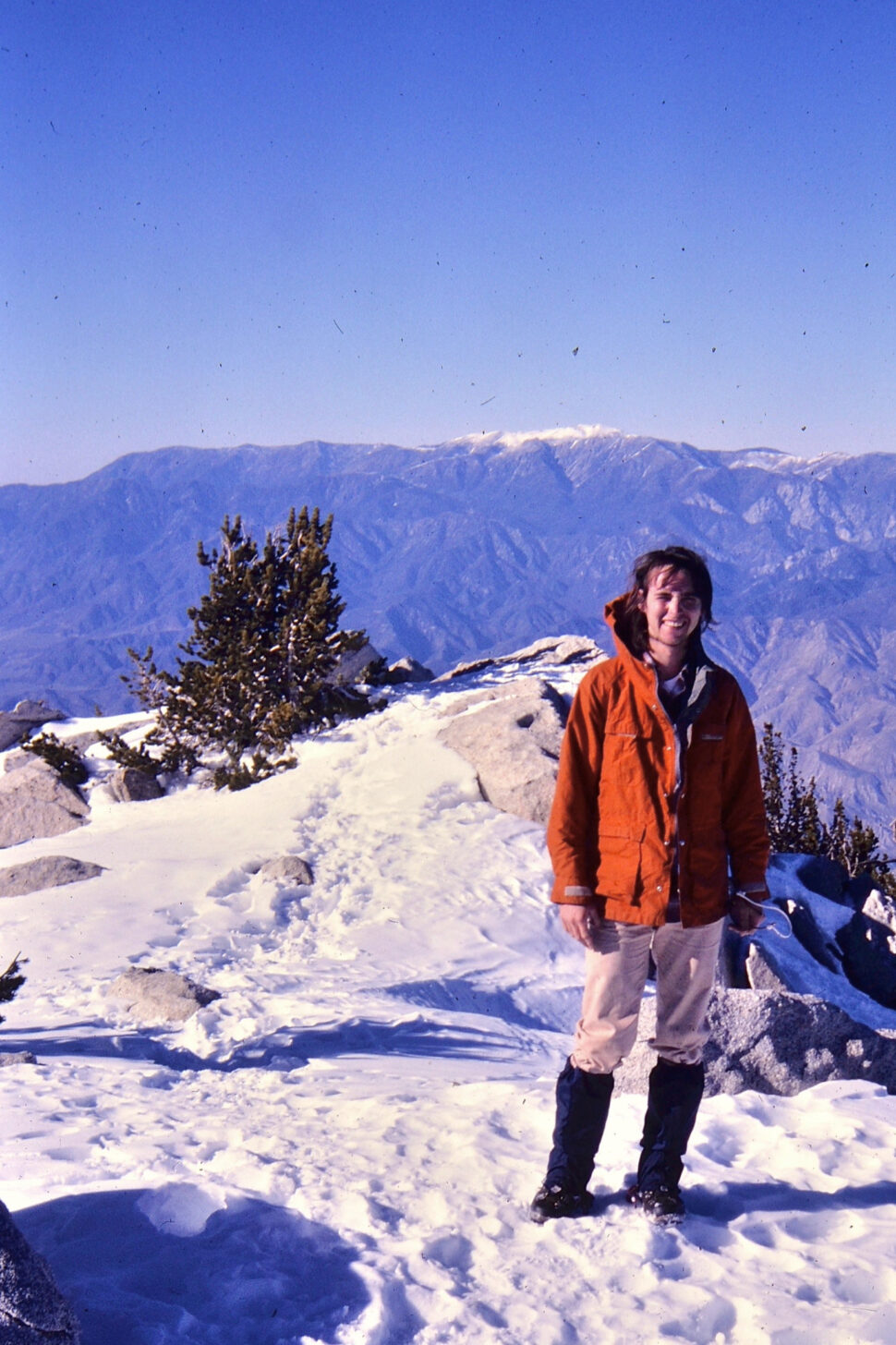
My first long backpacking trip was in the summer of 1968, from Red’s Meadows to Yosemite on the JMT. I carried a base weight of 35+ pounds (16 kg) – including a hatchet. There is not a single item in that pack (including the canvas pack) that I would consider taking along with me today.
Except for the poncho.
Being but a lad then, I could not recognize the elegance and perfection of design embedded in that poncho. It was just too simple and primitive. Newer surely would be better. When the first generation of breathable and not-at-all waterproof parkas came out, I gladly shelled out for a cutting-edge Sierra Designs 60/40 parka.
The advantages of ponchos
It was a fine and innovative garment, but it wouldn’t keep me dry for more than about 20 minutes. So when Gore-Tex jackets came out, I eagerly bought them – one every five years or so, each claiming to have cracked the code of waterproof breathability, each leaving me soggy if it rained more than an hour or two.
At about the same stage in life that I realized my parents actually were pretty smart, I also realized that the multi-functional backpacking poncho works pretty darn well. Here’s why:
- Ponchos are genuinely waterproof – because they are made of fully waterproof material instead of 2, 2.5, or 3-layer waterproof breathable fabric.
- They are well-ventilated by the nature of their design.
- They (usually) don’t have zippers and thus are not subject to zipper failure.
- They have few seams that can leak.
- They can cover your backpack – even a large backpack – and keep it dry.
- With some practice and skill, they provide a crude but effective shelter in which to eat lunch during an all-day storm.
- They can be a sleeping or cooking shelter.
- They can serve as a ground cloth.
- They can be worn while you are washing all your clothes at the laundromat.
- They are inexpensive.
- They never wear out.
- They require no maintenance.
- They never become obsolete.
- They never go out of style because they never were in style.

Yet poncho-wearers are a tiny minority in the backcountry, decidedly out of the mainstream. Wearing a waterproof breathable jacket is just one of those things that hikers are supposed to do if they want to do hiking right. Ponchos have acquired an air of dirtbaggery about them.
In our archives: This two part article on alternative rainwear provides a further argument for searching outside of traditional rain garments. Read part one here and part two here. Also, browse our poncho archives for specific gear recommendations.
Why some backpackers don’t like ponchos
We took a straw poll of Backpacking Light employees to see what they thought about ponchos. Here’s what they said:
Ryan Jordan (owner / founder) – I’m pro-backpacking poncho-tarp for trips with mild weather where the chance you’ll actually need raingear or a buttoned-up overhead shelter for a severe storm (with wind) is low. See this article for more on poncho tarping in inclement weather.
When faced with the decision to wear a rain jacket or a poncho in rainy conditions, I’ll opt for a poncho over a rain jacket below the treeline when wind is mild, humidity is high, temperatures are warmer, and the ventilation offered by a poncho is welcome. Otherwise, I find a rain jacket to be more manageable in high winds, colder temperatures, and lower humidity areas.
Andrew Marshall (managing editor) – I grew up backpacking in the rain with cheap, plastic emergency ponchos before moving to rain jackets in my early adulthood. My only experience with poncho ultralight backpacking since then was an experiment on the Colorado Trail with the Sea to Summit Ultra-Sil Nano Tarp Poncho, I loved the multi-functional concept – especially the extra material at the back to cover my pack – but struggled with it in high wind situations above treeline. I found that setting it up as an auxiliary meal shelter was too time-consuming in practice. But after editing this article and reading Drew’s suggestions (below) I’m seriously considering giving backpacking rain ponchos another shot. Too bad I gave my old Sea to Summit number away to a friend. Maybe I’ll check out Roger Caffin’s Make Your Own Gear: Silnylon Mountain Poncho article…
Chase Jordan (production editor) – When it comes to backpacking ponchos vs. rain jackets, I’m anti-poncho. They impede movement when in rough terrain and are less durable in comparison to rain jackets/pants combo. I also don’t enjoy the limitations of a poncho tarp in camp during storms, because the item I’d use to keep me dry while doing camp chores is being used as my shelter.
Matthew King (community moderator) – I haven’t ever used a poncho. They strike me as an incomplete solution allowing arms to get wet and seem like they would be prone to blowing around a lot. I have no interest in a poncho-tarp because it seems like a poor shelter and a poor rain shell. Also, what if you want to leave your shelter for some reason while it is raining?
I am pro-Packa on trips where there is a forecast for rain. I like that it covers the pack but more importantly, the airflow provided by having my jacket over my straps and pack is wonderful. I have the taped 15D version that is no longer sold which weighs 8.5 ounces (240 g) once I swapped the heavy shockcord/cord locks out for something lighter.
On a trip that doesn’t have a forecast for sustained rain, I bring a rain jacket. I prefer a silnylon jacket but mine failed and I haven’t found an appropriate replacement so I bring either a FroggToggs or an Outdoor Research Helium 2 jacket.
Mark Wetherington (staff writer) – I’ve never used a poncho and don’t plan to for the same reasons listed above.
In our community: Check out these forum threads for more on the topic of ponchos.
Common poncho problems and solutions
Most of the concerns listed above can be addressed with simple fixes in gear and technique:
Problem: ponchos flap in the wind
Solution: make a poncho belt. Get a 6-foot length of 3mm shock cord and a cord lock. Thread the ends of the cord through the toggle and tie it off to make a loop. After your poncho is on, wrap the belt around your hips, under your backpack, then put the toggle through the loop and tighten appropriately. Your poncho will still flap, but to a much more tolerable degree.
Member Exclusive
A Premium or Unlimited Membership* is required to view the rest of this article.
* A Basic Membership is required to view Member Q&A events


Discussion
Become a member to post in the forums.
Or make a version of the poncho tent.
http://www.alpharubicon.com/prepinfo/ponchotent.htm
After hiking in rain for a hours and getting wet and cold through and through two years ago, even while wearing good and well cared for rain gear, I bought a lightweight poncho (Nigor tarp poncho, 170g). It’s slightly more difficult to put on and yes, it flaps in the wind, but it works. When it rains lightly I just throw it over my windshirt and I stay completely dry, and if the rain stops for a moment, I just wear it like a cape and ventilate. When it rains heavily, I wear it over over my rain gear. The rain gear stops all the drops that get blown in by the wind and keep my arms dry when they are not tucked away underneath the poncho. The poncho prevents the rain gear from wetting out. As soon as your rain gear wets out, it’s no longer breathable. With the poncho, the jacket and top of my pants don’t wet out and the gear will still breathe. This way, I have far less sweat building up underneath the rain gear, so I stay dry, inside and out. Yes, the poncho ads a little weight (pack volume is really small), but combined with a light 2,5 layer rain jacket it’s still lighter, smaller and more water-resistant then a heavy 3 layer jacket. Yes, it’s a bit more fiddly, but it’s also a lot more versatile. I have used the poncho as a windbreaker or tarp for two while having lunch (in the rain). I have used it as an extension of the tent to create shade or a dry spot for reading or cooking while camping and I can bring it along on a day trek as an emergency shelter. I’m very keen on grams but I won’t leave the poncho home unless I’m trekking in really warm and dry areas.
Very versatile things, ponchos.

Sue was ‘warm enough’ inside her poncho.
(Going up to Col du Croix de Bonhomme near Mont Blanc, Europe. This WAS summertime.)
Yes, over-trousers, gaiters and light joggers as well.
Cheers
Been there, done that. No thanks, I’ll stick with my eVent parka and pants.
Sue is in exactly the kind of conditions where sweating out in a wp jacket won’t occur.
I don’t think she was sweating much at all!
Cheers
Having backpacked with a Packa for a few years now and on my recent Thruhike of the Ouachita Trail, it’s apparent to me that this is something to strongly consider. The Packa has an integrated elastic band pack cover. So on a potentially rainy day you can pre-stage it on your pack. Mine weighs 12 oz on my postal scale. It is lighter and provides better rain coverage than pack cover/rain jacket combo as no rain can get between the pack and my back. This is a cheesy video, but shows you it’s versatility. https://youtu.be/sXao8pqLtk4
Every 5 years or so I decide to give the poncho another try as shelter and rain gear. I will stick with it for between 4-18 months and then go back to a some sort of rain jacket and when colder rain pants. Why? Wet arms, struggles with snagging (even when I use a belt), soaks chest due to condensation (much less with eVENT or Shakedry shells), and I like having my shelter and rain gear separate from each other. Finally, I like more coverage (space) from my shelter than is practical from a poncho.
Never had any of those problems with a Packa. It has pit zips and has true arms that are elasticized are the wrists. No need for a pack cover nor rain jacket.
Bear in mind that you do not have to use the sleeves. I usually walk with my arms crossed in front of me, keeping both my arms (and hands) and my chest warm. With a Packa-style poncho (or my MYOG version) there is adjustable ventilation down the front.
Cheers
I know, I know. This is BPL, so grams matter and you want gear to be multi-use instead of it doing the same as other gear you already have in your pack. But after getting soaked on a winter hike walking in the rain for hours and getting wet through and through, despite my Marmot raingear, I decided to give the poncho a try. Having to put on wet base- and mid layers when it is around freezing isn’t great fun and even dangerous. The poncho I use wat sold as Nigor, which now sells as Bach (see above). The claimed weight is 220 g, but is actually only 172. Wearing the poncho over my 200g Marmot rain jacket, it keeps the rain jacket and the top of my rainpants completely dry. The rain jacket and pants catch whatever gets blown into the poncho, which isn’t all that much, but never ever wet out. So they breathe well and don’t wet out on the inside. You can even open your rain jacket for extra ventilation if necessary and as an extra bonus, even the straps and hip belt on your pack stay completely dry. So nice. At camp, I set up my Duplex and use the tarp as an extra awning. Even lightweight backpacking gets very comfy this way.. In the summer I don’t even bother with the rain jacket and I pair the poncho with my windjacket (Cumulus Windy Wendy) and at camp, the poncho makes a nice sunshade. Yes, the poncho might be redundant and extra weight, but is is still multi-use and adds a lot of comfort and safety to my kit that I wouldn’t have otherwise.
Inspiring to see that people actually do use it as a shelter as well. Good idea if you get caught in a storm during a day hike.
I like the idea of a poncho as a “redundant” rain gear item, in addition to a rain jacket. Being able to unzip a jacket underneath the poncho while walking sounds like a solid strategy in a lot of scenarios, as when it’s relatively warm but raining heavily. And I mean, in the 50’s and 60’s fahrenheit.
We stopped carrying rain jackets many years ago. We rely on our ponchos. They are so much more effective and convenient. When the sun comes out we don’t even have to stop: we just throw the poncho back onto the pack, and keep walking.

Dead easy.
Cheers
Seems to me that is an operation for two people… as I don’t think I could reach back and pull the poncho forward from the pack. I don’t think I could even get one on over me and the pack by myself. And winds are a problem
Well, yes, having two people does help, but we find it completely unnecessary.
And I agree that reaching for the poncho behind you at or above waist level can be difficult. We don’t do it that way.
What we do instead is to reach over our shoulder for the poncho hood., and pull it forward. Once you have the hood, the rest of the poncho follows easily.
Also, our ponchos are tied to the pack straps just behind the neck, so they can’t ‘escape’ or get out of reach.
Works for us.
See also https://backpackinglight.com/myog_mntn_poncho/
Cheers
I am surprised that nobody mentions front-zippered ponchos. While uncommon, they do exist, and are superior to regular ponchos in that I can unzip the front like a jacket for extra ventilation around my core.
No name brands, but I found a few on Amazon under $25 (search “front zipper poncho”).
I prefer a windbreaker in most conditions (Nisley-style), keep Seeber’s highest-MVTR-jacket-with-pit-zips in my pack (for cold or around camp), and carry the poncho for rain (especially when warm/humid). I might try Caffin’s mountain poncho or the Packa someday, but I am happy with this poncho for now.
I love this place. The depth of knowledge here was unexpected, but is very cool.
Carrying all three is about the same weight as my old 60:40 parka (1kg). I could save half that by sacrificing some comfort if I ever care that much. (If pressed, I would probably give up the rain jacket first. I use it the least.)
Regarding common objections:
I’d prefer a “snap close” or Velcro to a zipper on a poncho. Less fuss and issues with snag and grit. Or better yet, a pullover with a half zip. Any of these options still leave the problem of wind blowing the damn thing around. But in many ways, I can see the advantages of a poncho. Roger and Sue may have convinced me. Well, Sue convinced me.
and yes I know that a pullover poncho with a half zip won’t allow for throwing off the front of the body. But it would also have advantages.
Become a member to post in the forums.