



Editor’s Note: If you don’t hike (or plan to hike) in areas where the water is muddy or silty, don’t waste your time reading this article. We are committed to helping you save time on your quest to become a more informed and intelligent hiker. Consider instead: Ryan Jordan’s Ultralight Water Treatment Options for Backpacking.
Introduction
For a chemist like me, alums are an interesting group of chemical compounds, a large group of aluminium sulfates. Their name comes from the Latin word alumen meaning bitter salt, referring to one of them, potassium aluminium sulfate. Alums dissolve in water and they are quite widely found in nature. Place names such as Alum Springs and Alum Mountain appear occasionally on maps.
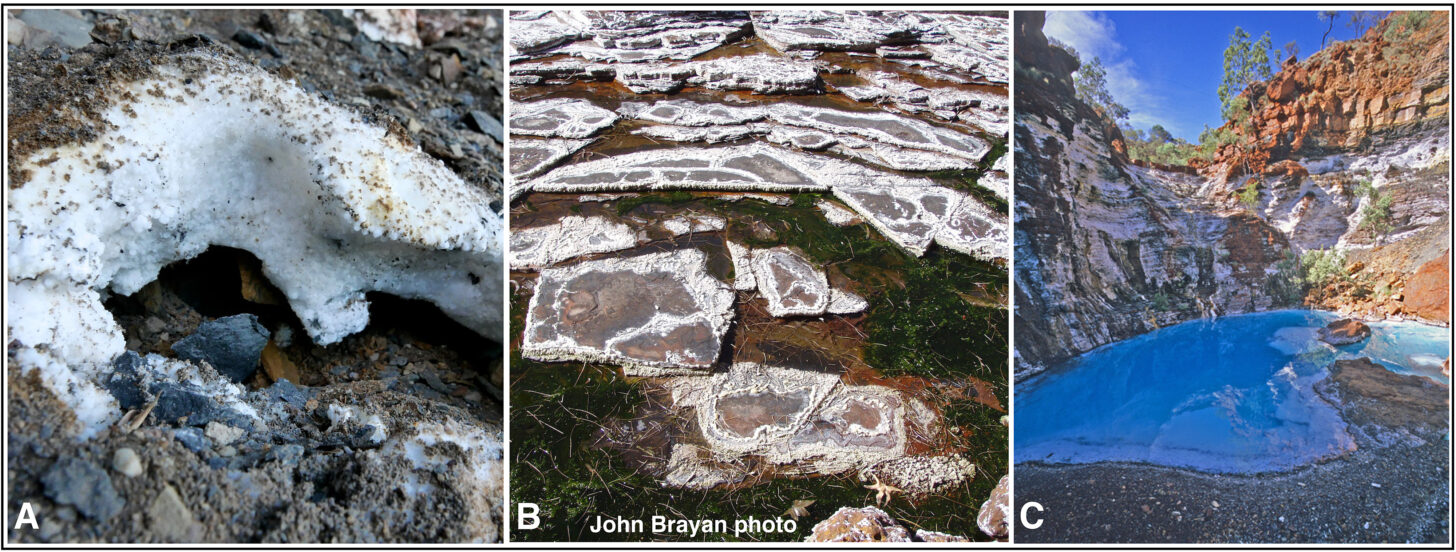
In my wanderings, I have come across alums in the bush. They can be found under the dry floors of some camping overhangs in the Blue Mountains of New South Wales (NSW) (Fig. 1A). More strikingly I have also seen them in Karijini National Park, Western Australia (WA), a place much better known for its spectacular gorges. On a two-week trip there, we found efflorescences of white crystals in many places (Fig. 1B), but the climax for that trip was observing crystals forming in a blue pool at the head of one creek (Fig. 1C). These crystals from the Blue Mountains and Karijini were both magnesium aluminium sulfates.
Editor’s Note: This article comes to Backpacking Light from Australia. We have preserved Australian spellings and vocabulary – aluminium instead of the American aluminum, for instance, or bush instead of backcountry – whenever possible, except for when clarity demands otherwise.
Why Use Alum to Clarify Muddy Water?
Alums are useful as well as beautiful, and humans have been using them for millennia. For example, the Egyptians used an alum to help the yellow dye bind to the cotton cloth used to wrap their mummies. Gardeners add alum to the soil to help their Hydrangeas turn blue. The Romans, Chinese, and possibly the Egyptians used alum as a coagulant for clarifying muddy water. Many modern water treatment plants, including those in Australia, also use it. Sydney Water uses an alternative coagulant, ferric chloride, while Melbourne Water uses aluminium sulfate.
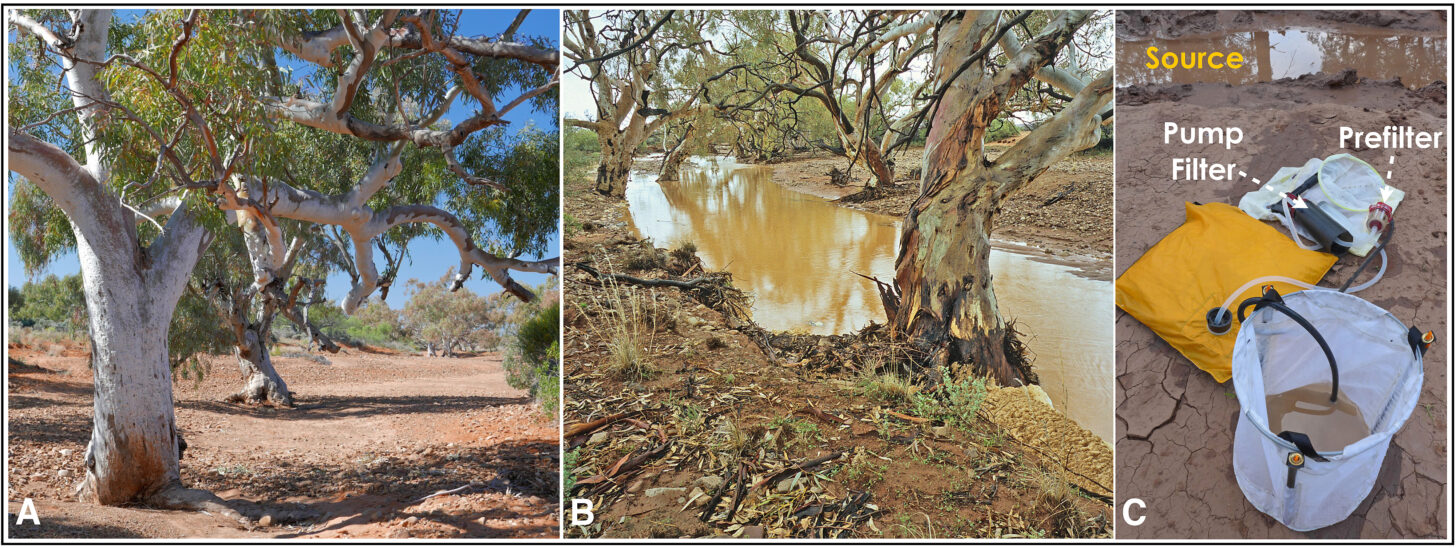
After some experiences in some of Australia’s semi-arid country (Fig. 2), I realized that I needed to try using alum as a clarifying agent on walks. In these places, water is often hard to come by and when it is available in any form, beggars can’t be choosers!
The use of alum for backcountry water treatment has been discussed previously in the forums here.
Mt Wright Creek, Mutawintji, NSW typically has no surface water (Fig. 2A). There is water there since the trees are healthy, but their roots go deep, more than 23 feet (7 m) for River Red Gums. On another trip, after a night of steady but not heavy rain, we woke up to find this creek flowing (Fig. 2B). I had a pump filter, but it would have quickly clogged as I had no prefilter. There were no other alternatives that day since all of the other water we passed was of the same muddy quality. Fortunately, it was a cold wet day and we weren’t very thirsty. We were able to get by with the remnants of clear water I had collected on the previous day. By the end of that wet day, we reached the main campground where there was a tank water supply.
On another occasion in the Flinders Ranges of South Australia (SA), we arrived at our campsite to find that the spring marked on the map was not there. There was an alternative though, muddy water in wheel ruts we had passed on our approach track. I was able to filter 3-4 liters of that with my MSR Sweetwater filter, this time with an MSR siltstopper prefilter (Fig. 2C). However, the process was slow and afterward, the main filter required scrubbing and the prefilter was a throwaway item.
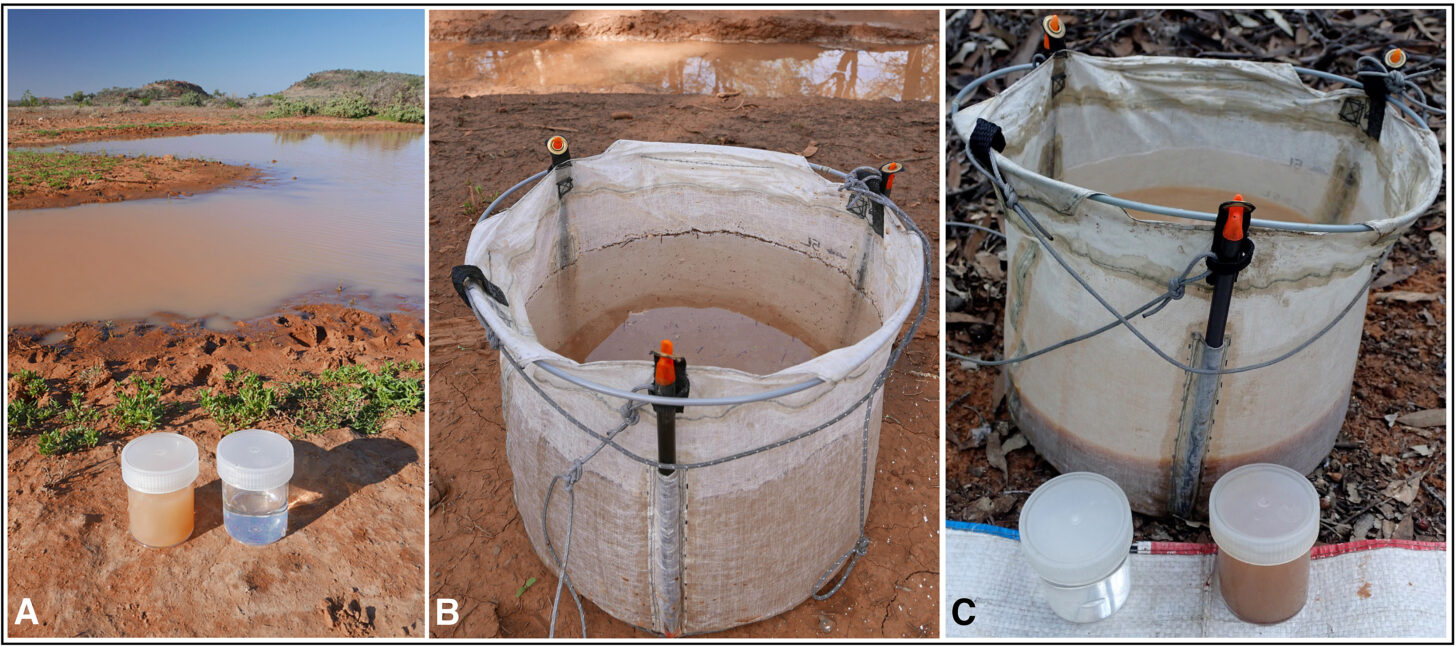
Like many before me, I have since found that adding alum, using only a simple procedure, is effective for clarifying muddy water on a trip. The alum I use is aluminium sulfate, with the method applied to a range of waters without failure so far (48 instances in the past 6 years).
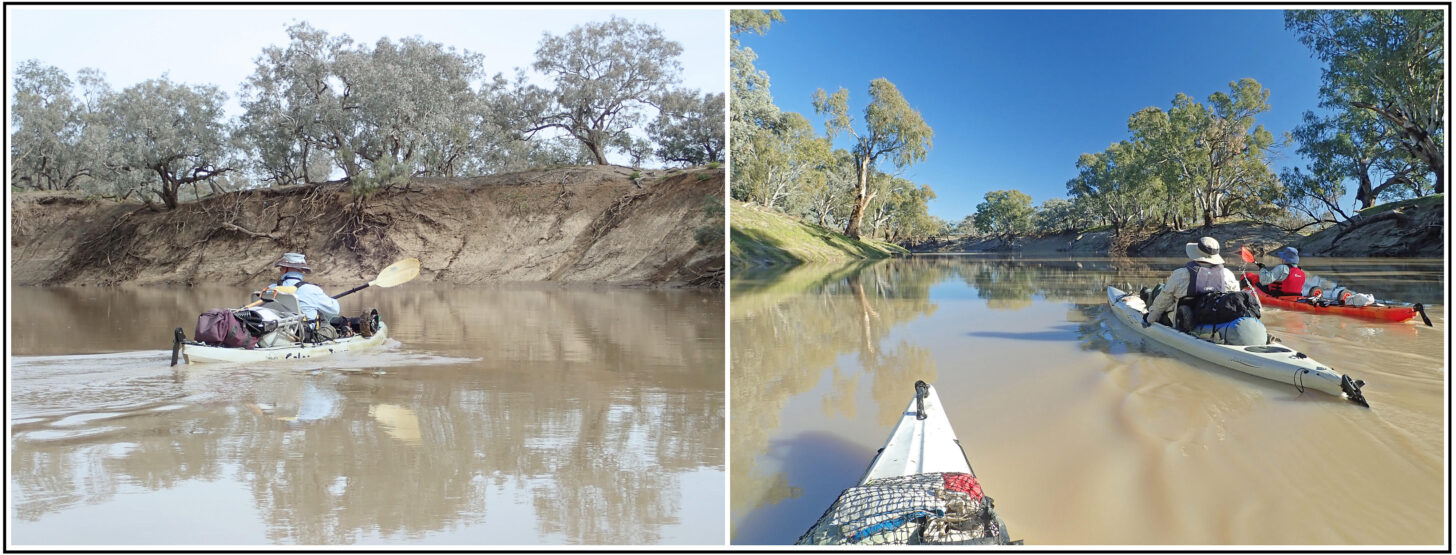
Recently (July 2021) four of us used alum-treated river water to provide most of our water on a week-long paddling trip down part of the muddy Darling River, NSW (Figs. 4 & 5). The two non-believers carried all their water from the start, which was 20 liters each of city tap water.
It is not common for walkers to use alum for clarifying water. That is because their supply is mostly clear and they haven’t needed to consider using it. That is not always the case, as the above examples show. Having this tool in the kitbag increases one’s choices of routes, and makes more comfortable the use of some water sources, especially in arid areas. In addition, alum treatment removes a good proportion of pathogens and subsequently makes simple disinfection procedures possible. Pathogen concentrations are often much higher in turbid flooded rivers.
There are commercially available sachets of mixed flocculant plus chlorination powders that do both. Chlor-floc and P&G Purifier of Water (formerly known as “PUR”) are two of these. While they have their place when managing crisis situations, I prefer the flexibility of my approach.
At a pinch, muddy water can be boiled then allowed to stand. Then, after standing a while, the mud settles. I haven’t thoroughly tested this myself. Unlike alum, this method is not very good when there is a larger amount of water to treat. The boiling only method is also slower, can only be done one pot at a time, requires extra fuel, perhaps an extra pot, and heat resistant vessels to decant the clearer hot water into.
My alum procedure is simple, it is robust, you use very little alum, and the process is easier than cooking. When you read the recipe below it sounds like cooking without the oven. It can require some patience when carrying it out, especially when using it on a new water source. It is also quite similar to the procedure described by Howard Backer in this paper.
How to Treat Muddy Water With Alum
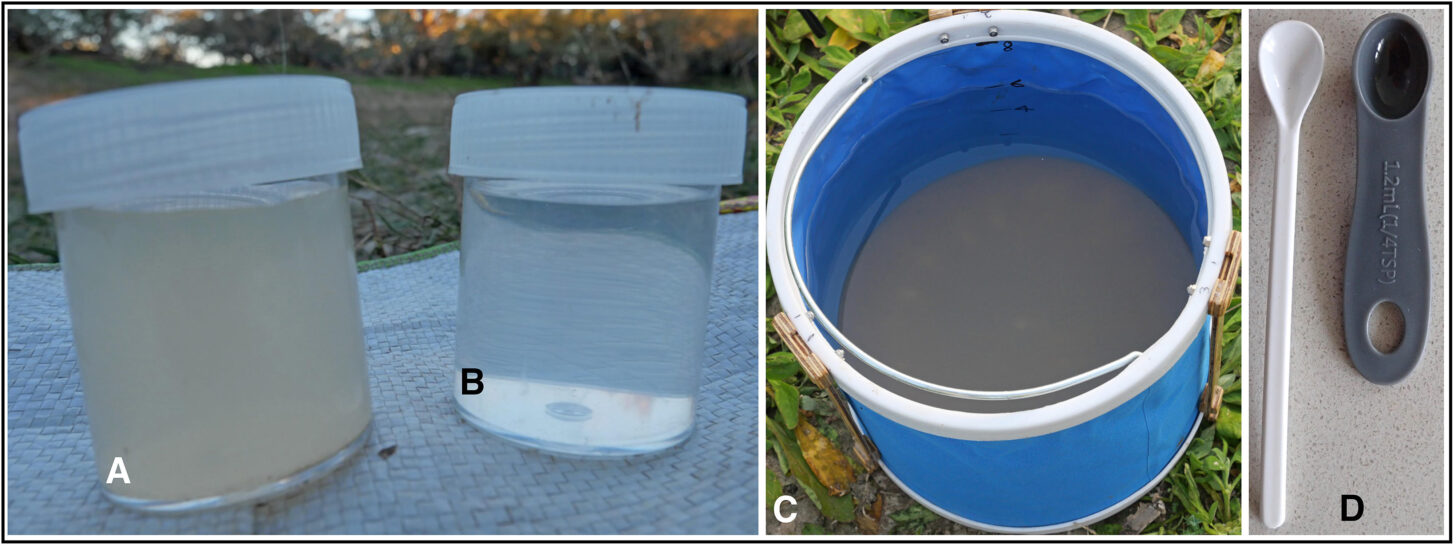
Collect 6 L of water in a bucket to treat at campsites. Mostly I use my own homemade buckets (e.g. Figs 2C, 3B & 3C), that are stabilized with side batons that prevent them from falling over. Commercial foldable buckets can also be used if they are stable, but often that requires securing them by the handle from above. That is not always possible (where there are no trees, etc.), but some of them can be modified to be freestanding like my homemade ones. How I have effectively stabilized two commercial buckets is shown in Fig. 6.
Member Exclusive
A Premium or Unlimited Membership* is required to view the rest of this article.
* A Basic Membership is required to view Member Q&A events


Discussion
Become a member to post in the forums.
Companion forum thread to: Using Alum to Clarify Muddy Water on Trips
A lesson in chemistry provides the solution for how to treat extremely muddy water sources in the backcountry.
Good information, thanks
After the floc settles is there remaining alum dissolved in the clear water?
Is this unhealthful?
Thanks for this article Rob. This subject is near and dear to my heart. I live and explore on the Colorado Plateau and often run into nasty water of the kind you’ve pictured. My alum experiments so far have been a bit hit and miss, so I’m hoping you can answer a few questions. 1) Is the alum that one would find in the spice rack at the grocery store acceptable to use for water treatment? 2) How important is using calcium hydroxide? Does it affect flocculation? 3) Do these chemicals have expiration dates? Thanks for any tips.
I have also used Alum on the Colorado Plateau and love it. Never found a need for any CaOH2. I do stir, then let it sit for 2-3 minutes and stir again. The second stir seems to quicken the process. Here is a picture of a cheap settling container from a gallon milk jug with a little pour notch for making decanting easier. A little string to tie it to the back of my pack and it is almost weightless.
Whitewater rafters running Arizona’s Grand Canyon on the Colorado River often must treat muddy river water for drinking and cooking. The two methods I’ve used are alum (without lime) and overnight settling, followed by disinfection with plain chlorinated bleach. Both worked well, but some fellow travelers didn’t like putting more chemicals into their drinking water, so we mostly used settling.
We used several five gallon (20 liter) plastic buckets for water treatment, since they have multiple uses on raft trips. Worked well for up to 20 people.
Slowly pouring off clear water without disturbing the settled sediments was a valued skill. Helps if you stop early, not trying to capture the last few quarts (liters).
Haven’t had to use either technique on backpacking trips – yet. Thanks for the reminder.
— Rex
Good tip about the milk jug Arthur. Thanks.
Would this method also work for clearing glacial flour from mountain rivers?
There’s a version of this type of product sold in the US (haven’t looked anywhere else) named Chlor Floc. It adds chlorine-based disinfection. Individually packaged in convenient 1-liter doses. It’s expensive, but we don’t use it a lot – mostly if the Colorado running muddy. Always carry some packets just in case.
https://www.rothco.com/product/chlor-floc-military-water-purification-powder-packets
If you look around, it can be found much cheaper than from Rothco.
We use 1-gallon freezer ziplock bags, mix it up, decant through a bandana or similar.
The initial Editor’s Note should probably be tweaked — looks like the triple negative was one too many. =)
The packets of alum plus have been available for as little as $.15 in the past.
Settling, followed by filtering with two layers of cotton cloth and SODIS pop bottle sunlight disinfection is commonly used in third world countries. Alum speeds up process.
Diane, Yes, it should help settle glacial flour.
“five gallon plastic buckets . . . have multiple uses on raft trips.”
I loved the write-up on sump pumps in the WestMarine catalog because after explaining gpm, discharge head, watts and amps, they note that “Nothing moves water as fast as a motivated sailor and a 5-gallon bucket.” These were one of my stocking stuffers around the office this year:
and make it much more comfortable to haul around a full 5-gallon bucket.
Even though self-bailing boats have pretty much made highly-motivated bailing obsolete, you’ll still find plenty of 5-gallon buckets on whitewater rafts, especially for overnight or longer trips.
Besides water purification:
– Three- or four-bucket dishwashing systems (rinse-soap-clorox-rinse)
– Urine buckets when river access is sketchy (“and you can pee right into the stream”)
– Handwashing after using the groover, with foot pumps on luxury trips
– Rinsing veggies for dinner
– Seats in camp for those that didn’t bring something fancy. Pro tip: upside down.
– Shopping for groceries from coolers and rocket boxes
– Splashing boats down on sunny days. What is the sound of two tubes exploding? BTDT.
– Cooling off in hot weather, which often leads to …
– Raft-to-raft water fights
– Collecting hoopy, cam straps, carabiners, and miscellaneous gear after trips
And more uses I’ve probably forgotten. Never push off without them.
Didn’t have no fancy plastic handles when I started. Usually pulled the wire handles off, bored a hole into the top edge with a big pointy knife, and threaded a loop of hoopy through to clip onto the boat somewhere.
Most of these uses won’t apply to most backpacking trips.
— Rex
PS – Yes, whitewater rafters have strange jargon, too.
Become a member to post in the forums.