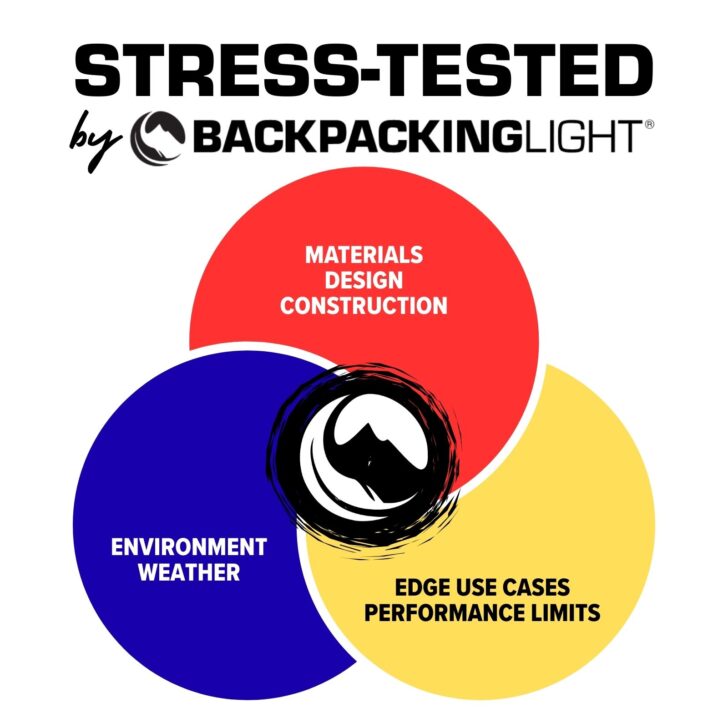
 When you see the Stress-Tested by Backpacking Light badge or phrase associated with a product, it means that the gear has been pushed beyond typical use to reveal its strengths, weaknesses, and real-world limits in both the lab and field.
We evaluate gear across three dimensions of stress:
1. Materials, Design, and Construction
- We examine how a product is built and whether its engineering choices hold up under strain.
- Focus areas: fabric strength, abrasion resistance, coatings, seams, stitching, hardware durability, and reinforcements.
- What this tells you: whether the build is robust enough for long-term use, repairs, and repeated cycles of wear.
2. Environment and Weather
- We subject gear to the same environments that test backpackers in the field.
- Focus areas: wind, rain, snow load, cold, heat, freeze–thaw cycles, UV exposure, dust, grit, and high-humidity conditions.
- What this tells you: how the product performs when nature is at its harshest.
3. Edge Use Cases and Performance Limits
- We intentionally push products into scenarios that reveal their breaking points.
- Focus areas: overload conditions, dynamic forces, extended endurance, misuse tolerance, and emergency scenarios.
- What this tells you: where the margin ends, how the product fails, and whether it can recover or be field-repaired.
Why It Matters
Most gear reviews describe how products perform under normal use. Our stress testing goes further. By mapping limits, edge cases, and failure modes, we provide you with insight that helps you:
- Choose the right gear for demanding trips.
- Understand trade-offs between weight, durability, and reliability.
- Make confident decisions about pushing your gear in difficult terrain and weather.
If a product carries the Stress-Tested by Backpacking Light badge, it has survived our 3-pronged process. That doesn’t mean it’s indestructible — it means we’ve mapped its strengths and limitations so you can trust it in the backcountry with clear expectations, and represents gear that is uniquely durable and performant within the competitive landscape of similar types of products.
Our Laboratory & Field Testing Environments
Backpacking Light conducts gear evaluations using a dual framework that integrates controlled laboratory protocols with ecologically valid field trials. This combined approach allows us to measure both the intrinsic material properties of equipment and its emergent performance under authentic backcountry stressors.
Laboratory Testing Environment
Our laboratory investigations isolate specific variables to characterize fundamental performance metrics. Testing procedures are designed to quantify mechanical durability, material resilience, and functional reliability across repeated cycles. Representative analyses include:
- Tensile and tear resistance of textiles, laminates, and seam joins under standardized loading.
- Abrasion and puncture testing using calibrated media to simulate rocky and brush-filled environments.
- Hydrostatic head and moisture vapor transmission assessments to evaluate textile water resistance.
- Thermal cycling to measure degradation of adhesives, coatings, and synthetic insulation.
- Hardware fatigue and impact testing under repetitive mechanical stress.
Laboratory testing ensures replicability and permits controlled manipulation of environmental and load variables. These methods allow for precise quantification of failure thresholds, degradation rates, and structural weaknesses.
Field Testing Environment
While laboratory protocols provide controlled insights, field testing is indispensable for capturing ecological validity – the way gear performs in dynamic, real-world contexts. Field trials are conducted across a range of environments that represent the most challenging conditions encountered by backcountry travelers. These include:
- Alpine and subalpine zones, where high winds, snow loading, and freeze–thaw cycles dominate.
- Arid and desert environments, with extreme diurnal temperature variation, UV exposure, and abrasive dust.
- Temperate forests, characterized by persistent moisture, biological fouling, and mechanical abrasion from vegetation.
- Extended-duration expeditions, designed to replicate high-mileage use, limited repair opportunities, and cumulative fatigue stresses.
Field protocols emphasize edge-use scenarios such as overloading pack systems, prolonged exposure to storm events, and deliberate misuse tests. These conditions reveal performance margins and failure modes that controlled tests alone cannot replicate.
Integrative Evaluation
By combining laboratory and field methodologies, Backpacking Light establishes a holistic assessment of product reliability. Laboratory data anchor findings in reproducible, quantitative measures, while field trials contextualize those measures within the uncertainty and variability inherent to wilderness travel. This dual approach strengthens the external validity of our conclusions and provides end-users with evidence-based guidance for gear selection and risk management.