


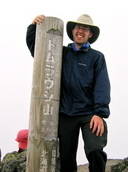
Huang-shan, Yellow Mountain, a fist of sandy-yellow limestone thrust into the sky. Sick of the cities of eastern China, I had caught a train to the interior, intent on a dose of natural beauty, and had arrived two days later, gobsmacked at the sheer stony monstrosity that was somehow possible to walk up. I set off at full speed, leaping up sets of stone stairs cut into the cliffside, full of pride at my strong western hiking legs, scoffing at the Chinese tourists that bought flimsy wooden hiking sticks and goofy hats, that had arrived unprepared, in business suits and heels. I had to tip my hat to the stout porters, carrying heavy loads of drinks and apples up the mountain, but I couldn't understand the men waiting by bamboo sedan chairs, offering to carry people up. Who but the most arrogant or frail would ride in such a chair, rather than take the cable car or walk? Who could suddenly require their services, when the mountain was a dayhike, an overnighter at most?
Twenty-four hours later I found myself swaying high over a cliff, borne up the stone staircases by two men in the very same bamboo sedan chair, a swollen knee useless and my pride in tatters. The same hubris had pushed me along the previous day, kept me walking when an old knee injury started to complain about the large stone stairs. "Just a little knee pain," I had thought, "These grannies are managing, surely this isn't going to stop me." My knee eventually gave out entirely, refusing to support my weight or arrogance. A kind group of Chinese students saw me struggling and started making phone calls, resulting in an entourage of two security officers, a manager, a doctor, my sedan bearers, and a crowd of interested Chinese tourists crawling up the staircases and through narrow tunnels, to deposit me, their inert burden, at the cable car, where a guide and a taxi to the hospital had been arranged. Would I ever hike again? So much of my identity was invested in my relationship with nature that I couldn't imagine life without hiking. I was disconsolate.
ARTICLE OUTLINE
- The Beginning: China
- The Comeback Kid
- More “Remote” than “Wild”
- Thorong La Pass
- When to Go
- Getting There and Away
- Gear List
# WORDS: 2920
# PHOTOS: 15
Member Exclusive
A Premium or Unlimited Membership* is required to view the rest of this article.
* A Basic Membership is required to view Member Q&A events


Discussion
Become a member to post in the forums.
Companion forum thread to:
Return to the Fight! Lightweight Rematch in the High Annapurnas
Great article and great to hear you were able to get back to the Himalaya. Thank you very much for sharing your experience! This is definitely on my to-do list.
Hi all,
I'm happy to be able to share my trip story with the great community here on BPL. I'm looking forward to reading through the comments!
Perrin Lindelauf
Perrin! What a surprise to see this article! After your blog went dead I often wondered where you had ended up. Looks like you got yourself out of Japan and stepped across the Japan Sea to China? What are you up to these days?
Great artcle and good story!
A well-told story, thank you. I laughed out loud at the caption for the baby yak photo. I've trekked in the Khumbu region to Everest Base Camp, and would love to get to China someday. The spice I take along is cinnamon, to add to breakfast porridge…
I just finished the AC a couple of weeks ago. It is actually possible to walk on the east side of the Kali Gandaki and avoid the road nearly all the way to Tatopani. You have to have good maps or a Nepali guide, and we crossed back to the west side of the river to sleep. The walk from Tatopani over to the Rhododendron surrounded Ghorepani is extremely good, and quite fabulous when the trees are blooming. From the top of Poon Hill (traditional viewpoint above Ghorepani) it is nearly 5500 vertical feet of mostly steep steps down to Hille, however. This walk would probably have crippled us at the beginning of our walk, but after 18 days of daily hiking our legs were pretty trail-hardened.
We had to rescue one of our porters on the Thorung-la who had bad AMS and an O2 sat reading of 45. Trekking in Nepal is great, I'm hoping to do the Manaslu trek next year. Cheers, Alan.
Wow! Thank you so much for sharing this trip! Hiking the Himalayas may not have crossed my mind in the past, but is definitely on my to-do list now!
The shots you took are fabulous and inspiring.
The cost for a supported trek seems relatively easy to stomach… minus travel costs from US, of course. I was very surprised by the room rates.
Enjoyed your story and pictures. We are headed to Nepal in about six months. I was wondering what type of water filtration you used?
Hi Donna: I know you didn't ask me, but I thought you might be interested in our water treatment experiences. I had an Aquastar Plus, which I really liked until it died. One of our group had a First Need filter, which worked really well too, but it also finally failed, should have brought another canister for it. Our third device, a SterPEN Adventurer worked for the duration of the trip.
If you want utmost reliability and can stand the weight, a ceramic Katadyn filter is hard to beat. We also had chlorine dioxide tablets as back-up and ended up using some of them.
Hah, yeah, my blog did indeed die.
After my adventures in Nepal, I spent a month in India ran out of money and ended up back in Japan, chasing a work visa and lessons once again. It would feel as though I came full circle if I didn't have all these crazy travel experiences in my head now.
And regarding yak cuteness: they really aren't all that tasty either. I gnawed on a dried and reconstituted chunk of yak meat in a curry sauce and it wasn't really worth the effort.
Great story! I really enjoyed reading about your trip. Thank you so much.
Hi- thanks for the post. I have read about the impact of the road after the pass- what about as you start the trek, at the beginning. Does the road impact you there at all, at Besisahar, etc? Sam.
Hi all,
I didn't filter my water. The Annapurna Circuit development council guys have built community-run water stations in several of the villages, so you can buy a clean liter of water for very little, about 50 cents I think. When there wasn't a water station nearby I just used chlorine tablets and then added the taste-remover tablets to make it palatable. I wasn't so keen on drinking chlorine for 3 weeks but I didn't suffer for it.
As for the road at the start of the circuit, it only continues for a couple hours past Besi Sahar, just up to where I slept the first night, Khudi. This is where the jeeps unload their goods onto mules, I believe. Unfortunately the (over)development committee seems intent on putting a new road in, following the trail across the valley. Road teams were blasting when I was there, and the military made us wait for an hour before it was safe to go ahead. At present the trail near the beginning alternates between a narrow village-linking trail and a road that can handle mule traffic more easily.
Once the valley opens up around day 5 there's a lot less construction and more untampered wilderness, but it is important to remember that these are not pristine nature trails, but miniroads that have connected towns and regions for hundreds of years. Meeting people and their yaks is part of the experience. Other than the blasting on one day, I didn't really find these mule-roads all that distracting from the awesome mountains.
The trail on the west side, however, is another matter. Someone mentioned that it is possible to avoid the road with a good guide, but unfortunately the dust that the buses kick up makes the mountain views a little less spectacular, and you can hear them honking for miles and miles. I walked the west side just to see what it was like, and it is certainly still a world-class place to see mountains, but the first half of the circuit is much nicer.
Become a member to post in the forums.