


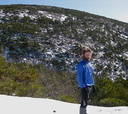
It had been barely over a month since I set foot on the Pacific Crest Trail. Seven hundred miles of desert were behind me, and the next step was something everyone had dreaded since the very first days when the gossip - the "vortex of fear" - at the annual Kickoff had turned to the snow that would undoubtedly block our path in the Sierra. "In a normal year you wouldn't even want to enter the Sierra until June 15," several people had said. This year, with snow levels approaching twice what was usual, my friends and I arrived at Kennedy Meadows on June 2 and decided that we wouldn't wait. Our nerves should have been on edge, but the excitement of finishing the first major section of the trail had sparked our enthusiasm even more than usual.
The first order of business, despite our high spirits when we arrived, was not celebration, however. It was all business. Waiting for me at the Kennedy Meadows general store were three large packages containing eight days' worth of food, one bear canister, one ice axe, and a pair of MICROspikes. Others in my party also had new pairs of sneakers, replacement parts for damaged equipment, new clothes, new packs, and just about anything else you could imagine. Coming out of the general store, we looked like a bunch of kids moving into college dorms, hauling stacks of boxes and spilling their contents as they toppled around us.
The next few weeks on the trail promised to be the hardest test yet for my packing and navigating skills. The next road to cross the trail would be 250 snowy miles later, with six major passes above 11,000 feet in elevation, and a few more above 10,000 feet. Resupply options were slim, but with the reports of snow through the entire section of trail, we knew we had to come up with something. The decision we made was to take the trail in 100-mile increments, escaping for town days in Independence and Mammoth Lakes. After Mammoth, the trail would head downhill enough that maybe the snow would be less of a problem.
After two nights of preparation and steeling myself for the trail ahead, I set out on the morning of June 4, my pack weighed down like it was full of bricks. I had added almost four pounds to my base weight and was carrying several pounds more food than I had at any point yet on the trail, so my legs strained with the new burden. Maybe the ascent to 10,000 feet and an ambitious goal of 28 miles for the first day was a bit too much. My group, now consisting of seven others and myself, chugged along, finally walking into the most anticipated part of the Pacific Crest Trail.
ARTICLE OUTLINE
- Bear Canisters and Ice Axes
- The Wet Stuff
- Wetter and Colder
- Interlude
- Racing the Passes
- Lost and Tired
- A Longer Break
- Wetter and Warmer
- Gear List and Highlights
- A Final Note: The Dangers of the Sierra Snow
# WORDS: 6770
# PHOTOS: 20
Member Exclusive
A Premium or Unlimited Membership* is required to view the rest of this article.
* A Basic Membership is required to view Member Q&A events


Discussion
Become a member to post in the forums.
Companion forum thread to:
Hiking Through Hyperbole Part 2: The Snowy Sierra
Thanks for taking the time to write such a thrilling account of your adventures. The pictures are spectacular.
I had to laugh at the section about getting lost just south of Reds. I have been through there twice, once in each direction and lost the trail. And that was without any snow. I was surprised to see that you didn't use your ice axe or microspikes very much. I would have expected more use given your early entry. It's making me reconsider taking either one. Thanks again for the great read.
Good stuff, well written.
However, if I can offer one word of advice:
> One by one we tried to cross, and three of the four of us currently together in the group were swept off our feet in the middle of the stream.
Crossing swollen rivers singly is a very bad idea. No wonder you had a lot of trouble. Far, far better is a group crossing.
You form a line facing the river, lock arms however you want, and move slowly TOGETHER. The strongest person should be upriver. If necessary, you move one at a time, with the others around you providing stability. Before stopping to let the person next to you move a step, make sure your footing is stable. The up-river people actually deflect the water around the down-river ones.
Sue and I cross rivers in Australia this way a lot, but if you really want to learn about river crossing, go to New Zealand.
Cheers
another great write-up- thanks!
^ Roger's advice is spot on, have taken several river rescue courses and one of the first items normally covered is multiple person crossing (or could be a rescue)- of course they let folks have a go at on their own first- the difference is really dramatic, especially as you add people
Great article!
The Vortex of Fear concept is very interesting
Can't wait for the next installment
Roger, you are very correct about that. There's a long story with that Evolution Creek crossing, but I'll only elaborate a bit for now: we ended up doing a group crossing after we'd all been knocked over once. The group crossing worked much better.
Ed, it was fantastic to hike with you! That's about all I can say about that.
Greg, I'm glad I'm not the only one who got lost in that area. But remember, don't take my word about the axes and spikes as gospel. It's different for everybody, and I don't regret taking mine, even though they weren't necessary for me. If I were to do it again, I might take them, but I can't be sure. It's a call you have to make based on what seems right to you when you're about to enter the snowy areas.
Still, I do like to point out that the reports of certain doom in the Sierra are a little over the top :)
shhhh! I need to be stealthy so I can bump your articles ;)
Very exciting read. Because I'll probably never have the chance to do this, it is especially exciting. I know a few of those places too and seeing and reading about them is wonderful. I really appreciate your analysis of the trip, as you've written about so far, because it helps throw a bit of perspective on this beautiful trail and the trials and tribulations you'll find while walking it. Again, it seems that it really boils down to skill sets and common sense. Two things we can't really ever have enough of. As before, I'm already excited to read next weeks installment. Ryan, this is very well written and you should consider transforming the entirety of it into a book when you are done here. Thanks for sharing all your thoughts on the PCT technique and even comments about pack selection and how you chose to pack the pack. And the bear canister logistics as well. I've got that to deal with most times I overnight. So it's great to read your take and practice on it. And finally, what a great thread this should produce with the experience of others added here and the fact of being able to learn from both their exploits as well as their mistakes. The old addage, "learn from others mistakes, the tuition is much cheaper", sure rings true here. -Ryan, many thanks.
Ryan,
Thanks for another well written installment. Your pictures make me want to head up to the high country early in the season someday in the future. The scenery looks dramatically different covered in snow. You covered some serious ground given the conditions.
+1, I was briefly lost hiking into Reds southbound this past summer.
Loved your first installment and this one was even better. Thanks.
Guthook,
Superb work. I did make frequent use of my Stabilicers and ice axe. Mather pass was the worst. The last traverse from the rocks over that snow chute was terrifying. Looking forward to the next installments.
I'm really enjoying your PCT series. The pictures are fantastic. Which camera did you use? Keep up the good work.
Denny
Ryan,
As I'm prepping for my own hike, this series on your experience is at times exciting, illuminating, comforting, and a bit scary!
The shot out over range after range covered in snow…amazing. Uh-May-Zhinggg.
Love your gear synopsis afterward. Well done. I'm stuck on your pants though. (figuratively speaking, of course!). Around 5oz, while mine are 17 (TNF Paramounts).
Loving this. Keep 'Em coming, and I second the book idea. As a former English major/creative writing/ journalism nerd, I'm encouraging you! Your writing style is engaging & easy to read without sacrificing detail & the ability to take a reader where you are. Imagining the finished product, in your style, with chapters at the end detailing your gear comprehensively, all overseen by a helpful editor and multiple revisions…I'd buy it!
Thanks again!
Denny, I think he was using the Canon Powershot DS1100is.
Dug
http://thf2.wordpress.com
Not that being careful isn't a good thing as many here have pointed out. But I can't even count the number of times my partner(s) and I looked at each other and said, "THAT was a non-event."
I've seen a lot of snow cups, but those things look huge! No wonder they were a bother. It makes you change your walking pace, to match the cups.
Ryan,
I am thrilled that you this is a series of articles vs. a one off write up.
Have to say that yours has been the best write up that I have read since becoming a BPL member.
Thoroughly enjoy your writing and the personal nature of it that helps me to feel like I was there with you.
Can not wait to read more and see more of your photos.
-Tony
Ryan:
I have only gone over Forester and the other high passes in summer, so this account was a great read.
Not looking for advice on weather to carry an axe, we all must make our own call on that, just if you ever even for a moment recall in was good to have when a slip could have caused a long slide?
Great writing keep it up. Thanks for crossing through "The Vortex Of Fear".
Art
Thank you so much for this wonderfully-written article! The photographs are stunning. The PCT has been a dream of mine for some time; however, I can see that I need to get some high-mountain backpacking experience under my belt before I tackle the PCT. Living in flat Michigan, that's a little hard to do. I plan to do the Colorado Trail and the John Muir Trail before I even attempt the PCT.
You are an excellent writer, Ryan! I felt I was right along on the trip. I enjoyed this thoroughly.
Art, good question. There were two places where the sense of security from the ice axe was very nice. The last few yards at the top of Forester Pass were a little scary, and most of the climb up Mather Pass was wicked steep. Of course, it was probably more dangerous in easier places where people let their guard down than in the steeper areas where we're on edge.
Thanks for the feedback, everyone. So many stories to tell that didn't make the cut here, but I think you all understand. Every hike has many stories, and I know you all have plenty of them, too. The next two articles in the coming weeks were less eventful for me than the first two, but I hope you enjoy them anyway!
I left Kennedy Meadows a day after Guthook and a day before Uncle Tom with Megatex and hiked most of the Sierra solo.
I might only add or underscore:
(1) For me some kind of traction device on my shoes was essential in 2010 – many slopes were steep and icy and there was not enough food in my pack to wait around for the best time of day to cross.
(2) I carried my ice axe as a self-arrest device many dozens of times. I never fell, but I might have and I was very glad I had it – YMMV. It was also useful as a breaking device when glissading.
(3) I was swept away in a stream and spent about 5 minutes in the ice water – I had become overconfident in fording streams and misjudged one. My BPL emergency fire starting kit probably saved me from hypothermia and my firesteel is now one of my most cherished possessions. http://www.backpackinglight.com/cgi-bin/backpackinglight/firelite_firesteel_mini_firestarting_kit.html
(4) I had to take 6 days off after the Sierra because I couldn't walk without great pain – I had Immersion Foot.
Fantastic photos and discussion. Thank you Guthook!
Ryan, sorry for the late post- did your trash compactor bag function well when you were swept down stream. How much of your gear go wet?
Tad, good question. Unfortunately, I don't have a great answer. When I fell into Evolution Creek, I didn't have my pack with me. Long story, but I ended up crossing three times– first to bring my pack across, the second time to go back and help my fellows, and the third to do a group crossing with the others. I fell in on the second crossing.
From later experience in torrential rains, though, I found the compactor bag was more than adequate for keeping the sleeping bag and sleep clothes dry.
Another great article on the PCT. Your experience in the Sierra was definitely harder then many thru-hikers will ever see.
I just want to make a comment on the whole June 15th (Ray Day)being the optimal entry date for an average year..
The date originally comes from Ray Jardine's out of print PCT Handbook and I tracked down an used 1st edition before my own thru-hike to understand it better. Actually the June 15th date comes from those using Jardine's 5.5 to 6 month schedule tables which is longer then most hikers today take(4.5 to 5 months is more typical). All schedules taking less then 5.5months were suppose to enter the Sierras on June 13th not the 15th according to Jardine's book. And no where does it talk about those dates being somehow optimal for snow or ford levels in an average year which is what the trail community has assumed. The only thing he talks about in mentioning those dates is trying to create an artifical gathering at Kennedy Meadows (much like how the ADZPCTKO formed near the border whose dates is indirectly related to Ray Day) where hikers could form groups and enter the Sierra together. This isn't a bad idea. But if you think about it, if someone was only taking 3-4months to hike the trail, why would they want to leave KM on June 13th like Ray's schedule tables show? A later June entry would allow them to keep their speed and distance up more and still finish in August long before snow comes to the Cascades. From looking at Jardine's own 2 NOBO hikes (a 3rd was SOBO), he never used the date himself having gone in earlier.
So there is nothing magical about June 15th. The only valid advise seems to be the latter you can delay your entry into the High Sierra, the less snow you'll encounter. Only you know how fast you want to hike the the trail and what date you need to finish before. That would seem to be more relevant to determining your Sierra entry date.
what an amazing trip!
Become a member to post in the forums.