


I agree.
My favorite pot is an aluminum 5.5″ diameter with bail. ( vintage boy scout)
My favorite fuel is wood/twigs
Topic
Become a member to post in the forums.
 .
.
I agree.
My favorite pot is an aluminum 5.5″ diameter with bail. ( vintage boy scout)
My favorite fuel is wood/twigs
yes, but
maybe a Ti pot will take 3 times longer for the inside of the pot to heat up compared to an aluminum pot
but if it takes, for example, 6 seconds for the inside of a Ti pot to heat up, and an aluminum 2 seconds, it doesn’t matter because you run it for 3 minutes to boil your water

Yes, but it also applies to side to side conductivity where you can think of a heated molecule/unheated molecule as the surface boundary. This also means the heat will dissipate quicker to the inside from a larger area maintaining the heat differential to absorb more heat. (Not quite true but a useful model.)
If you want to make an electrical resistance analogy, thermal resistance is not 1/k (k=thermal conductivity). Thermal resistance is L/(k*A), L is the thickness you are conducting through (in the direction of heat flow) and A is the area you are conducting across (perpendicular to heat flow). Just like the resistance of a wire is not 1/(electrical conductivity). The thickness of the pot does matter.
Yes, to be exact. I was just making a point. Most people get a little cross eyed with a lot of numbers and/or variables.
approximately:
2 cups of water is 470 grams
it takes 4.186 Joules to raise 1 gram of water 1 degree C
196742 J to boil 2 cups of water (raise 100 degree C)
the area of my pot is about 12 cm x 12 cm = 0.0144 m2
180 seconds to boil on my canister stove (the only sensible way to boil water : )
75903 W/m2 – watts per meter squared power going through my pot while it’s boiling, a watt is a joule-second
204 W/mK is the conductance of aluminum
0.001 m is the thickness of an aluminum pot
temperature difference across the pot while it’s running is the W/m2 / conductance * thickness, analogous to voltage drop across a resistor with a current through it = 0.37 degree C (or K)
titanium is thinner but less conductance so the temperature drop through it is about 3 x, so about 1 degree C
Since the temperature of the outer surface where the flame is, is maybe 2000 degree C, a 1 degree C, or 0.37 degree C difference is insignificant
It doesn’t make any significant difference whether you use a Titanium or Aluminum pot
I probably divided where I should have mulitplied somewhere, maybe this is theoretically all wrong, regardless, I don’t think it matters whether you have Aluminum or Titanium pot as far as efficiency goes : )
Become a member to post in the forums.
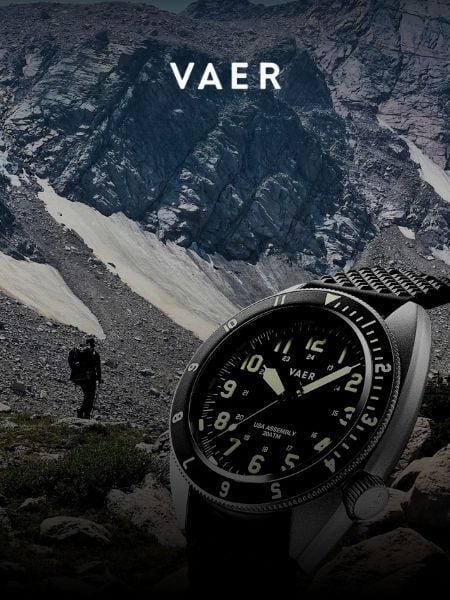 Vaer C4 Tactical Field SolarDurable timepiece for wilderness users - 20ATM (200m) water resistance, 120-click bezel, 316L SS casing, sapphire glass, solar-powered, Epson VS-42 Japanese movement, C3 Lume, USA assembly.
 © Beartooth Media Group Inc.
 Loading...