Topic

Carbon/kevlar insulated pot lid

  • This topic is empty.
Viewing 16 posts - 1 through 16 (of 16 total)
PostedJan 13, 2013 at 6:28 pm

I've been trying to find ways to reduce the amount of fuel I use for cooking, and I decided to try making a lightweight insulated pot lid that is still strong enough so the pot can serve as a protective hard-sided container in my pack.

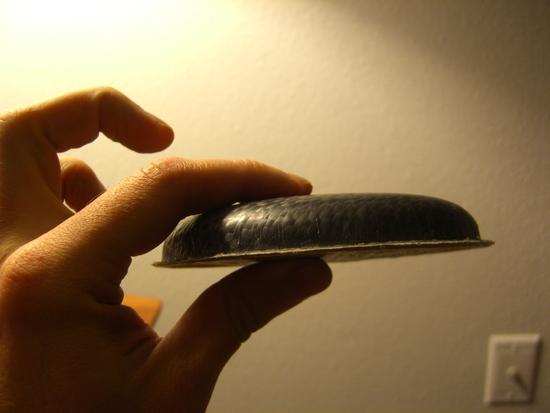
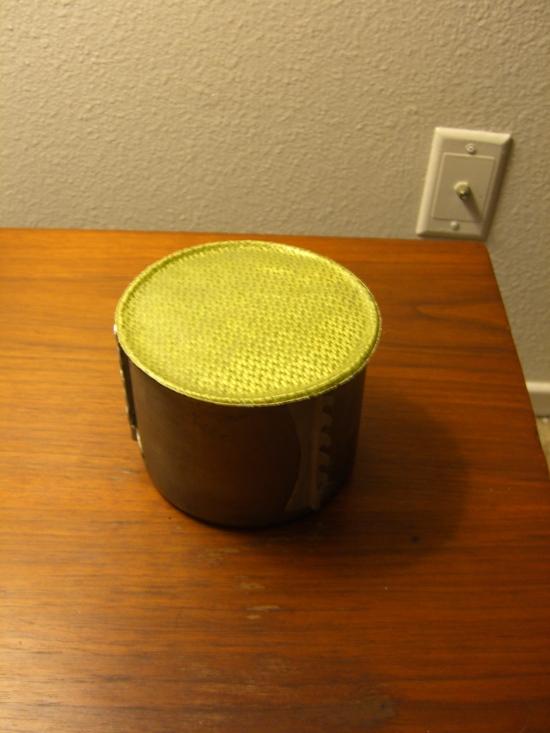
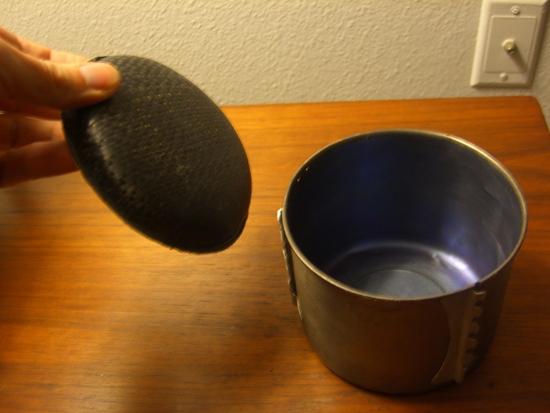
This lid was layed up with high temperature (>450F) epoxy using one layer of carbon fiber on the bottom, a 3/4" thick chamber containing 7 grams of aerogel granules in an aluminized Kapton film pouch, and a top layer composed of the same carbon fabric and another layer of kevlar fabric. My wife chose the kevlar for the top, saying that it would help the pot to be more visible when cooking after dark. The top and bottom surfaces have a thin coating of food-grade silicone rubber. I thinned the silicone with hexane, applied it with an airbrush, and cured it overnight. Most epoxies have BPA and MDA, and you can never get the resin/hardener ratio stoichiometrically exact, so I don't trust it for food contact.

The lid weighs 18 grams, which is 2 grams less than the titanium lid that came with my pot (a BPL firelite 950). The domed aerogel chamber should have an R-value of about 7.
lid

lidunder

chamber

The domed insulation chamber protrudes into the pot about 3/4", but it can be flipped over if I need that last bit of capacity in the pot.
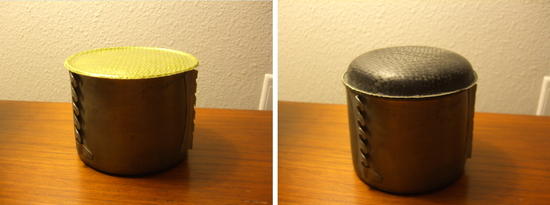
both

PostedJan 15, 2013 at 12:17 pm

Very cool!! All the new MYOG threads here lately are making me itch to tinker. Every since my girlfriend moved in, I've not had the chance to even touch my gear. I'm dying here.

PostedJan 15, 2013 at 1:37 pm

I'll do some boil tests against the stock lid when I get a few free minutes. An insulated lid is only likely to make a significant difference in boil times when a low-powered stove is used (when boiling takes a long time) and in very cold weather (when the temperature gradient across the lid is large). Testing under cold conditions is difficult here in California's central valley. I'll do the test outside early in the morning, when temps are in the low 40s F.

Even if boil times are not enough improved to save much fuel, the new lid is a bit lighter than the old one, and it would probably help to keep food/water warm longer in the pot, so I'll still use it. The materials had been sitting unused for a couple of years in my closet (since before I started grad school), so the monetary cost for the project was zero, and it was a good excuse to take a much needed break for a couple of hours.

"Every since my girlfriend moved in, I've not had the chance to even touch my gear. I'm dying here."

Ha. I know that predicament well. Same goes for having kids, I would guess. It's a small price to pay, but it can be agonizing to leave the tools in the drawer when you have an idea.

PostedJan 22, 2013 at 11:28 am

I'm quite certain you will shorten your boil times, and save fuel with this great lid.
Lids are neglected in the pursuit for performance
I saved about 30 seconds of boil time (or about 3g of fuel each and every burn) with a lid made out of
2 aluminum disposable pie tins, with the edge trimmed from one of them, and then sandwiched reflextix insulation between them using a 3M adhesive. I stapled the edge for added strength. I added a bit of aluminum tape folded onto itself as a lid lifter.
I think it weighed about 16g, and saved almost 30 seconds on every 2-cup boil in my 1.3l vargo pot. Not to mention the added benefit of keeping the lid on, when I put the pot into the reflectix cozy to finish cooking.
Please share your test results when you get a chance.

PostedJan 22, 2013 at 12:20 pm

Colin,

You have definitely taken the myog posts to a new level with your last two posts.

I'll keep posting the simple unsophisticated projects so we have a range for contrast.

Daryl

. . BPL Member
PostedJan 28, 2013 at 11:11 am

Colin,

Props – Looks very nice.

How did the fit turn out? Does it have sufficient compressive memory and rigidity to stay on inside of your pack?

Have you thought about adding a sealable sipping port? That would be fantastic for hot drinks at the beginning/end of the day.

PostedJan 28, 2013 at 2:25 pm

Thanks. Yes, I used the pot itself as the mold for the bottom part of the lid, and then I sprayed on a layer of silicone, so the fit is snug.

I thought about various elaborations, like adding a sipping port, or drainage holes, or a stirring port (for inserting a utensil to stir without removing the lid). My composite fabrication skills are limited, though. Even a simple enhancement like drainage holes makes the layup much more complicated because the insulation chamber has to assume a non-circular shape to make room for them. I might try something more complicated in the future.

PostedJan 28, 2013 at 6:12 pm

David, I don't plan to make any to sell. I just don't have time for it, and because I don't buy materials or make composites on a large scale, I would have to price them unreasonably in order to break even.

PostedJan 28, 2013 at 6:42 pm

Thanks for a quick reply. Sure would like to have one of those. :( BTW – What would an "unreasonable" price be?

PostedJan 28, 2013 at 9:18 pm

I really haven't done any arithmetic to determine a hypothetical price because time limitations would still prevent making them for other people. A cottage company (Ruta Locura?) could buy carbon and kevlar fabrics by the roll and epoxy by the gallon, make and store their own prepreg sheets, and fabricate a jig for laying up several pieces at a time with minimal labor. They could turn out dozens in a day this way, and sell them at a price that (a few) people would be willing to pay. If there was some demand, I think they could be sold sustainably for $35 each. They could be made a bit more cheaply if some other insulation was substituted for the aerogel. If you contact a cottage company that does carbon fiber layups they might be willing to try making one for you.

PostedDec 19, 2013 at 12:39 am

This project is awesome, the lid is very close to be superlid for tourist pots, especialy for fuel-efficient systems, negative sides – cost of materials, a lot of work to do it, BUT it is lighter then titanium lid despite of it is much thickier, it should be very-very heat resistant, even too much, you could probably make it 3 times thinner w/o any sacrifice in insulation.

Could you make standard test in boiling 2cups of tap water with this lid, with original ti lid and without lid, please?

P.S: and yes, I am the one in line, if you decide to make some for sale.

Mark Fowler BPL Member
PostedDec 19, 2013 at 2:37 am

I agree that an insulated lid should improve fuel usage. I've been using a lid made from a disk of reflectix on my pots for a while now. The lid for an Evernew 900ml pot weighs 3 grams. It's been in use for over 20 nights now and seems as good as new.

Easy, cheap and light but not as insulating as the op. The only proviso is cut the disk about 3 – 4 mm wider than the pot. The material shrinks slightly during the first couple of boils.

pot with reflectix lid

Viewing 16 posts - 1 through 16 (of 16 total)
Loading...